AI CapEx, Rate Hikes and an Inflation Story Hits Close to Home

From Peter Boockvar:
What will this mean for CapEx spend?/The more nuanced rate discussion/’All the raw materials are going up everywhere on everything’
For the sake of the economy, the stock market, the earnings picture along with profit margins, the existential question is whether ‘It’s time for AI improvement pacing’ is more in the functionality and feature rollout or will it mean a slowdown in the overall level of CapEx spend. The stock market this morning is of course hedging for the latter but of course it remains to be seen. My bar of expectations with respect to GenAI CapEx is what is currently estimated on the Street broadly, $800 billion for this year and $1.2 trillion next year.
Ahead of the expected rate increase on Wednesday from the Federal Reserve, I want to highlight how nuanced the inflation story is and the rate response to it. Some think simplistically that ‘we still have inflation above 2% after all these years, the Fed should hike.’ If it were only that easy. First, we know we have major supply chain problems and supply chain driven inflation that the Fed will have difficulty addressing directly. Then, it’s how can they influence the demand side. Well, a main driver of demand side inflation has been the robust pace of upper income consumer spending. What will a rate increase do? It will put even more money in their pockets as interest income would rise for those holding US Treasuries. Easy back of the envelope puts $700 billion into the pockets of US domestic holders of US Treasuries (about $1 trillion of US federal gov’t interest expense and where domestic holders own about 70% of) annualized currently in interest expense and goes up by about $56 billion for each 25 bps rate increase (on $32 trillion of marketable securities, 25 bps equals $80 billion of which domestic holders own 70%).
What can negatively impact the demand side of upper income consumer spending that can help to cool inflation on the flipside? A decline in the stock market driven by higher interest rates, to speak honestly, that would impact the wealth effect and thus the economy but that is not something the Fed, nor anyone wants.
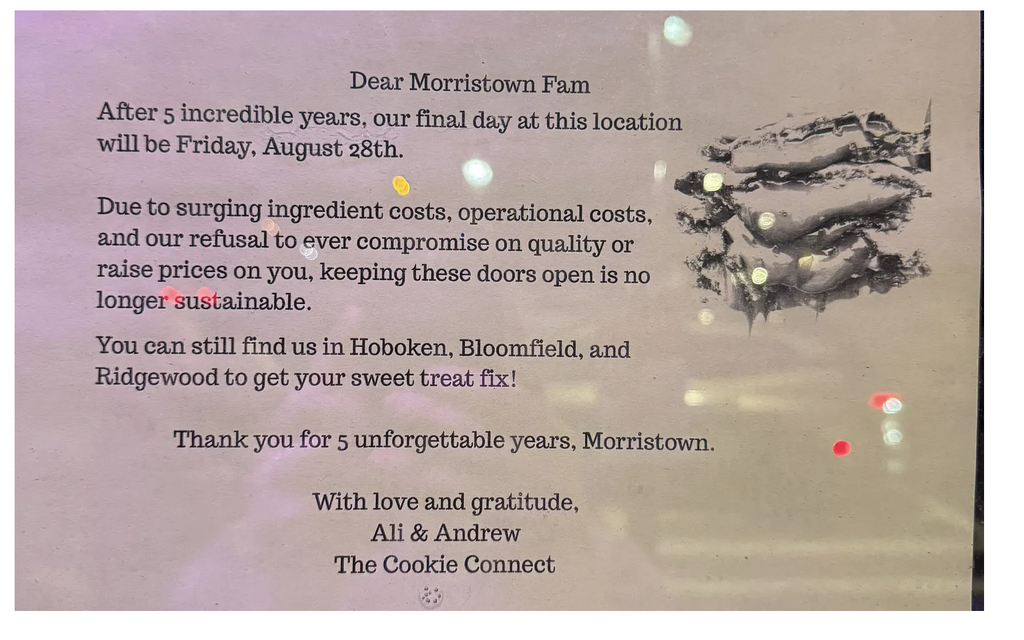
I also want to state again my belief that a complete inflation analysis MUST include both producer prices along with consumer prices. Unfortunately this was made crystal clear to me again over the weekend when I saw this message below on the window of an ice cream place in the town I live in. So, I’ll say again, an environment where CPI is at 2% (the Fed’s ultimate goal) when PPI is at 4% (for sake of this argument), is not and should not be considered ‘price stability.’
To a few notable earnings calls late last week.
From RH’s Gary Friedman: “So $109, like, I mean, oil is $63 at the beginning of the war. You’re not going to be able to mitigate that. Costs are going up, inflation’s going to go up. There’s a reason why the administration said that the war was ending and we were going to have a deal in a day or two, 38x…So yes, we’re in a time of conflict. We’re going to be in a time of inflation. I don’t think they’re going to be able to keep a lid on interest rates. So I keep thinking, gosh, it’s like my entire career, and I’ve been doing this a long time, I never saw a housing market that was down longer than 18 months. So it looks like we’re going to go into year five….Yes, there’s a massive increase cost. Nobody’s got a magic wand. Nobody’s going to get that much of a better price than somebody else…So we’re going to be in a higher cost world for probably at least the next six to 12 months. I mean, even if tomorrow they end the war, there’s too much inflation in the pipeline. All the raw materials are going up everywhere on everything. Everything is impacted by oil. You’re seeing crazy things, right, trying to manipulate currencies, buying back things like this. It’s a crazy time.”
From Kroger:
“sales were tracking well through the quarter until our final period, when we absorbed the impact of the Cyclospora outbreak, which cost us roughly 35 bps of total company IDs without fuel, reflecting the impact of produce categories. Our identical sales without fuel grew .2% this quarter. Customers continued to shop in our stores and online, and we saw traffic increase during the quarter.”
“At the same time, the macro environment is challenging. We know fuel over $4 has an impact on consumer spend. Lower drug prices in pharmacy reduced sales by approximately 140 bps. The top line was soft across the industry this quarter.”
“Customers remained under pressure, and that has affected the industry broadly. Unit growth has slowed since the start of the year. Reductions in SNAP benefits, higher fuel prices, and softer consumer confidence are all putting pressure on household budgets. Customers are buying more on need. At the same time, we’re still seeing them prioritize their health. We continue to see strong engagement in natural and organic, and we’re responding by expanding the assortment in natural and organic, and we’re responding by expanding the assortment across the store.”
“Value continues to matter, and it matters more when budgets are tight.”
Position: None
