Rinse, Warsh and Repeat; More War; Wall Street Ugliness


“I know that there’s no true coherence except in apparent coherence. Every object clothes itself in chaos. To take shape, every thought must manage its own vagueness.”
– Patrick Dubost (French mathematician and poet), 2009
Same as It Ever Was?
Yes and no. Vague? Certainly. Understandable? I think so. On Wednesday afternoon, the Federal Reserve’s Federal Open Market Committee held the target range for the overnight Fed Funds Rate steady at 3.5% to 3.75%. Incredibly, the committee issued the same exact statement on Wednesday afternoon that they issued on June 17 with one exception. I often knocked the Janet Yellen and Jerome Powell Feds for their “cut and paste”-style policy statements, but this really took the cake. That exception? The first sentence…
June 17th’s
“The Federal Open Market Committee approved the following statement for release by a 12-0 vote.”
… became…
July 29th’s
“The Federal Open Market Committee approved the following statement for release by a 9-3 vote.”
So, it was that three regional bank presidents with 2026 voting rights dissented from the broader decision to leave interest rates where they were, in favor of a rate hike. I had told readers that both Cleveland Fed Pres Beth Hammack and Dallas Fed Pres Lorie Logan were likely to dissent in favor of a more hawkish policy. Minneapolis Fed Pres Neel Kashkari, who was only a moderate surprise, joined them in favor of taking a more aggressive approach in the fight against rising consumer level inflation.
This was the first time since 2016 that three Fed officials dissented in the same direction from the broader committee on the trajectory of monetary policy. Clearly, Fed Chair Kevin Warsh leads a fractured Fed as the pace of the war in Iran and the CentCom region re-accelerates and as that pushes oil / energy prices higher. Does he really lead a fractured Fed? I am not so sure.
Not to be cute or some kind of wise guy, but Warsh did not lose a single governor. Do votes from the Board of Governors count for more than votes from regional district presidents? No, not for any single decision among the eight decisions per year. That said, governors hold permanent voting rights for as long as they serve on the board. Voting rights among the district presidents rotate. Cleveland, Minneapolis and Dallas will all lose their voting rights by January.
So, in a sense, keeping the Board of Governors united on policy is far more important to a Fed Chair than it would be to keep the entire FOMC united. Don’t get me wrong. I don’t think Warsh wants to lose anyone, but losing votes among the governors would be a much bigger deal. I’m not patting Warsh on the back. This was only his second policy meeting as the alpha dog at the Fed and he’s already swimming with alligators. Still, we’re a long way from heading out to the garage to grab our pitchforks.
Warsh
During the press conference, Fed Chair Warsh did say that while the central bank will not provide hints on where interest rates are going, necessary steps will be taken in order to reach the unaltered 2% goal that had been in place since before his return to the Fed. Warsh stated:
“I understand the desire for rolling forecasts and commentary from this committee, but for our part, we need to observe market reaction to developments direct and unfiltered. I want to stress, of course, that decisions by this committee matter a great deal, and where necessary and appropriate, we will not hesitate to act.”
Warsh also told us on Wednesday that financial markets are responding more to the economy than to the Fed. He makes a somewhat valid point. Longer-term yields are on the rise without any interference by the central bank. The U.S. Thirty-Year Bond now pays 5.228%. That’s the highest yield paid by the U.S. long bond since 2007. The yield on the U.S. Ten-Year Note now approaches a level not seen in more than a year and a half.
Is it not better to allow for the marketplace to adjust borrowing costs in response to inflation than to force rates higher at the short end of the curve? Artificially? The Two-Year Note paid less by day’s end on Wednesday than it had prior to the Fed’s statement. U.S. Three-Month paper? Pays a lot less than it did earlier this month.
Two things become glaringly apparent to me. One, Warsh though he seems to be returning the Fed to a time where it was less noisy, which is probably a good thing, does understand that increased short-term rates do nothing to combat inflation when that inflation is caused by a negative shock to supply. Higher rates blunt demand. That serves no purpose in this case and would slow economic activity. That’s something we definitely do not need.
Secondly, the yield curve is steepening. Short-term rates are flat to lower. Long-term rates are rising. Not one single species of Treasury debt securities is currently inverted against the next in “chronological” order. Do you know what that kind of yield curve is good for? Organic economic growth. Should this war end, upward inflationary pressures will ease with it. The credit / debt environment is finally, after all of these years of misguided monetary policy, set up in an almost healthy manner for such a natural progression.
About That War
On Wednesday evening, U.S. military forces began launching retaliatory strikes inside of Iran in response to that nation’s failed “surprise” attack against U.S. troops in Jordan on Tuesday while Pres. Donald Trump was yet again extending the olive branch. The U.S. president was obviously perturbed.
The president talked to reporters from the Oval Office. He said, “We are going to hit them very hard” and “It’s our turn.” The president also used some colorful language in speaking to Fox News. These are the president’s words: “We’re going to beat the f—ing sh—t out of them. We’ll be hitting them hard. They’re going to get a beating.”
We may or may not approve of such language, but Pres. Trump was clear.
Front-month WTI Crude futures prices rose on that news, but with an $84 handle (per barrel), still stand well below where they were trading a week ago. This is even with a weekly report that showed a drop of 7.2 million barrels for commercial U.S. inventories and a 3.8 million barrel drop for the U.S. Strategic Petroleum Reserve.
Wall Street did not like the resumption of hostilities nor the “tough” talk very much. Oil was up, bonds were down (yields up) and equities were slapped around. That said, the quickest way to end this war might just be to go and win it definitively. I don’t know who the Trump administration has been dealing with in Iran, but the guys with the missiles do not seem to be very interested in a peaceful resolution.
Marketplace
Ugly. Wednesday was ugly. There was simply no place to hide. I think James “Rev Shark” DePorre, here at TheStreet Pro used that line yesterday. Probably why it’s still in my head. On Wednesday, the S&P 500 gave up 1.52%, as the Nasdaq Composite surrendered 1.74% and the tech-heavier Nasdaq 100 was taken out to the woodshed for a beating of 2.06%.
Looking toward our more narrowly focused indexes, it gets worse. The small to mid-cap indexes performed in line with the broader marketplace while the KBW Banks were pummeled for 2.67% and the Philadelphia Semiconductors were strafed for a very nasty 5.33%. Even the defense stocks were trading lower. The Dow Jones U.S. Marine Transportation Index gave back 9.85% on Wednesday for obvious reasons.
Breadth
Nine of the 11 S&P sector SPDR ETFs closed out the regular session on Wednesday in the red. Energy ($XLE) obviously led to the upside. The Industrials ($XLI), led lower by the maritime shippers and tech ($XLK) just as obviously led the losers.
Losers beat winners at the NYSE by a rough 11 to five and at the Nasdaq by about seven to three. Advancing volume took just a 34.4% share of composite NYSE-listed trade and an even 30% share of composite Nasdaq-listed trade. Aggregate trade across NYSE-listings was higher day over day, but lower day over day across Nasdaq-listings. Trading volume was also higher across the membership of the S&P 500.
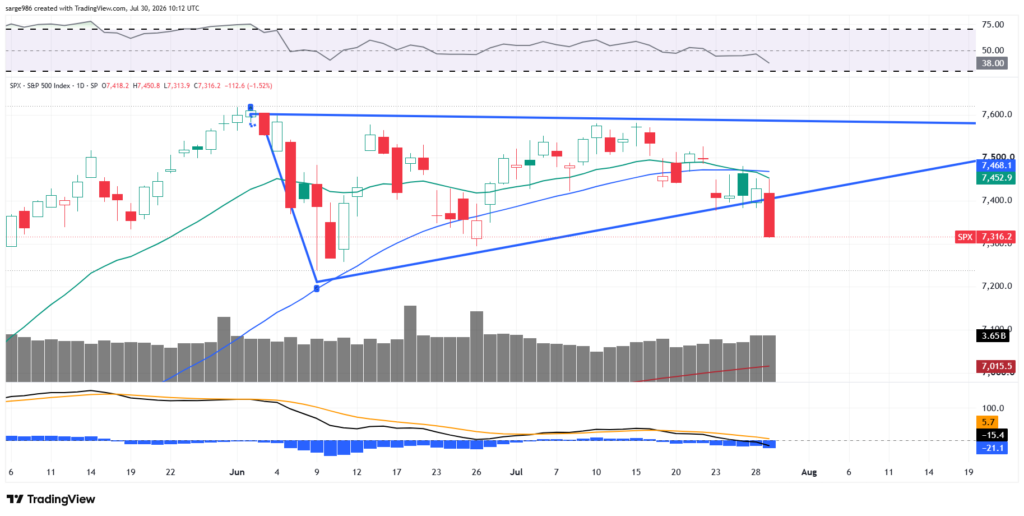
I had been asked by readers if I thought the S&P 500, with its Ascending Triangle pattern, could pull the Nasdaq Composite, with its signaling for non-directional volatility, to the upside. It would appear that the opposite has occurred. The Nasdaq Composite has pulled the S&P 500 to the downside, and that “bullish” setup has broken lower. The daily moving average convergence divergence is now clearly negative.
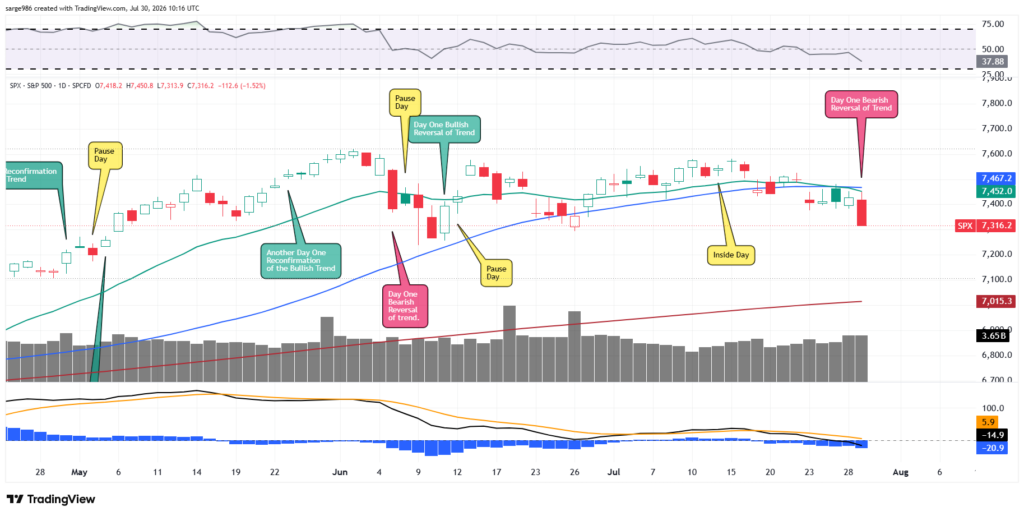
It now seems that we are going to have to refer to Wednesday as “Day One” bearish reversal of trend. For confirmation, we’ll still need a pause and then a resumption of the move lower. Though trading volume was lower across the Nasdaq, volumes are at their highest this week since early July. In addition, the S&P 500 has now lost contact with its 50-day simple moving average. Regaining that line would be paramount to avoiding a confirmation of any new downtrend. A mildly “up” day that hits resistance at that line would smell like a “pause” to me and would be a negative development.
Economics (All Times Eastern)
08:30 – Initial Jobless Claims (Weekly): Expecting 206K, Last 187K.
08:30 – Continuing Claims (Weekly): Last 1.796M.
08:30 – GDP Growth Rate (Q2-adv): Expecting 2.3%, Last 2.1% q/q, SAAR.
08:30 – Personal Income (June): Expecting 0.3% m/m, Last 0.7% m/m.
08:30 – Consumer Spending (June): Expecting 0.4% m/m, Last 0.7% m/m.
08:30 – PCE Price Index (June): Expecting -0.1% m/m, Last 0.4% m/m.
08:30 – Core PCE Price Index (June): Expecting 0.1% m/m, Last 0.3% m/m.
08:30 – PCE Price Index (June): Expecting 3.7% y/y, Last 4.1% y/y.
08:30 – Core PCE Price Index (June): Expecting 3.2% y/y, Last 3.4% y/y.
10:30 – Natural Gas Inventories (Weekly): Last +32B cf.
The Fed (All Times Eastern)
No public appearances scheduled.
Today’s Earnings Highlights (Consensus EPS Expectations)
Before the Open: BMY (1.60), CROX (4.34), HSY (1.43), MLM (4.79), MA (4.78)
After the Close: AMZN (1.81), AAPL (1.89), GDDY (2.24), RDDT (1.45)
At the time of publication, Guilfoyle was long AMZN equity.
