The Day Ahead: US Calendar is Light, but Tech Continues Selloff

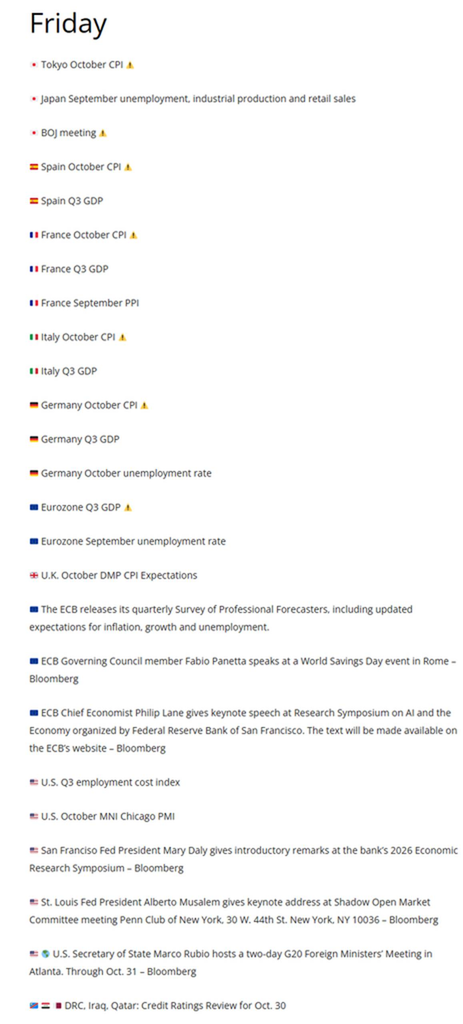
Futures are pointing to another rough session for large cap indices with the S&P 500 indicated lower by over 1% and the Nasdaq-100 ($QQQ) 2.5%. Again non-Tech is faring better with the Russell 2000 ($RUT) indicated lower by just under a half percent.

Otherwise though catalysts are light today:

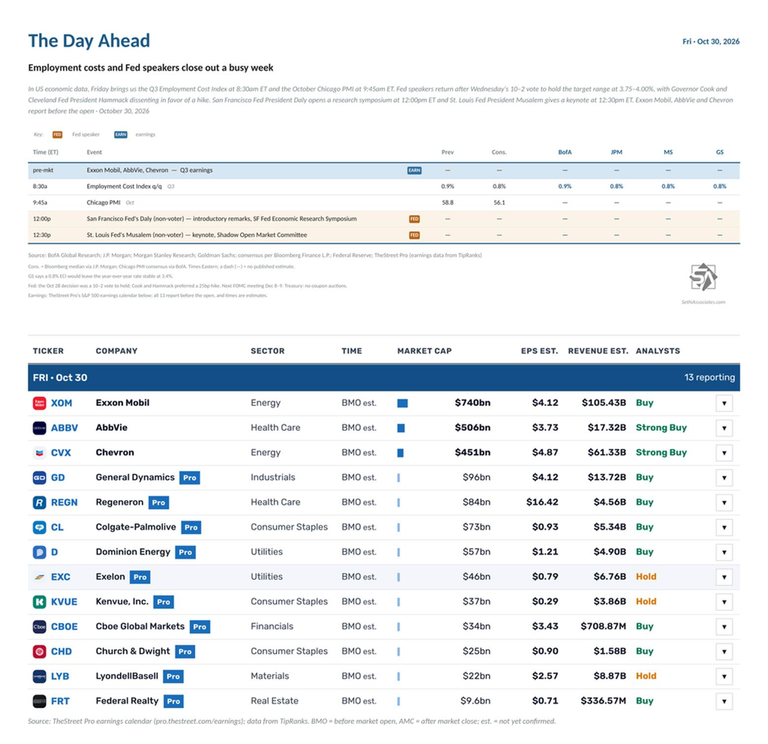
In US economic data, Friday brings us the Q3 Employment Cost Index (the Fed’s preferred wage inflation metric) and the October Chicago PMI.

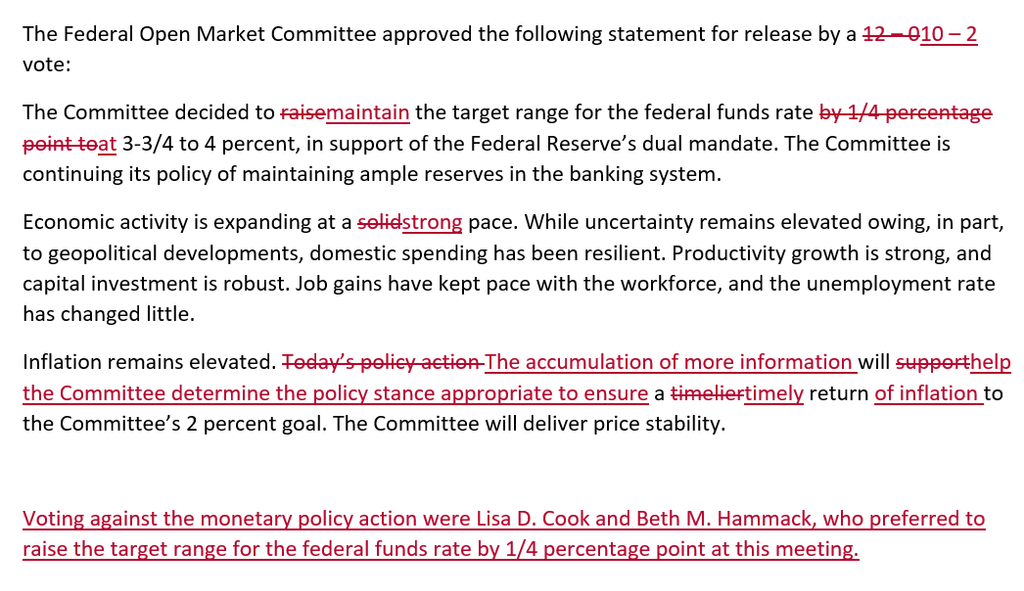
Fed speakers return after Wednesday’s 10-2 decision to hold the fed funds target range at 3.75%-4%, with Governor Cook and Cleveland Fed President Hammack dissenting in favor of a 25bp hike. San Francisco Fed President Daly gives introductory remarks at the San Francisco Fed’s Economic Research Symposium at 12pm ET, and St. Louis Fed President Musalem delivers a keynote address at the Shadow Open Market Committee meeting at 12:30pm ET.

There are no non-Bill (>1yr in maturity) US Treasury auctions.

13 S&P 500 components report, all before the open, three of them with market caps over $100bn:

Before the open: Exxon Mobil ($XOM), AbbVie ($ABBV), Chevron ($CVX), General Dynamics ($GD), Regeneron ($REGN), Colgate-Palmolive ($CL), Dominion Energy ($D), Exelon ($EXC), Kenvue ($KVUE), Cboe Global Markets ($CBOE), Church & Dwight ($CHD), LyondellBasell ($LYB) and Federal Realty ($FRT)

Outside the US, AstraZeneca ($AZN), Sanofi ($SNY) and BP ($BP) report.

Ex-US is a busier day, with highlights including a decision from the Bank of Japan, Japan October Tokyo CPI, September jobless rate, job-to-applicant ratio, retail sales, industrial production and housing starts, UK October Lloyds Business Barometer, the ECB Survey of Professional Forecasters, Germany October CPI, unemployment claims rate, Q3 GDP and September import price index, France October CPI, Q3 GDP, private sector payrolls, September consumer spending and PPI, Italy Q3 GDP and October CPI, Eurozone Q3 GDP and September unemployment rate, Spain October CPI and Canada August GDP. The G20 foreign ministers also meet in Atlanta (through October 31).
From Christophe Barraud’s international Week Ahead rundown:
FOMC Holds Rates Steady; Governor Cook Dissents

As expected by most, the Fed held rates unchanged this afternoon, reiterating their commitment to bringing down inflation, but not offering a clear signal on December.

The statement remained short but upgraded the assessment of the economy to a “strong pace” from a “solid” one in September.

The committee went on to say that the the “accumulation of more information will help the committee determine the policy stance appropriate to ensure a timely return of inflation to the committee’s 2% goal.”

There was one big surprise, though. I mentioned in my preview there would likely be dissents, particularly from Cleveland Fed President Hammack, who did dissent, but there was also a dissent from Governor Lisa Cook, her first dissent since becoming a Board member in 2022. As you may recall, President Trump has recently renewed efforts to remove Cook from the Fed, following an earlier effort blocked by the Supreme Court.

From the press conference

Warsh starts on economic growth, noting the strong numbers fueled by consumer spending and business investment. Unemployment rate down from a year ago. Says later that the investment boom is “broadening”.

“Not willing to call financial conditions tight” but they have moved “in the direction of achieving a longer and more durable period of economic growth”.

There will be eight meetings next year, but one will focus “exclusively on broad monetary policy strategy with neither a vote on the Federal Funds rate nor a policy statement anticipated” and sees that growing to two meetings on strategy and six on policy in 2028.

Interesting moment at the presser: before answering a question from Colby Smith of The New York Times, Warsh said, “I have been reading your stories this week.” Smith was seen by some as an outlet the Fed used to signal coming moves during blackout periods when she covered the Fed for the Financial Times. The remark could raise her standing as a potential “Fed whisperer,” a title long held by The Wall Street Journal’s Nick Timiraos. Timiraos seems to have lost some favor after his report that Governor Waller wasn’t a fan of Warsh’s task forces which drew harsh criticism from Treasury Secretary Scott Bessent.

Warsh on the impact of interest rates on the AI buildout: “On the thrust of your question of — with respect to the new technology and this investment surge — do interest rates matter? I believe they do. And I don’t believe that they’re somehow divorced from the rest of the economy.”

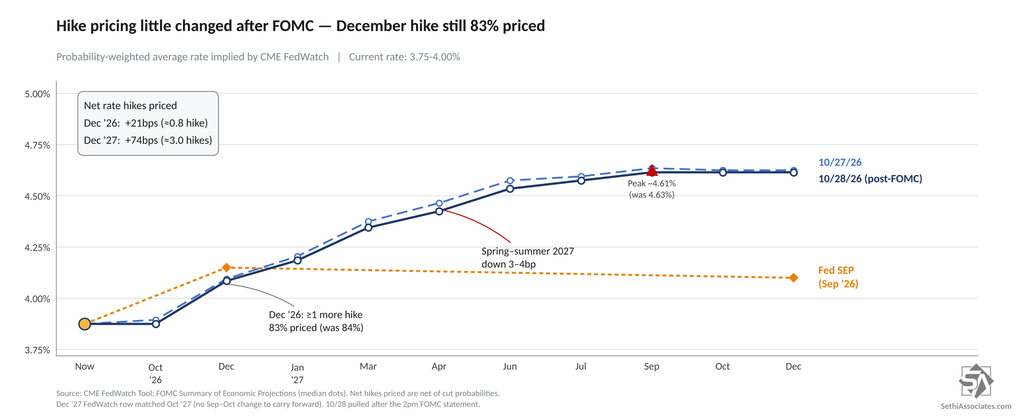
Post-FOMC rate hike expectations are little changed:

  • December: the odds of a hike are 83%, from 84% yesterday.
  • Hikes priced by Dec ‘26: +21bps (about 0.8 hikes), from +22bps.
  • Hikes priced by Dec ‘27: +74bps (about 3.0 hikes), from +75bps.

2-Year Treasury Shorts at Risk?

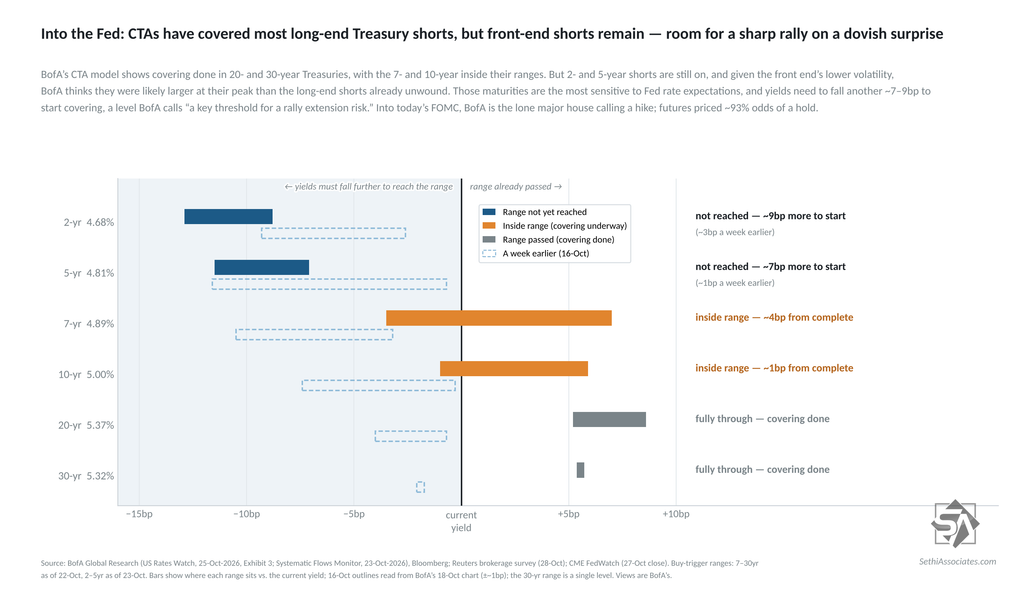
Into today’s FOMC, BofA’s CTA model shows while trend followers have mostly covered their long-maturity Treasury shorts, there remains a healthy amount of short-maturity shorts which could be at risk from a dovish Warsh:

▪ 20- and 30-year: covering done
▪ 7- and 10-year: inside their covering ranges, the 10-year ~1bp from finishing
▪ 2- and 5-year: shorts still on

The 2-year in particular is highly sensitive to Fed rate expectations. Because the front end is less volatile, BofA thinks those shorts were likely larger at their peak than the long-end ones already unwound. Yields there need to fall another ~7–9bp to start covering, a level BofA calls the “key threshold for a rally extension risk.”

So an unexpectedly dovish Fed could set off a sharp move lower in front-end yields, as covering adds to the rally.

The Fed and the 1-Day VIX

I mentioned in the Week Ahead that my expectations for the Fed today were for no major fireworks:

The Fed has never hiked with less than a 10% chance priced into markets, so we’re either going to get the biggest surprise to markets the Fed has ever delivered (on par with the surprise 75 basis point hike in 2022) or a relative snoozer that is already priced. It would be quite something though if they did hike (which is what BofA still calls for by the way) as it would not only be a huge hawkish surprise – a handful of days before the election – but it would also mean the long-standing “troika” at the top of the Fed in Chair-Vice Chair-NY Fed President (Warsh-Jefferson-Williams) had been busted wide open.

In terms of the rest of the meeting it is expected to also follow the “snoozer” pathway, particularly as there is no new Summary of Economic Projections and Chair Warsh has consistently been cutting back the length of the press conference and providing little information. Again, a change to that would be a big surprise. But the one thing that won’t surprise is dissents. The other regional Fed Presidents (Hammack in particular) have expressed a preference for continued rate hikes.

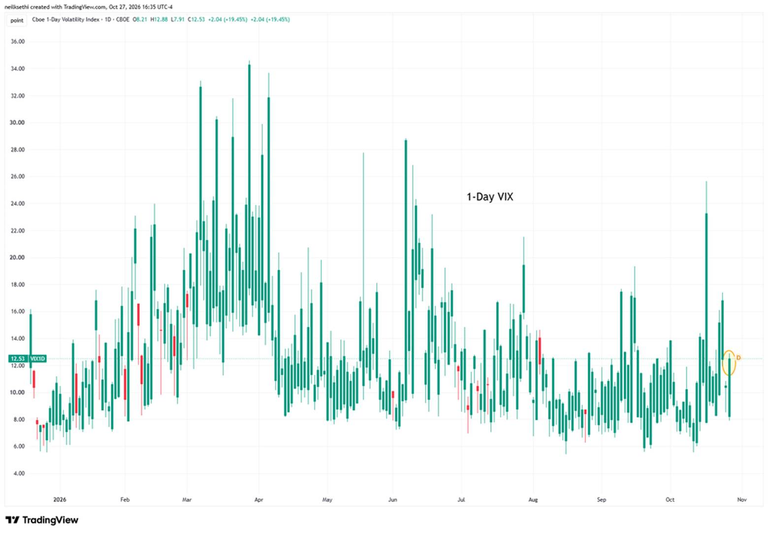
It seems markets are expecting a relative snoozer as well. I mentioned in last night’s update that “the 1-day VIX rose to 12.5 Tuesday, implying a move of about 0.79% for the S&P 500 today, pretty subdued.” I went ahead and looked back, and it’s the lowest pre-Fed day reading since April.

Slower AI Buildout = Fewer Rate Hikes?

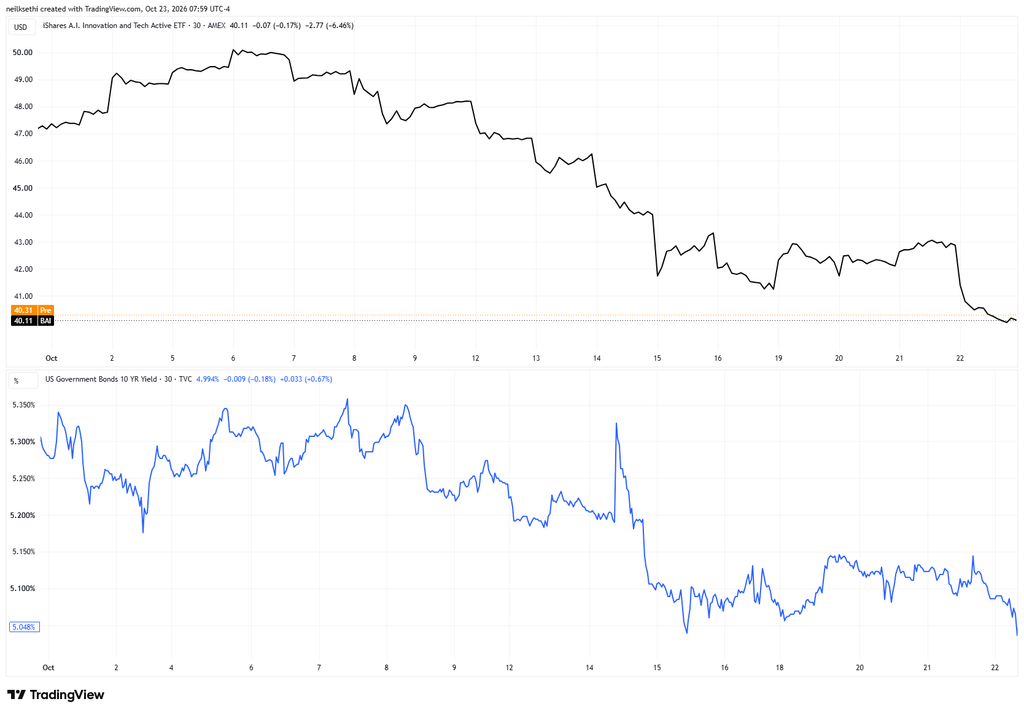
In addition to the negative correlation between AI stocks and yields this month (below chart is Philadelphia Semiconductor Index ($SOX) and 10-year yields)…

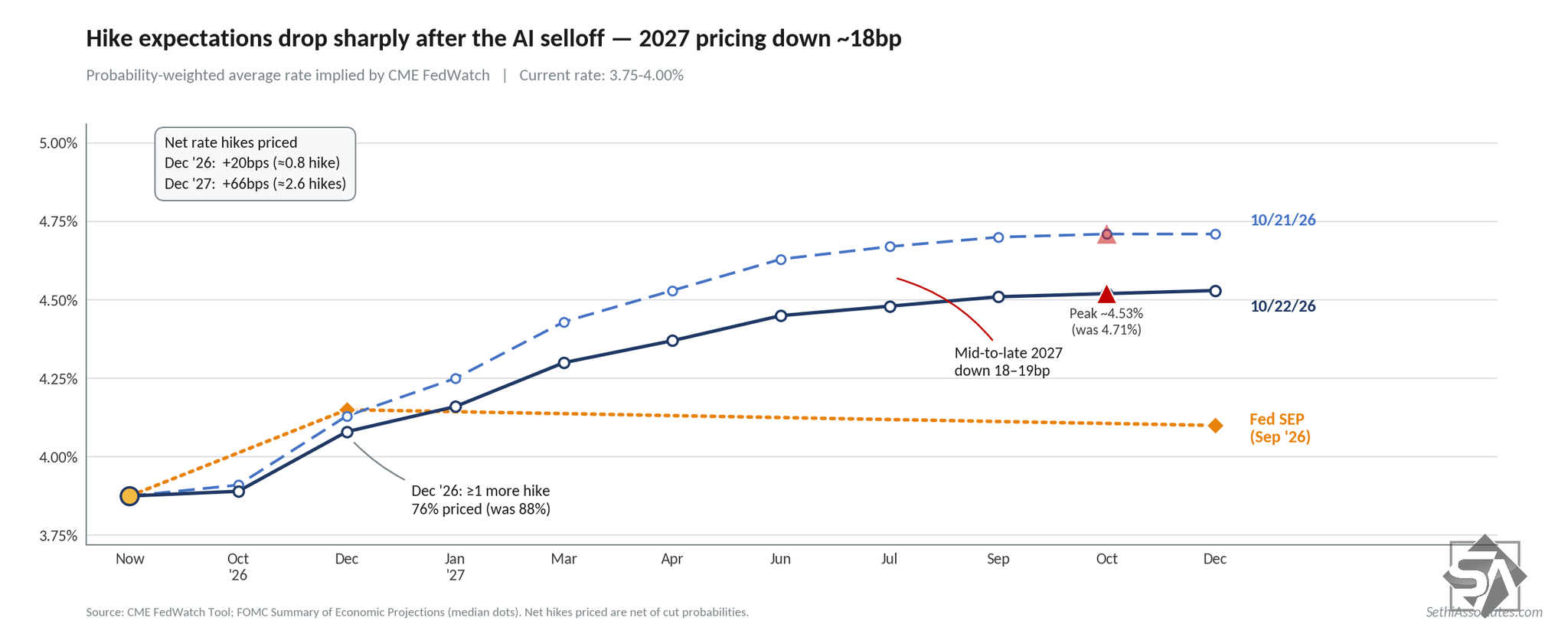
… we’ve seen weakness in the AI trade weigh on Fed rate hike expectations, on the idea that a softer AI complex means slower growth through both the buildout and equity channels, and so less need for hikes.

As noted in last night’s update, October is now a 93% chance of a hold, and December is less sure of a hike at 76% (from 88%). 2027 expectations dropped as well with now just 66 basis points of total hikes priced through December next year, down from 83 basis points Wednesday.