Here’s the Amazon Support Level We’re Watching After Selloff


As the market opens Friday, shares of Amazon ($AMZN) are following the same path taken by Meta ($META) and Alphabet ($GOOGL) following their quarterly results, and by that we mean lower. Similar to Google’s results, despite showing substantial growth and visibility into 2029 at AWS, the key driver of profits for Amazon, free cash flow levels and another leg up in capex spending next year are weighing on the shares. But that focus overshadows what was arguably the strongest AWS report in years.
AWS growth accelerated for the sixth straight quarter, its backlog grew triple digits to $578 billion, and Andy Jassy now expects AWS to grow north of 40% in both 2027 and 2028 on the way to becoming a $1 trillion revenue business in the next five to 10 years. We’re also seeing record operating margins at the company level and continued margin expansion in retail.
We continue to see the funding of this build-out as the overhang near term, but we are also seeing SpaceX ($SPCX), Meta ($META) and Microsoft ($MSFT) address those concerns. While the speed with which they moved to shore up their balance sheets and answer funding questions may surprise some, we suspect managements are reading the market tea leaves. With both the Meta and Microsoft offerings subscribed multiple times over, the market has an appetite, and it’s one that is likely supported by the multi-year backlog levels.
We would not be surprised if Amazon or Google follow Meta and Microsoft to address those funding concerns. As we shared yesterday and again this morning, in our view, that would go a long way to removing the funding overhang and return the market’s focus to where it should be – accelerating revenue and expanding margins, fueled by strong orders and a climbing backlog.
While Wall Street trims its EPS forecasts for the December quarter and most likely a wee bit for 2027, and also cuts their price targets to $285-$380 from $320-$400, we’ll keep our longer-term $325 target. We’ll also zoom out and watch support for AMZN shares near $229 or the 100-day moving average on the weekly chart.
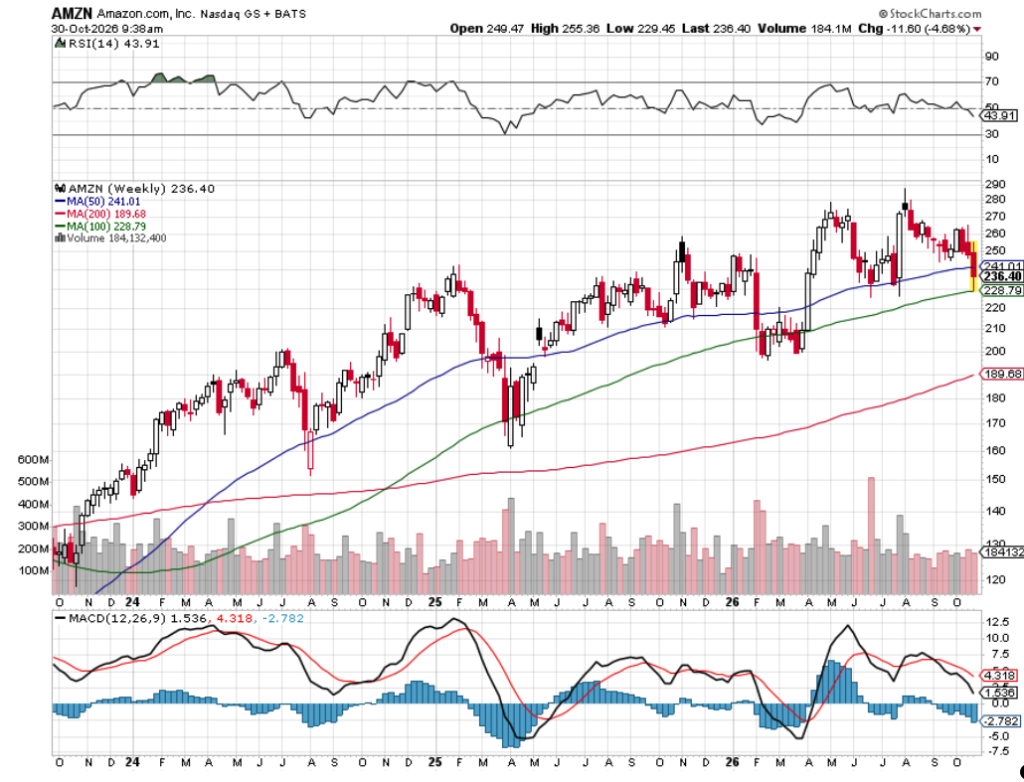
And while this is primarily an alert on AMZN, we’ll also note we are eyeing the 100-day moving average on the weekly chart for GOOGL near $265.
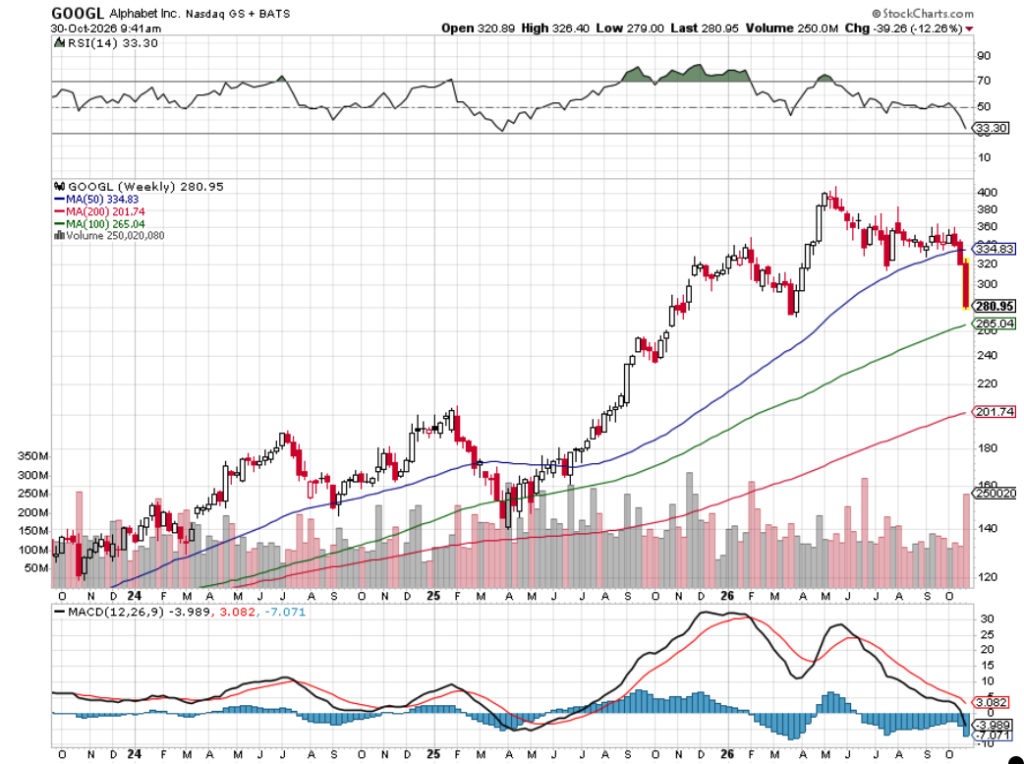
It’s also fair to assume we are watching similar levels for other holdings as well as market indexes.
Although some may have the temptation to make a move today, remember the midterm elections are right around the corner as are some of the first pieces of October inflation data. Label us overly cautious, but we’d rather make a higher conviction move once we have more data in hand.
Amazon’s Q3 2026 by the Numbers
Amazon’s September quarter came in a hair light of Wall Street’s expectations, and its December-quarter outlook was softer still. Revenue rose 12% to $201.9 billion, just shy of the $202.2 billion consensus, while EPS of $1.89 missed the $1.97 forecast and fell from $1.95 a year ago. AWS was the bright spot, with revenue up 39.3% to $46.0 billion versus the 38.2% Wall Street expected, but North America retail revenue of $112.9 billion, International revenue of $43.1 billion and advertising revenue of $19.6 billion all came in below expectations.
Cash capex was $75.9 billion in the quarter, and purchases of property and equipment of $77.3 billion ran about $20 billion above estimates. Simple math tells us capex consumed roughly 1.8x the $42.4 billion in operating cash flow Amazon generated, leaving free cash flow of about negative $33.5 billion for the quarter, its third straight negative quarter, and negative $42.4 billion on a trailing 12-month basis. Amazon held its 2026 cash capex forecast at roughly $220 billion and said it expects to spend “meaningfully more” in 2027.
For the December quarter, Amazon guided revenue to $240 billion-$247 billion, bracketing the $244.5 billion consensus but with a $243.5 billion midpoint that’s a touch lower, and operating income to $28.5 billion-$33.5 billion. That $31 billion midpoint is well below the roughly $33 billion analysts were modeling, but Amazon is a known entity when it comes to delivering guidance that skews conservative, especially for the all-important final quarter of the year.
Some Needed Context for Amazon’s Q3 2026
Similar to unexpected softness in Google’s Search business, which management is addressing with a few smart moves, Amazon’s retail and advertising businesses came in softer than expected. But in Amazon’s case, that can be attributed to Amazon’s Prime Day occurring a month earlier this year (June) compared to last year (July). Management estimates that the Prime Day shift into the June quarter shaved roughly 400 basis points off September-quarter growth.
Looking at its North American segment, combined Q2 2026 and Q3 2026 sales were up double-digits compared to year-ago level. There was also a notable shift when talking about the digital shopping business to one that refocused on cost containment and margins. That likely comes as shipping costs have ticked up, but management noted the company is on track to lower its cost to serve per unit as better inventory placement, shorter shipping distances and more than a million robots in the fulfillment network offset higher costs.
That suggests further improvement for the North American and International margins. During Q3 2026 North American margins continued to expand as did the ones at AWS, which climbed to 38.7% in the reported quarter vs. 34.6% in Q3 2025. Viewed through a different lens, AWS’s operating income grew 55% year over year compared to the better-than-39% figure for its revenue.
During the earnings call, management admitted that AWS margins are feeling the pinch of higher memory and other component costs. Management didn’t offer specific AWS margin guidance for the current quarter, and odds are we’re not going to see a dramatic step up even though the capex comments suggest a slower build-out in the current quarter before picking back up again in 2027.
For advertising, which is a very profitable business for Amazon, with NBA games back on Prime Video in the December quarter, management expects ad growth to return to the high teens. We also suspect advertising on the digital shopping platform will benefit this holiday shopping season as companies jockey for positioning with consumers.
Looking ahead, Amazon Ads Agent pulls its full ad offering into a single AI platform, and full-funnel campaigns combine sponsored, display and streaming TV ads. That should not only improve the advertising business but also be a boon for the now-profitable, per management, Prime Video business, which boasts a revenue run rate in the tens of billions. We’ll be looking for that rebound to high-teens growth to confirm the September quarter was a timing issue.
More on AWS: Demand, Capacity and Margins
AWS added $3.8 billion in revenue from the June quarter, reaching $184 billion in annualized revenue in Q3 2026, with core compute and storage growing at their fastest rates in several years alongside triple-digit growth in AI revenue. On the earnings call, CEO Andy Jassy said Amazon is installing an AI accelerator about every 14 seconds and that “almost as fast as we install capacity, customers are gobbling it up.”
Last week he said AWS is largely sold out of data-center capacity for 2027, and on the call, he noted that the big chunks of capacity, hundreds of megawatts up to a gigawatt, are reserved well in advance, giving Amazon good visibility into 2027, 2028 and some of 2029. Inference already accounts for well over half of AWS AI revenue, token volume for Amazon’s Bedrock cloud service for generative AI grew nearly 17x year over year, and Fortune 500 companies are spending nearly 7x more on Bedrock. That all suggests AI adoption and usage are both on the rise. As we think about that, let’s remember that Anthropic’s IPO prospectus shows a roughly $110 billion, 10-year AWS contract, and AWS’s acceleration has coincided with Anthropic’s sales surge.
Connecting the Dots to Other Portfolio Holdings
Inside AWS, custom silicon is a big part of the story, with Trainium and Graviton revenue commitments each up more than 20x and plans to sell Trainium outside of AWS starting late 2027, a positive read for our positions in Marvell ($MRVL) and Broadcom ($AVGO).
Aggregating Amazon’s capacity build along with those for the other hyperscalers is a positive read for several other Portfolio holdings. Even as Trainium takes on more of AWS’s AI work, Amazon continues to deploy Nvidia ($NVDA) GPUs, and an AI accelerator going in every 14 seconds against capex that will rise “meaningfully” in 2027 keeps AWS an important Nvidia customer. We would make the same comment about aggregate hyperscaler spending and Arista Networks ($ANET). While Amazon is not a known Arista customer, Meta, Microsoft, and Google are.
As we touched on above, Amazon management flagged higher memory and other component costs as a margin headwind, and that squares with comments from others that memory and overall chip capacity is poised to remain tight into 2028 if not 2029. As we mentioned this morning when discussing Intel’s ($INTC) plans to step up its capex along with several of its competitors, that keeps us bullish on Applied Materials ($AMAT), which supplies the equipment memory makers need to add capacity.
More Pro Portfolio:
- Adding to 2 Holdings After Earnings, PMI Updates
- Tracking 49 Signals Across 11 Portfolio Investment Themes
- Weekly Roundup: Renewed AI Concerns Weigh on the Market and Portfolio
At the time of publication, TheStreet Pro was long AMAT, AMZN, ANET, AVGO, GOOGL, META, MRVL, MSFT, and NVDA.
