The Race Is on for These Two Dividend ETFs. Which Is Best for You?


With a mere $1 billion gap in the way, SCHD is about to dethrone VIG. But bigger isn’t always better.
With a mere $1 billion gap in the way, SCHD is about to dethrone VIG. But bigger isn’t always better.
Takeaways support our decision to exit the shares of Builders FirstSource.
Positions: None.
The price chart remains bullish but probably not for long.
From Randorama:
“Iranian State TV Confirms Reports Of Blasts Across Southern Regions”
“Reports Of Explosions In Chabahar, Qeshm Island And Bandar Abbas, Iran”
Positions: None.
This is interesting.
So much for the AI productivity miracle, which has turned out to be nothing but inflationary and societally disruptive in a bad way.
Oddly, more and more capital keeps going in and the incremental return seems to be getting worse and not better.
Scaling failed a long time ago.
Investment into Gen AI should have been curtailed at this point, and the dollars directed toward alternative approaches. Instead, because the short-term rewards in terms of stock price were so great, and the U.S. government got behind it (just like they did alternative energy and flushed scads of dollars down the toilet there too), the reflexive investment boom into a broken technology accelerated.
Further to this point, regarding OpenAI’s latest pay when it works model. How many times can the business model change and pivot? Is Sam Altman going to start doing Only Fans next when this doesn’t work?
I think the big issue is they have to move to this model because of how poorly the tech/product works. In third-grade terms, after the trillions of investment, the tech still sucks.
“Independent testing found OpenAI’s Operator agent fails 62% of real desktop tasks.”
This opens a giant can of worms too regarding defining success. This is a disaster for cash flow… that they don’t have to begin with.
One can only laugh at the notion of AI funding UBI. How do you fund UBI with losses? I worry the only thing they will fund is Universal Basic Debt, and the whole mess gets dumped on the taxpayers again with some form of backdoor bailout or just a stock market bubble pop that screws everyone, while these guys all sold billion of stock along the way.
Lastly, these AI pundits have become worse than the Bitcoin guys. There were a few Bitcoin guys, like Strategy’s Saylor, that more or less exploited the retail community. With AI, there are theoretically more credible people, doing the exact same thing. It has become like religion for them and their cult followers too. There are several big mouths on Twitter and they just go back and forth with themselves, spewing complete nonsense. It starts from the top down with guys like Elon Musk and Jensen Huang, then you have the David Sachs class of people, then the investment class of people and then a bunch of influencers and other dorks. It is like a giant circular reference of nonsense.
The only thing they are missing is a cookie in the middle, but that sure is how they have circularly financed the whole industry. A mass formation psychosis has set in around a broken technology that they have all tied themselves to, and now the economy along with it.
My advice, they should stop wasting time with all the promotionally nonsensical tweets and just keep tweeting HODL. What is the diff?
If data centers in space are already solved, well then why are there not data centers in space?
Further, if space is the answer, why are you vehemently arguing for data centers on earth? Tweet and subtweet, notice the circularity between the two:
This one is a classic too, AI expense is up 100x since March and doubling every month. If it is so efficient, why is its expense doubling every month? Also, let’s do the math here. For arguments sake, say the expense was $10k in March. If it wasn’t that, what were you even running your mouth about. If it is up 100x, it is $1 million at the end of August. If it doubles every month, it is $4 billion a year from now. Then $8 billion the following month.
Soon, bigger than the entire GDP of the world, which I think Anthropic may be claiming is their addressable market. There is no scenario in which a doubling of expense every month does not quickly put you out of business.
Position: Short NVDA (S)
There are challenges ahead, but we’ll be watching for Portfolio opportunities.
The following is from Peter Boockvar:
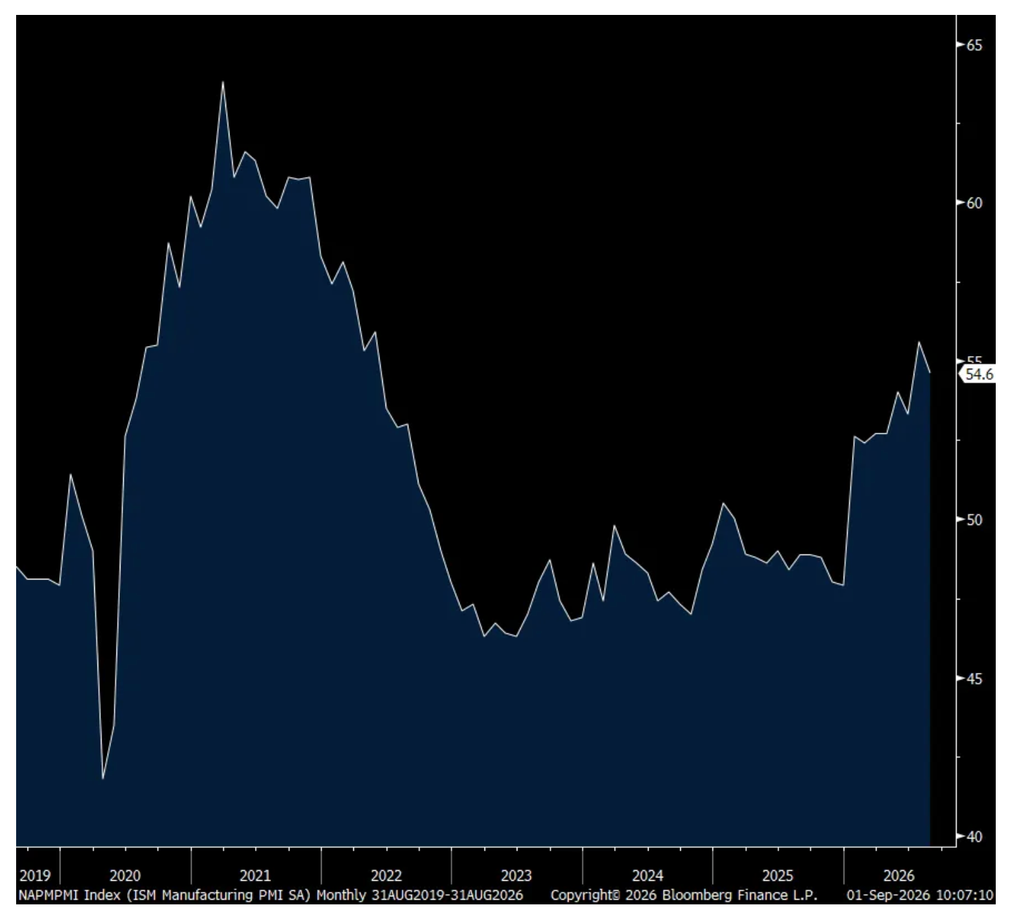
The August ISM manufacturing index fell 1 pt m/o/m to 54.6 and below the estimate of 55.2 but still continuing the run of above 50 prints and highlighting the recovery in manufacturing that is global.
New orders fell 3 pts but still above 50 at 53.7. Backlogs slipped too by 3.2 pts to 51.8. Inventories were above 50 for a 3rd month but down .6 pts to 50.6. Customer inventories remain low at 42.8 but up 2.1 pts m/o/m. Export orders were little changed at 53.2 but above 50 for the 3rd month in the past 4. I highlighted this morning that exports helped the manufacturing indices overseas as well.
Supply chain issues remain as the Supplier Deliveries component at 59.3 is well above 50. These were some respondent comments highlighting the problem::
“Supply chain situation, especially in the electronics market, is going through another crisis even bigger and more complicated than during and post COVID-19. That’s mainly due to AI infrastructure and uncertainties in the global market (for oil and other critical supplies) due to war in the Middle East and more complication on trade rules.” [Computer & Electronic Products]
“Supply markets are increasingly challenging due to inflation and supply availability. Each month has been more difficult than the previous one. Starting to resemble the post-COVID-19 disruptive period.” [Computer & Electronic Products]
“Photonics, high speed connectors, semiconductors and government orders are expanding significantly. Supply chains domestically and globally are difficult, with increases in lead times and cost.”[Machinery]
“Commentary this month echoes that of recent months: (1) significant availability/price challenges in commodities heavily consumed by AI, (2) great uncertainty over when the Iran conflict will end, and (3) another round of shifting U.S. tariff policy. Despite these tensions, we continue to focus on what we can control, and the market for our products remains strong.” [Miscellaneous Manufacturing]
Prices paid were unchanged but at still elevated 71.1 and 15 of 18 industries reported paying higher prices. No one paid less.
Finally component wise, employment was above 50 for a 2nd straight month at 51.2, down 1.6 pts, after a long stretch below 50. Only 7 of 18 industries though reported an increase in hiring.
Breadth wise, it didn’t change much m/o/m as 15 industries saw growth, the same number seen in July. Two saw a contraction in their business (wood products and chemical products) vs one in July.
Bottom line, the manufacturing recovery is here but it ain’t easy according to what the respondents have said. Here were some more comments:
“The economy is annoying; it is getting in the way of otherwise good business. We are making great new products but struggling to compete when prices escalate due to things like tariffs and the conflict in the Strait of Hormuz. I fear that the inflation caused by these factors will lead to lower sales and lower spending power of our customers. Call it inflation! At some point, it leads to an economic downturn or at least an economic pain for many consumers. It’s an uncertain year, our second in a row.” [Chemical Products]
“For our building products division, profitability is not far off from last year despite economic headwinds, as our specialty products have maintained their market share and sales. Specific to IT, the rising costs in component inputs have caused some budgetary constraints as we plan for the 2027 fiscal year. However, we largely been able to keep costs close to historic consumer price index averages.” [Chemical Products]
“Commentary this month echoes that of recent months: (1) significant availability/price challenges in commodities heavily consumed by AI, (2) great uncertainty over when the Iran conflict will end, and (3) another round of shifting U.S. tariff policy. Despite these tensions, we continue to focus on what we can control, and the market for our products remains strong.” [Miscellaneous Manufacturing]
“This month is a blur: Steel prices continue to climb as supply diminishes, aluminum is rising after dropping, and there are many holes on the plate side. Demand seems to be a seesaw. Our prediction ability continues to diminish, with the exception that the year will remain difficult until the end.” [Primary Metals]
“High steel and aluminum prices (due to Section 232 tariffs) continue to make profitability a challenge. Uncertainty over the U.S.-Mexico-Canada Agreement is at the forefront of many customer conversations. Our industry has also been hit with countervailing and anti-dumping penalties, further raising the cost of equipment.” [Transportation Equipment]
“Volume is consistent. Our main customer is shifting production from U.S. plants to Mexico plants.” [Transportation Equipment]
ISM Mfr’g
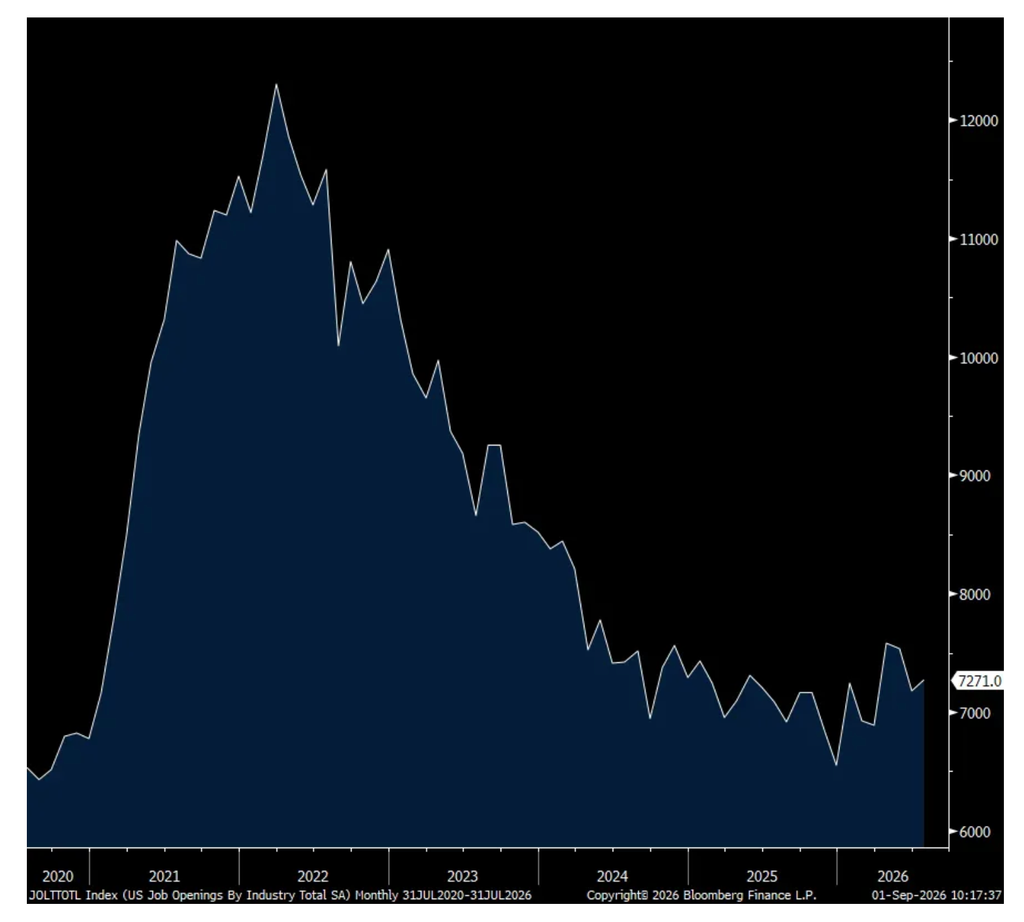
Bond yields are falling off their early morning highs maybe in response to the print in job openings in July which were below expectations and with the downward revision to June. In July they totaled 7.27mm vs 7.18mm in June (revised down from 7.36mm).
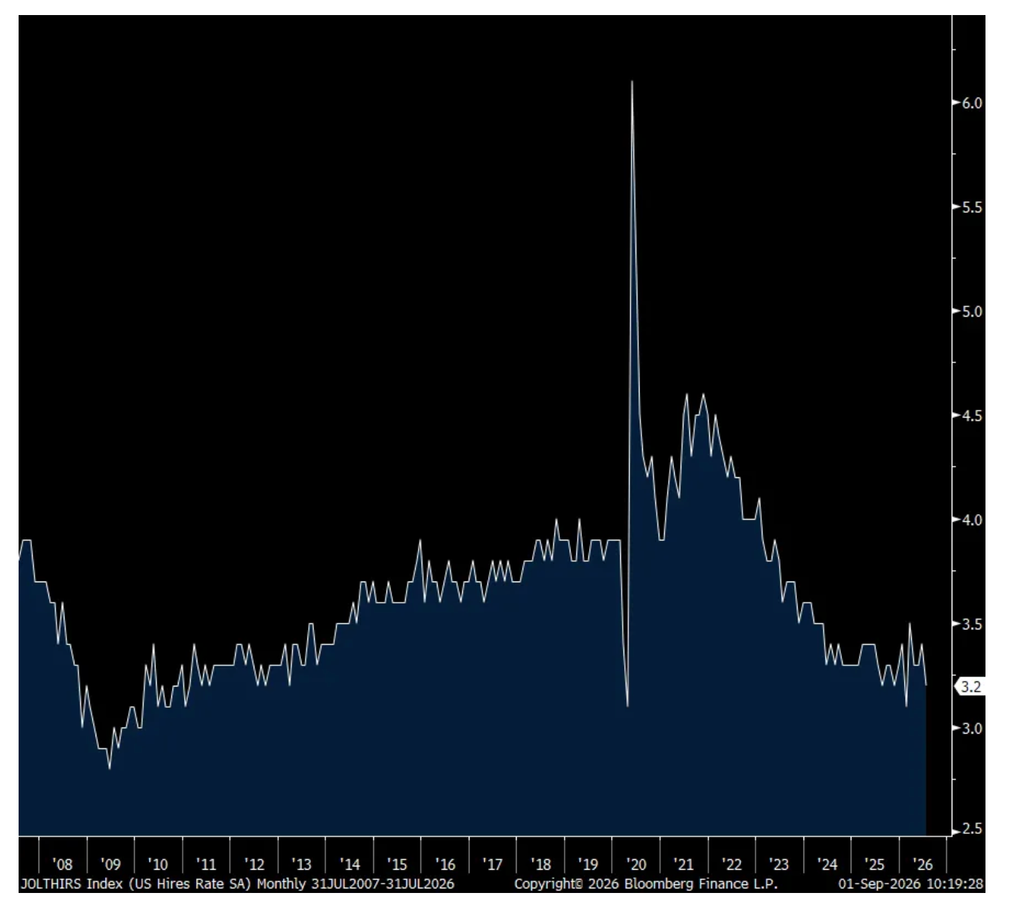
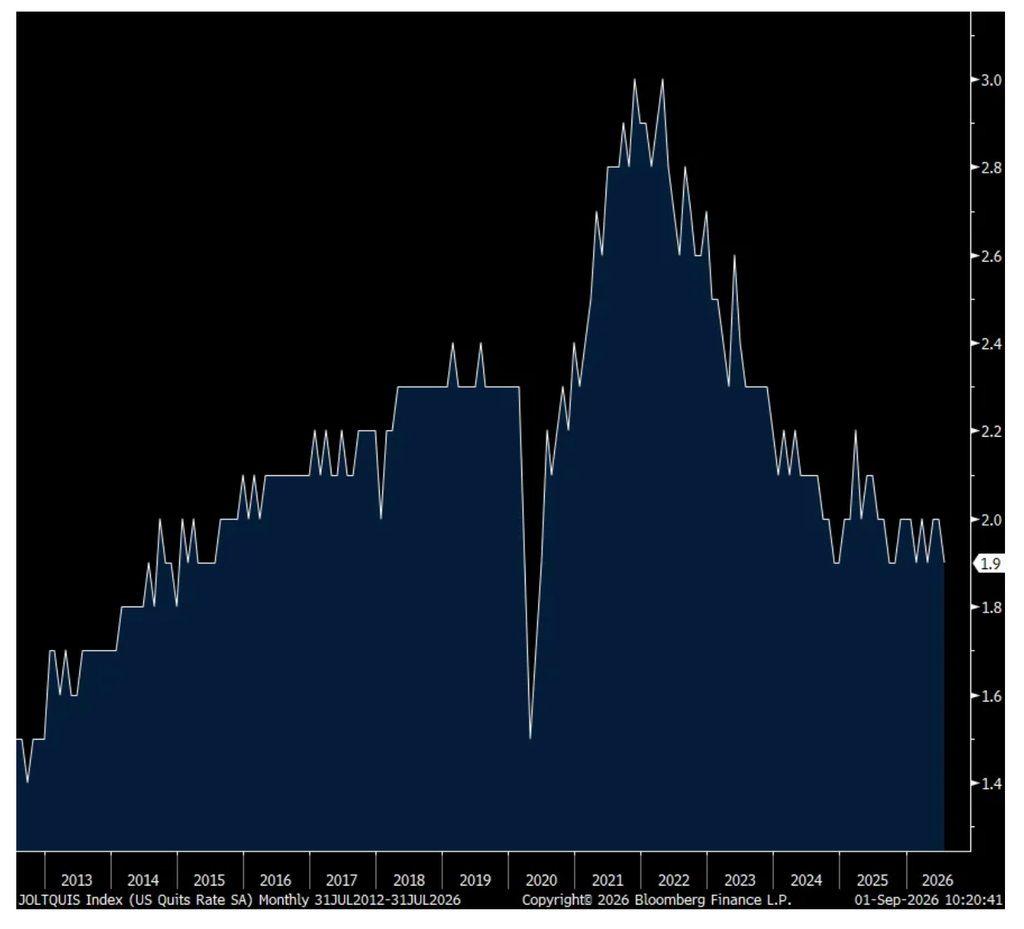
Of particular note was the drop in the hiring rate to 3.2% from 3.4% and that matches the 2nd lowest print since 2011 not including immediately after the Covid shutdowns. The quit rate fell to 1.9% from 2%, matching the lowest since 2014, also not including Covid.
Job Openings
Hiring Rate
Quit Rate
Ugly action feels much worse if you have no flexibility. Here’s what I’m doing.