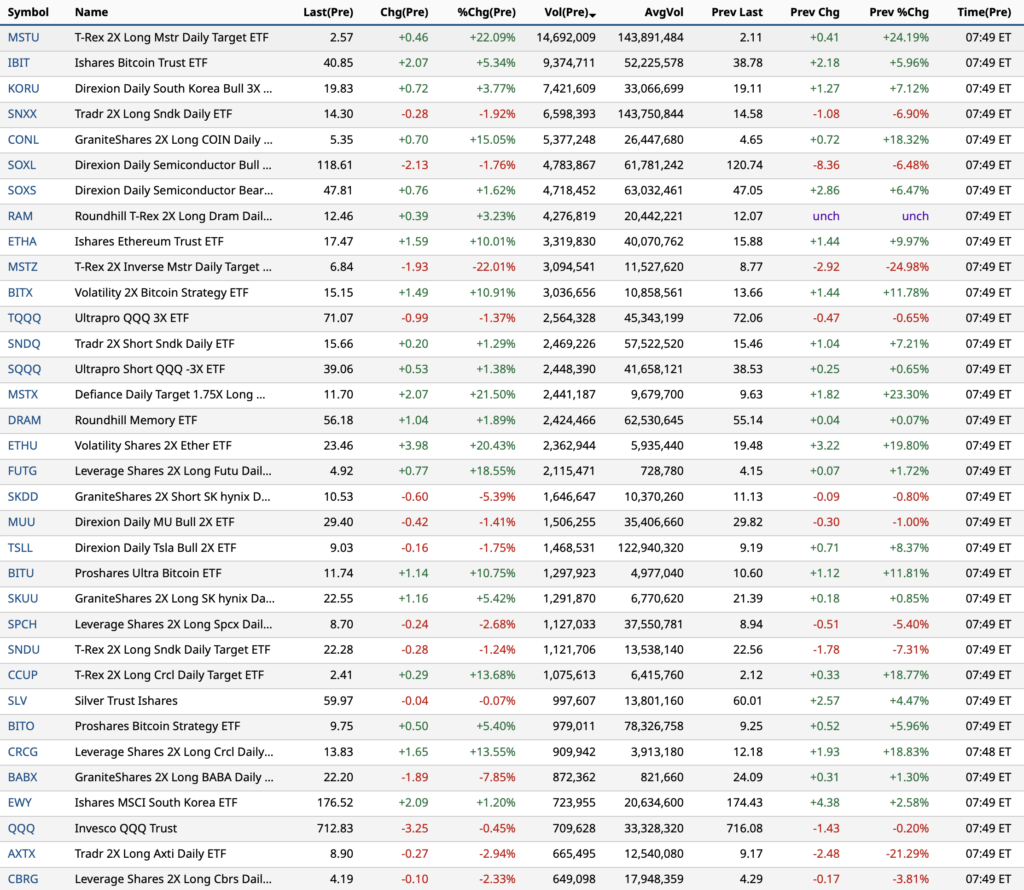
Moderna Leads the Charge as Pharma ETF Hits All-Time High


Tempus AI and Merck are key contributors to Moderna’s success.
Tempus AI and Merck are key contributors to Moderna’s success.
The following is from Peter Boockvar:
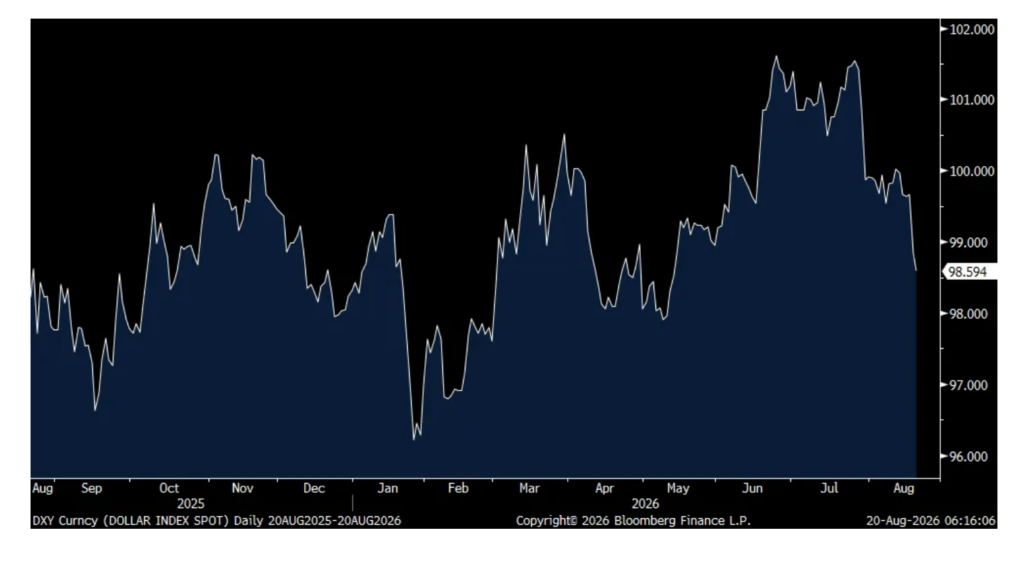
I expressed my thoughts on what Scott Bessent & Co announced yesterday so don’t have much to add here but of course watching to see what the follow through is both in the US Treasury market and the US dollar. As I see the buyback as nothing more than what FX intervention brings, a temporary respite, I don’t think it works without a coincident fundamental change in the situation, which there currently isn’t. I wonder what bazooka gets pulled out next if I’m right. The next problem for Treasury would be caused by another rise in inflation expectations in the TIPS market as that would be tough to contain without Fed rate hikes which would now be even more expensive for the Treasury with the increase in T-bill issuance. As for the US dollar today, it’s down again to a 3 month low and gold is at the highest level since early June. We stay positive and long on gold. The 10 yr Treasury yield is basically back to where it was yesterday morning before the news hit at 4.69%.
I’ll say again, what a box we are in.
DXY
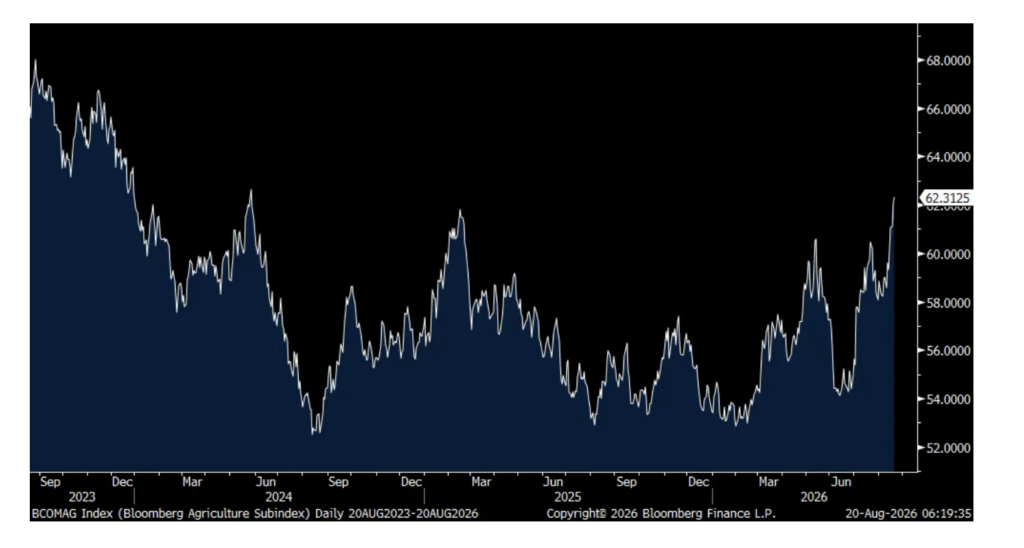
I repeat my belief that with respect to inflation, we’re in a commodity bull market that will be followed by ag prices soon. The Bloomberg agriculture index yesterday broke out to the highest level since May 2024. Included in this index is coffee, corn, wheat, soybeans, soybean oil/meal, cotton, and sugar.
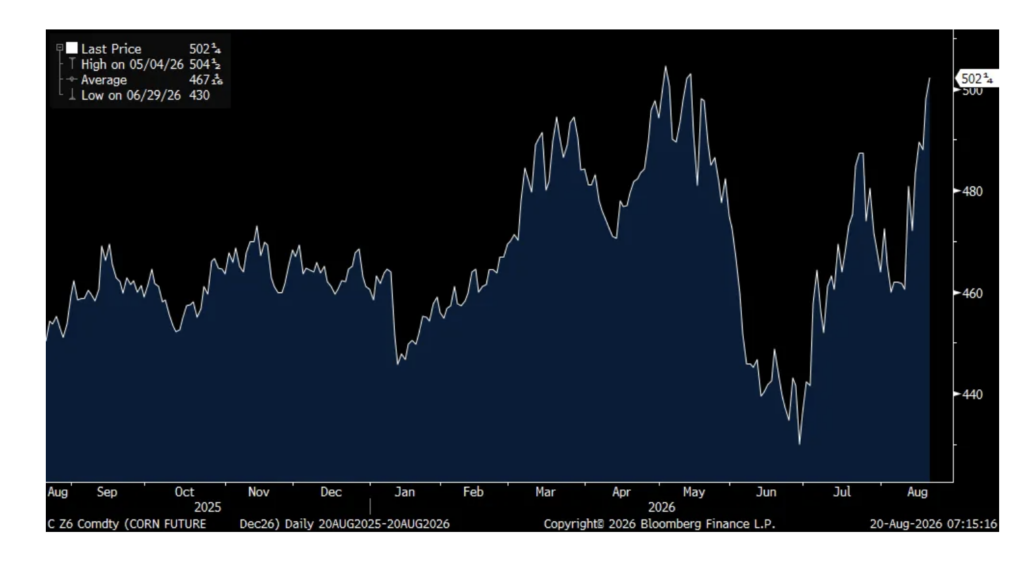
We’re long some fertilizer stocks as a play on this. Corn in particular is back above $5 per bushel and wheat is back to $7.
Bloomberg Agriculture Index
Corn
Here were some notable comments I pulled out of some of the earnings calls yesterday.
From Target, 4% yesterday:
“Comparable sales increased 3.8%, driven by a 3.6% increase in traffic, with average ticket about flat. Store comparable sales grew 2.7%, while digital comparable sales increased 8.7%, led by growth of more than 25% in same-day delivery.”
“I think broad based strength is the headline I would leave with on a bunch of fronts. We saw that across guest demographics. We saw that across categories and we saw strength throughout the quarter.”
They saw particular strength in food and beverage and also beauty. Estee Lauder by the way had a good quarter yesterday, a stock we own.
“I think traffic is actually a great place to start because when we see the strong traffic response like we did in Q2 and we’ve seen so far this year, it’s just a reinforcement to us that guests are responding to the change that we’re making and that we’re earning more and more trust that’s translating to more and more trips to Target.”
“we’re encouraged with what we see in back-to-school and back-to-college so far.”
From TJX, down 4% yesterday:
Comps rose 4%, “which was above our plan.”
Their Marmaxx division (which includes TJ Max and Marshalls) was “below our expectations” but “our three other divisions delivered comp sales increases of 6% to 7%.”
“We are seeing improvement at Marmaxx to start the 3rd quarter and are confident that we will see greater improvement by the holiday selling season.”
“Our 2nd quarter comp was driven by a higher average basket and an increase in customer transactions. Further, our home categories outperformed our apparel categories.”
“we are confident that consumers will continue to look for value in the current environment.”
This was from Walmart’s earnings release just out where US comps missed expectations and the stock is down as a result:
On their US stores, “Sales reflected continued strong momentum in eCommerce and broad-based share gains, partially offset by 125 bps headwind to comp sales from pharmacy deflation related to new maximum fair price regulation.”
From Advanced Auto Parts, who missed comp estimates and is trading down sharply pre-market:
“Our 2nd quarter comparable sales results reflected low single digit growth in the Pro channel, which performed in line with expectations along with Main Street Pro trends outpacing overall Pro trends. However, total enterprise sales performance was impacted by the DIY channel as tighter household budgets constrained spending more than we anticipated, especially during the last four weeks of the quarter.”
From Viking Holdings, the upper end cruise line operator and down 8% yesterday as low water levels in some regions is impacting the business:
Revenue rose 16.5% and the “results reflect the continued strong demand for our destination focused travel experiences and the great execution of our teams across the organization.”
“From an advanced booking perspective, our 2026 season is effectively sold out with 96% of the capacity for our core products already booked…As of August 9, 53% of the capacity for our core products for 2027 was booked, and this includes a 15% y/o/y increase in capacity.”
And why the stock traded down, “the historically low water levels this year, combined with conditions that have deteriorated week-by-week, have impacted guests on some of our itineraries this season.”
And in response, they are “issuing future cruise vouchers to certain affected guests. While we believe this is the right approach from both a guest satisfaction and loyalty perspective, these vouchers will have a financial impact extending beyond 2026 and into 2027 and 2028 as they are redeemed.”
Shifting to semis, this was from Analog Devices, which was little changed yesterday:
“Demand for our solutions continues to grow, supported by robust AI and defense spending, cyclical momentum, and underlying secular content growth across our diversified end markets.”
Overseas, the Swedish Riksbank left its policy rate unchanged at 1.75% as expected but left open the door for a hike this year as they access “that the probability of a rate increase later this year remains. If the unexpectedly high inflation during the summer were to be the start of a larger and more lasting upturn in inflation, the Riksbank would adjust its monetary policy in a tighter direction.”
The UK CBI industrial orders index improved by 20 pts to -25 and well better than the estimate of -40. The global recovery in manufacturing is helping. The CBI said “Stronger global demand is providing some welcome relief for manufacturers, with export order books improving sharply and lifting overall orders. Firms also expect output to fall at a much slower pace over the next three months.”
The caveat, “However, it is too soon to know whether this marks the beginning of a sustained shift in conditions, particularly given ongoing cost pressures reported by manufacturers, with selling price expectations in our survey picking up again and remaining well above historical norms.”Pound sterling is higher, the 10 yr gilt yield is up 1 bp and the FTSE is lower by about 1/3 of a percent in response.
Positions: None.
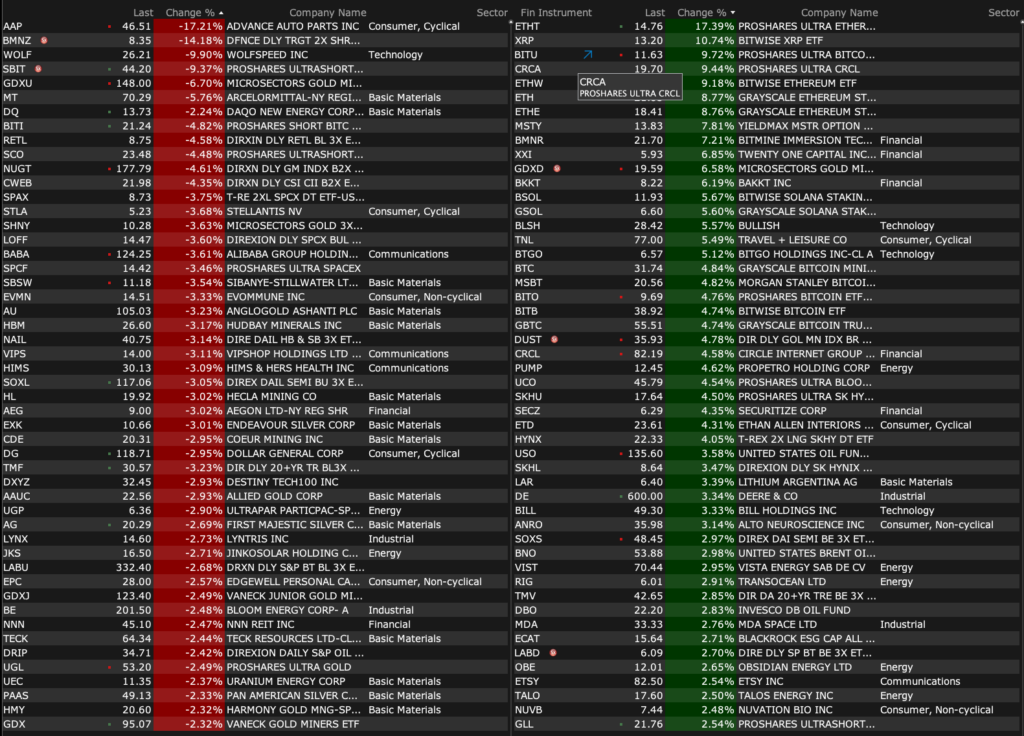
MSTR +10.0%, BMNR +8.0%, COIN +7.5%, CRCL +6.5%, BLSH +6.5%, ABTC +6.0% (Bitcoin rebound above $71K and renewed crypto-policy optimism after White House crypto discussions; crypto beta names reprice higher)
NDSN +8.0% (earnings beat and margin resilience exceeded expectations; investors focus on industrial recovery rather than slower macro backdrop)
DE +5.0% (earnings reaction as equipment demand outside agriculture offsets farm-cycle weakness; guidance seen as better than feared)
TEM +4.5% (AI-healthcare/data platform growth continues to exceed cautious expectations)
HOOD +4.0% (crypto trading volumes and retail activity expectations improve with digital asset rally)
MARA +4.0%, RIOT +3.5%, CLSK +3.5% (Bitcoin miners gain leverage to crypto rebound)
XOM +3.5%, CVX +3.0%, OXY +3.0% (energy sympathy as crude rises more than 2% on supply/geopolitical concerns)
NEM +4.5%, GOLD +4.0%, AEM +3.5% (gold miners benefit from commodity rotation and rate volatility)
ALGN +4.0% (earnings reaction as profitability outlook improves versus lowered expectations)
MRNA –10.0% (profit-taking after historic prior-day repricing; investors lock gains after the Phase 3 cancer vaccine breakthrough)
FRHC –35.0% (major earnings-driven valuation reset as growth expectations deteriorate)
PAYC –14.0% (earnings/guidance disappointment forces lower growth expectations for enterprise software)
COTY –8.5% (larger-than-expected loss and weaker sales outlook pressure turnaround assumptions)
AAP –8.0% (forward demand concerns overwhelm quarterly beat as investors focus on consumer repair-cycle weakness)
WMT –6.5% (same-store sales growth missed expectations despite earnings beat; consumer spending read-through weakens)
BABA –1.0% (profit miss as AI investment raises near-term margin pressure despite cloud growth)
NEBI –10.0% (AI infrastructure valuation pressure after $4.5B convertible debt financing raises dilution concerns)
TER –6.0% (semiconductor equipment weakness as investors question AI infrastructure spending durability)
SMCI –5.0% (AI hardware valuation pressure continues after crowded trade unwind)
MRVL –4.0%, AMD –2.5%, NVDA –2.0% (AI hardware rotation away from crowded winners; investors favor profitable AI beneficiaries over lower-quality beta)
CRWD –3.5%, SNOW –3.0%, PANW –3.0% (software duration pressure as Treasury yields remain elevated)
LOW –3.0%, DG –3.0% (consumer discretionary caution after mixed retail earnings signals)
Oil moving through the strait, $40 trillion in debt and other headlines moving the market this morning.
Positions: None.
11:00 a.m.: Treasury Announces a 13 Week and a 3and 6 month Bill Auction;
11:00 a.m.: Treasury’s Note Announcement;
11:30 a.m.; Treasury hosts a $110B 4 and a $100B 8Week Bill Auction;
1:00 a.m.: Treasury hosts an $8B 30-Year TIPS Auction;
2:00 p.m.: Treasury buyback (liq support)
11:10 a.m.: Federal Reserve Bank of St. Louis President Alberto Musalem (Non-Voter) participates in a live interview on CNBC’s “Squawk on the Street.”

Positions: None.
Positions: none.
Let’s start the day with a brief discussion on the deterioration of the underlying AI fundamentals.
I suspect most have seen the news per the WSJ about OpenAI’s most recent quarter being quite ugly, but you wouldn’t know this if you watch the ubiquitous and shallow daily discussions of AI and hyperscalers on Fin TV.
Revenue growth decelerated sharply. They only grew revenue by about $1 billion sequentially, while increasing operating losses by $3 billion sequentially (to buy that revenue). They managed to lose $12.3 billion in the quarter alone ($48 billion annualized) on the $6.7 billion of revenue.
It is not very impressive to lose $2 for every $1 of revenue (I do not think I have ever seen anything quite like it). It must truly be revolutionary technology to pull that off. This speaks volumes about the economics of this industry and why all the borrowing and circular financing needs to happen to keep it propped up.
It is not a surprise their revenue growth slowed. Token prices are cratering, and both OpenAI and Anthropic continue to lose share to open source. Given this macro overlay and what happened to OpenAI, one would think Anthropic’s trajectory would start showing the same slowing as well. The recent growth engine was token consumption for coding and the related tokenmaxxing (which has now been stopped or slowed).
At any rate, I have no idea where these guys get the data, but it looks like Anthropic’s coding-related revenue, after skyrocketing December-April, went almost completely flat starting in June. No wonder Anthropic’s backward-looking revenue is being hyped by the usual mouthpieces. My guess is the going is going to get a lot tougher going forward for them:
The other thought I have about coding is a lot of it is a one-time project.
If a company wants to use an AI tool to write code, to replace a CRM app, for example, that can certainly be done (and part of why Salesforce ($CRM) stock got hammered). But once those tokens are consumed, and the code is written, that code becomes the property of whomever used the AI tool to write the code. It is a one time project, and does not repeat. Then, the code can then be run on said company’s internal server architecture, or very low cost, low value added hosted capacity (which is a fraction of the cost of higher value added cloud capacity or AI capacity). There are a lot of one-time projects being done now, driving token demand for coding.
How long that bolus of stuff lasts before it is done is also something to monitor.
This may be part of why overall token growth seems to be flattening as well (and token price is cratering while both OpenAI and Anthropic seem to keep losing share):
https://openrouter.ai/rankings#leaderboard-table
Token prices:
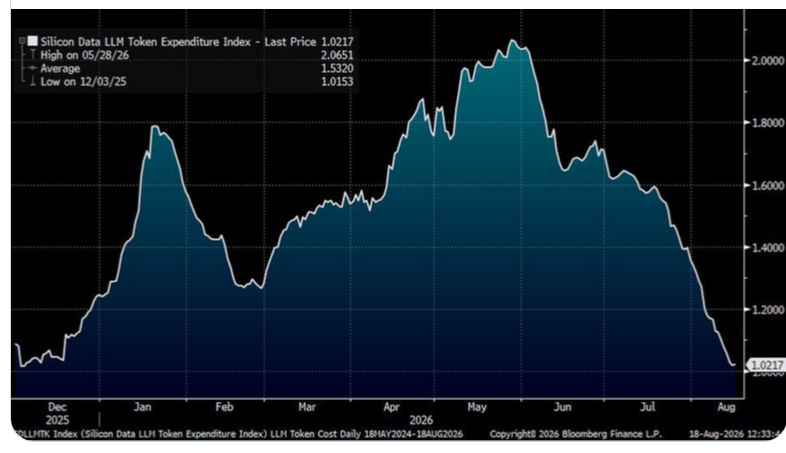
And these are the two companies that are the pillars supporting the whole circular scheme while fighting a very tough macro trend and one of them at least seems to be losing almost $2 for every $1 of revenue.
Well whaddya know, even the Fed seems to think AI is inflationary, as based by the hawkish minutes that were just released.
So much for the great productivity enhancer.
Left out of their commentary is how the investment in AI is also clearly raising the cost of capital (rates) in the economy overall, which may be even more problematic. It seems Secretary Bessent is bringing a knife to a gunfight in this regard. This latest announcement (which is really just a sterilized twist and not money printing) will probably work about as well as his yen intervention: https://josiahwaters.substack.com/p/the-yen-intervention-bessents-desperate
“Most participants anticipated that inflation would step down over the rest of the year as the effects of tariffs and earlier energy price increases wane, but many participants noted the possibility that inflation might be more persistently elevated,” the minutes said.
Position: None
A Treasury intervention and 170% move in Moderna produced only a 0.2% gain in the S&P 500.