What Apple and Palantir Are Telling Us About This Market


Apple ($AAPL) and Palantir ($PLTR) both reported solid earnings earlier this week.
Apple’s fiscal fourth quarter yielded earnings of $2.10 per share, above consensus estimates of $2.00. Revenues for the quarter were slightly higher than anticipated.
Remember all those concerns about the price and availability of components? When Apple sold off in June due to a “100 year flood” component shortage, and the stock dropped to $273, we explained why that selloff was overdone.
Apple’s Mixed Quarter
Macs and iPhones were strong. Wearables and iPads were weak. Apple’s new Duo, a foldable version of the iPhone, could cannibalize sales of smaller iPads going forward.
Another concern for Apple is declining gross margins. Apple’s gross margin was 50.1% in the quarter ended in June, but only 47.9% in the just-ended quarter. Apple sees its margin shrinking further to between 45-46 in the current quarter.
Despite these concerns, investors still consider Apple a premier, market-leading stock that investors should own for the long haul.
Palantir Comes Out Strong
Palantir’s numbers were more impressive. The Aventura, Florida software innovator earned $0.44 per share vs. estimates of $0.405.
Revenues also beat estimates handily, as the company brought in $2.31 billion for the quarter. Analysts predicted revenue of $2.18 billion.
That $2.31 billion figure represents a 96% year-over-year increase in revenue. Palantir raised full-year revenue guidance to about $8.53 billion, up from $8.15 billion.
We first recommended Palantir at $35. We later exited our position at $135 for a healthy gain. We currently have no position in the stock.
Price Action Leaves Clues
Based on earnings and revenue figures, you’d expect Apple, and especially Palantir, to have a positive reaction. After all, these are two market leaders. Apple closed at an all-time high on October 29, and Palantir reached its most recent all-time high on October 12.
That wasn’t the case. Both stocks were dumped at Tuesday’s open.
Take a look at Apple (left) and Palantir (right) on the five-minute charts. Both stocks opened at their lows for the day, falling on heavy volume.
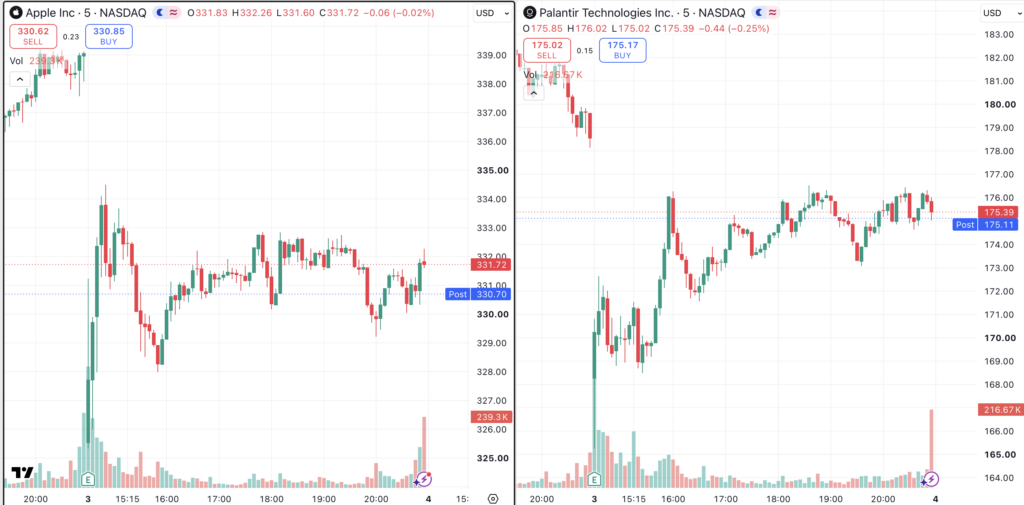
On the left, we see that Apple quickly bounced from its low to its high of the day, getting solid volume in both directions. On the right, Palantir sold off on heavy volume, but clawed its way back slowly, and on lighter volume.
Risk Aversion?
Could this be a sign that risk aversion is creeping into the markets? Palantir is a volatile, high-multiple stock. Apple has been a reliable name for decades. Apple is just 5% below its all-time high, while Palantir is now 17% away from a new high.
Palantir has been an outstanding name to own over the past two years. However, the charts are suggesting that under current market conditions, investors would rather own Apple, despite Palantir’s greater upside potential.
That says more about the market than it does about either stock.
General Wariness
Why would investors prefer to own Apple, a company dogged by shrinking margins, over Palantir, a company that is seeing significant margin expansion?
It could be that recent steep declines in formerly high-flying sectors have created a general wariness toward volatile, high-multiple tech stocks. We may be undergoing a shift from an unsustainably narrow AI-focused bull market to more normalized market conditions.
At the time of publication, Ponsi was long AAPL.
