AI Rout Sends the Tech Sector to Its Worst Day Since the Covid Crash

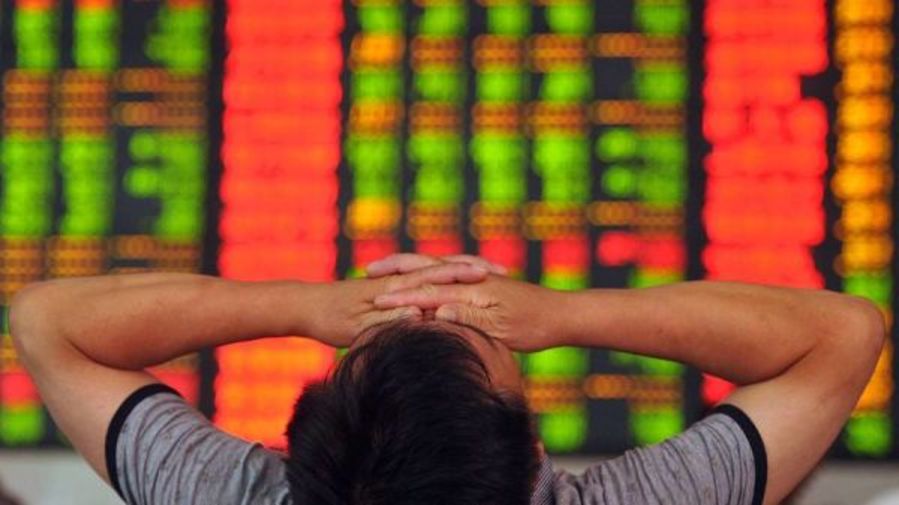
Worries that Democrat political gains will slow the AI buildout morphed into a broader selloff Thursday pulling every sector lower, led by Tech.
Worries that Democrat political gains will slow the AI buildout morphed into a broader selloff Thursday pulling every sector lower, led by Tech.
A Democratic sweep of Congress supercharged the rotation trade, with hyperscalers joining a rally that lifted almost everything except semiconductors and AI power and data center names.
Let’s examine three major headwinds blowing against AI infrastructure buildout.
Lifting our price target and our rating, but why you shouldn’t chase the shares today.
Plus, several other holdings we’re eyeballing and where some prudent portfolio management could be called for.
Ahead of the election, there was much concern about the impact of a “Blue Wave” Democratic sweep on equities, particularly those related to the AI trade given the expressed desire from many Democratic candidates to slow the growth of data centers.
Predictably, as early returns showing just such a result came in Tech stocks fell with Nasdaq-100 futures down about 1.5% at midnight, but as of this morning, traders were rethinking things with those futures now higher and the S&P 500 indicated to open up around 1.2%. Meta Platforms ($META), Amazon ($AMZN), Nvidia ($NVDA) and Alphabet ($GOOGL) all trading higher before the open Bloomberg reported.
That may be because the first read from most analysts is that the Democratic sweep slows the AI data center buildout rather than stops it.
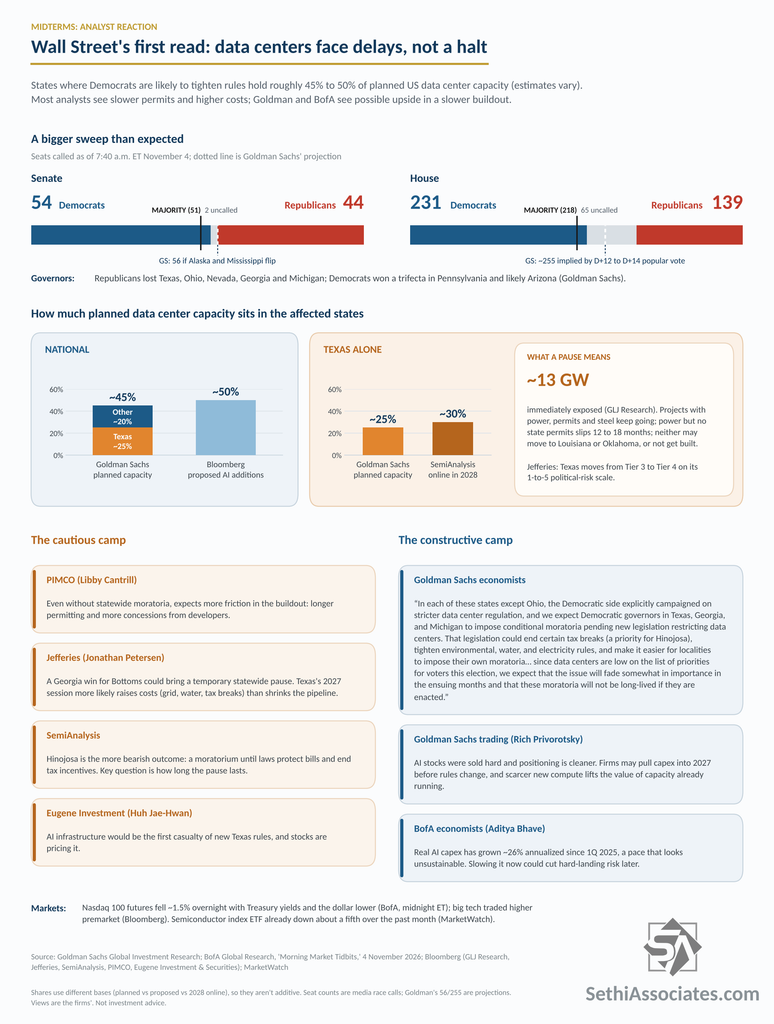
Bloomberg reports that 54 Senate seats (a majority) are now in the hands of the Democrats with Alaska likely to follow (according to Goldman) and Mississippi a coin toss. In the House, Goldman sees a popular-vote margin of roughly 12 to 14 points, consistent with a majority of around 255 seats (Bloomberg has that currently at 232 Democrats). Its economists don’t think the Senate flip changes the federal outlook much, since the House was already expected to turn.
The bigger change perhaps is in the statehouses. Republicans lost governor’s races in Texas, Ohio, Nevada, Georgia and Michigan, and Democrats won full control in Pennsylvania and likely Arizona.
Goldman estimates the states likely to tighten data center rules hold about 45% of planned U.S. capacity, with Texas alone about 25%. It expects Democratic governors in Texas, Georgia and Michigan to impose conditional moratoriums until new laws pass, which could end tax breaks and tighten water, power and environmental rules.
Texas is currently a key state for the buildout. Bloomberg cites SemiAnalysis putting Texas at nearly 30% of the U.S. capacity due online in 2028, and GLJ Research estimating about 13 gigawatts there is immediately exposed. GLJ expects fully permitted projects with power to keep going, while those with power but no state permits slip 12 to 18 months. Jefferies thinks new Texas rules are more likely to raise development costs than to materially shrink the pipeline, and PIMCO’s Libby Cantrill expects “a lot more sand in the gears” even without statewide moratoriums.
Similarly Goldman says Ohio was one state where Democrats didn’t run explicitly on tighter data center rules, but Bloomberg notes Governor-elect Amy Acton has called for a conditional moratorium, which matters for the cluster of projects around Columbus.
So the thinking so far: slower permits and higher costs, not a shutdown.
Not everyone reads this as bad news. BofA economist Aditya Bhave notes real AI-related capital spending has grown at about a 26% annualized pace since the first quarter of 2025, a front-loaded wave he calls “symptomatic of over-investment.” Slowing it now, he argues, could lower the risk of a harder landing later.
Goldman’s head of European equities trading, Rich Privorotsky, told clients AI stocks had been “sold to death” into the vote, according to MarketWatch. He thinks companies may pull spending into 2027 to lock in today’s permitting, and that limits on new supply make capacity already running more valuable, which favors Amazon, Microsoft ($MSFT) and Alphabet. For neocloud providers such as CoreWeave ($CRWV) and Nebius ($NBIS), he says it depends on how much of their compute is contracted versus already built. Privorotsky also expects volatility to fall quickly now that the election is over.
On fiscal policy, Goldman expects Democrats to reverse last year’s spending cuts, adding about 0.25% of gross domestic product to 2027 spending, per MarketWatch. The first test is December 11, when government funding runs out; Goldman sees a short-term extension to February or March as most likely. Corporate America is also bracing for a wave of congressional investigations once Democrats gain subpoena power, the Financial Times reports.
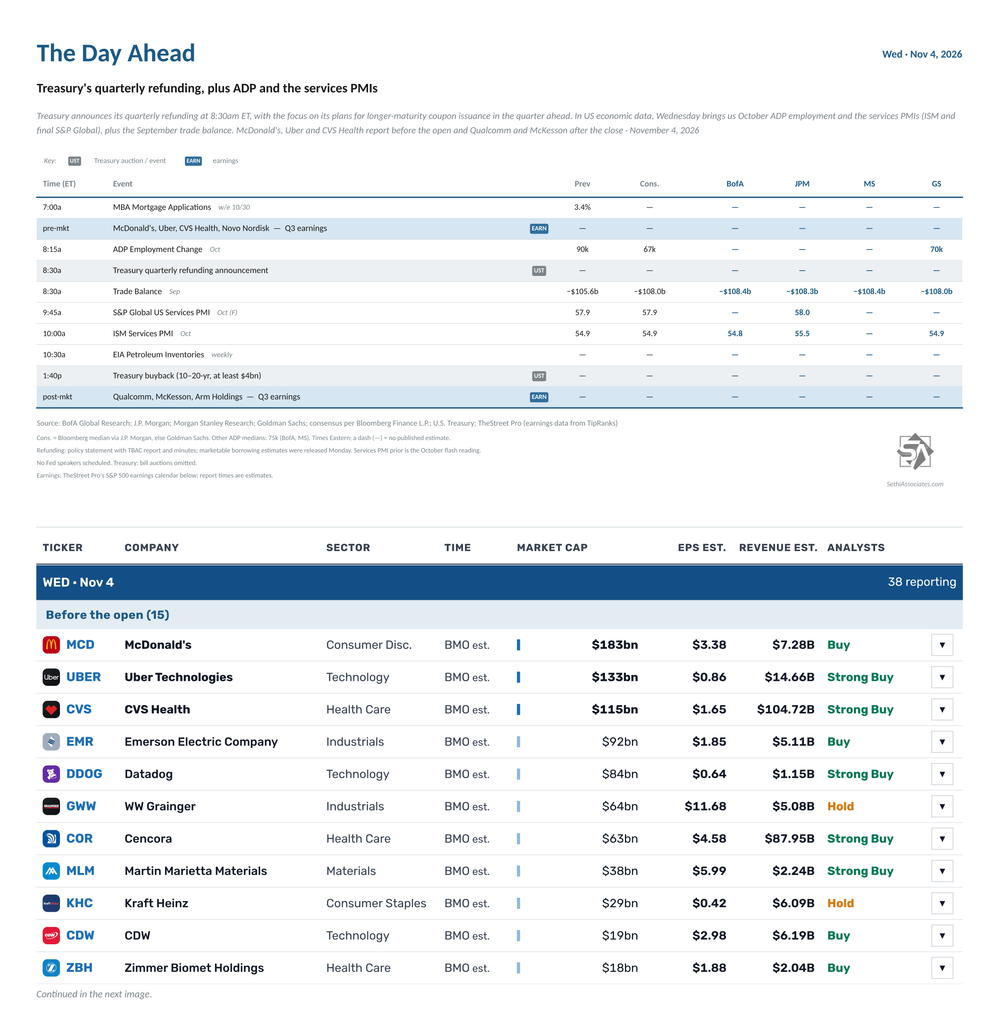
In US economic data, Wednesday brings us October ADP private employment growth and the services PMIs (ISM and final S&P Global), plus the September trade balance. We’ll also get weekly MBA mortgage applications and EIA petroleum inventories.
There are no Fed speakers scheduled.
There are no non-Bill (>1yr in maturity) US Treasury auctions, but Treasury announces its quarterly refunding at 8:30am ET, with the focus on its plans for longer-maturity coupon issuance in the quarter ahead. It also holds a buyback of 10- to 20-year securities in the afternoon.
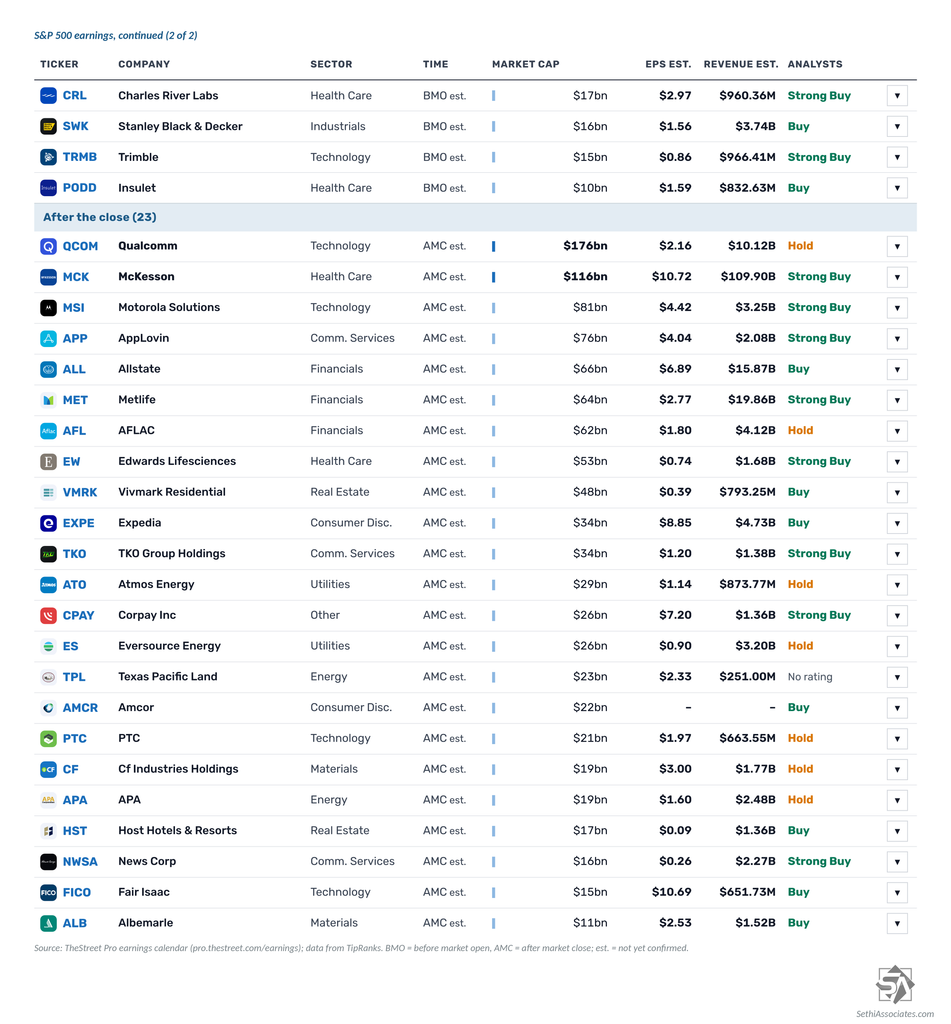
38 S&P 500 components report, five of them with market caps over $100B:
Before the open: McDonald’s ($MCD), Uber ($UBER), CVS Health ($CVS), Emerson Electric ($EMR), Datadog ($DDOG), W.W. Grainger ($GWW), Cencora ($COR), Martin Marietta Materials ($MLM), Kraft Heinz ($KHC), CDW ($CDW), Zimmer Biomet ($ZBH), Charles River Laboratories ($CRL), Stanley Black & Decker ($SWK), Trimble ($TRMB) and Insulet ($PODD)
After the close: Qualcomm ($QCOM), McKesson ($MCK), Motorola Solutions ($MSI), AppLovin ($APP), Allstate ($ALL), MetLife ($MET), Aflac ($AFL), Edwards Lifesciences ($EW), Vivmark Residential ($VMRK), Expedia ($EXPE), TKO Group ($TKO), Atmos Energy ($ATO), Corpay ($CPAY), Eversource Energy ($ES), Texas Pacific Land ($TPL), Amcor ($AMCR), PTC ($PTC), CF Industries ($CF), APA ($APA), Host Hotels & Resorts ($HST), News Corp ($NWSA), Fair Isaac ($FICO) and Albemarle ($ALB)
Outside the S&P 500, Novo Nordisk ($NVO) reports before the open and Arm Holdings ($ARM) and MercadoLibre ($MELI) after the close.
Also, opening arguments are scheduled in a Los Angeles trial over claims that Meta ($META) and Snap ($SNAP) designed their platforms to be addictive and harmful to young users, per Bloomberg.
Ex-US highlights include the final October services PMIs (including China’s RatingDog services PMI), Eurozone October CPI, Spain’s October unemployment rate, UK October official reserves changes and Canada’s September trade balance. There are rate decisions from Sweden’s Riksbank, Poland and Brazil, the ECB releases its wage tracker, ECB Chief Economist Lane and Bank of France Governor Moulin speak, and the Bank of Japan releases the minutes of its September meeting.
Semiconductors led a rebound that broke the S&P 500’s three-day losing streak, but the average stock fell.
Energy and pharmaceuticals offer some compelling alternatives.