While everyone will be focused on earnings from Alphabet ($GOOGL), Microsoft ($MSFT) and Amazon ($AMZN) this week, a Wall Street Journal analysis shows they aren’t expected to contribute enough to third-quarter S&P 500 earnings growth to get their own callout in terms of needle-movers. That’s quite a change from the second-quarter season, when their “other income” was one of the biggest sources of upside surprise.
In contrast, Nvidia ($NVDA) and Micron Technology ($MU) alone account for about a third of the nearly 30% year-over-year growth in S&P 500 third-quarter earnings. That figure blends actual results from companies that have reported with estimates for those that haven’t. Just 10 companies account for nearly two-thirds of that growth. Along with Nvidia and Micron, they are Broadcom ($AVGO), Exxon Mobil ($XOM), EchoStar ($SATS), Sandisk ($SNDK), Marathon Petroleum ($MPC), Meta Platforms ($META), Chevron ($CVX) and Valero Energy ($VLO).
That didn’t take long. When Meta Platforms ($META) unveiled its new non-voting Class C shares alongside earnings last week, I noted that its filing showed management’s long-range plan needing to raise “hundreds of billions of dollars” beginning as early as this fall. The filing also said the company “expects to conduct offerings of Class C common stock from time to time.”
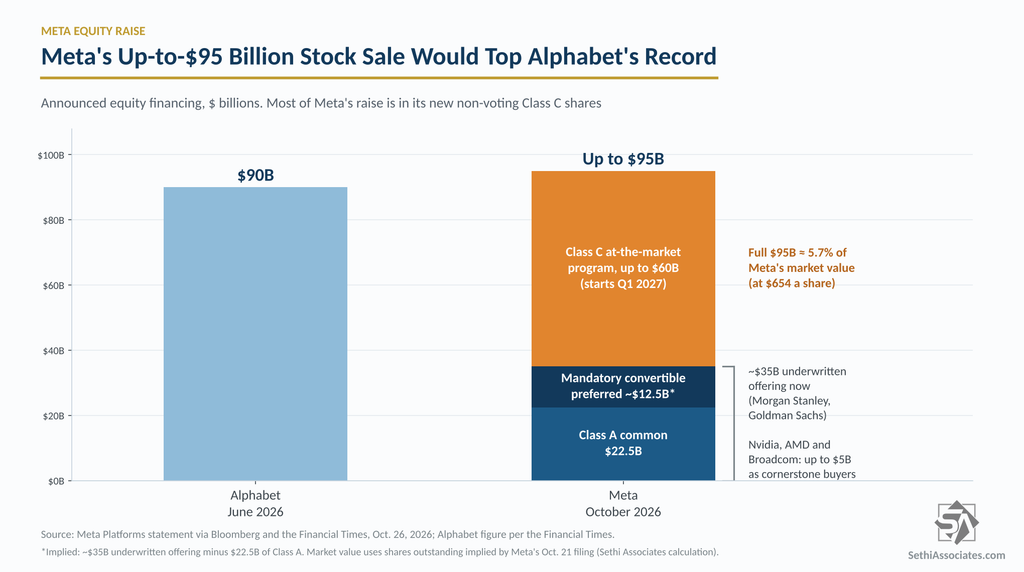
On Monday it got started. Meta is seeking to raise as much as $95 billion by selling common and preferred stock, per Bloomberg. About $35 billion is being offered now, roughly $22.5 billion in Class A common and the rest in mandatory convertible preferred. The remaining roughly $60 billion will come through an at-the-market program in the new Class C shares, which the Financial Times says is expected to begin in the first quarter of 2027.
Nvidia ($NVDA), Advanced Micro Devices ($AMD) and Broadcom ($AVGO), all Meta chip suppliers, have agreed to buy up to $5 billion of the common as cornerstone investors. Morgan Stanley and Goldman Sachs are leading the deal.
If fully executed, Meta’s raise would top Alphabet’s $90 billion June offering, which lead bookrunner JPMorgan called the “largest multi-tranche equity transaction in history,” per the FT. At about $654 a share, the full $95 billion is roughly 5.7% of Meta’s market value.
The timing fits what Meta’s special committee flagged in the filing: it wanted to front-run potential equity offerings from Alphabet ($GOOGL), SpaceX ($SPCX), Anthropic and OpenAI. Alphabet has raised once already, SpaceX completed the biggest-ever IPO in June, and Anthropic is expected to list before year-end, per the FT.
One wrinkle: because the Class C shares won’t exist until January, this first tranche is voting Class A stock. According to Claude, the $22.5 billion of Class A trims CEO Mark Zuckerberg’s voting control voting control only modestly, to about 60.2% from 60.6%, before any conversion of the preferred. The $60 billion ATM goes into the non-voting shares, so it won’t dilute his control at all.
It appears this was priced in by the market with Meta shares little changed as of 8:30 am ET.
At the time of publication, in terms of securities mentioned, Sethi was long META, NVDA, GOOGL, and SPCX and short AMD.
Brent topped $116 and stocks pulled back on fears of renewed U.S.-Iran hostilities after the midterm elections. For the week, small caps led with the Russell 2000 up 2% while the S&P 500 and Nasdaq slipped.