Alphabet Miss, Why Fed Shouldn’t Raise Rates, All Eyes on Amazon


Higher statistical growth coupled with accelerating statistical inflation seems like a good reason to raise rates. I’ll explain why it’s not.
Higher statistical growth coupled with accelerating statistical inflation seems like a good reason to raise rates. I’ll explain why it’s not.
* Bona fide business threats had emerged but were ignored as passive and relentless buying of Google’s shares masked a growing AI headwind
* Is Amazon as vulnerable as Google?
Google ($GOOGL) is not only an example that the threat to its search business is real…
Price Is Not Truth
… But it is also testimony to the threat represented by market structure.
What do I mean by that? Let me explain…
Well, passive price momentum-based products and strategies carried Google’s shares ever higher in recent months — and the blind monkeys in the business media (without any or with limited analytical rigor), confidently took the price increases as a sign of fundamental progress. Indeed Google became the darling of the hyperscalers based principally on chart gazing.
Here is perennial bull Gene Munster voicing his concerns:
This gets me back to Amazon ($AMZN).
What has kept me from buying AMZN at seemingly an attractive price-earnings multiple is what has threatened Google. Is the utility of using Amazon markedly reduced as AI/Personal Bots expand their tasks?
Again from Gene Munster:
Finally, about two years ago we observed the dramatic change in the hyperscaler from capital light to capital intensive — suggesting that this was not market friendly and that it was price-earnings multiple altering/contracting:
Position: None
The Fed held rates steady with two hawkish dissents, Oracle’s aggressive long-term targets lifted AI names, but Alphabet fell about 9% after missing expectations.
Microsoft ($MSFT) shares were up about 2% in after-hours trading Wednesday, off their highs, after the company’s fiscal first-quarter results topped Wall Street estimates on revenue and earnings, led by faster growth in its Azure cloud business, according to TipRanks. Shares came into the report up nearly 35% over the past three months.
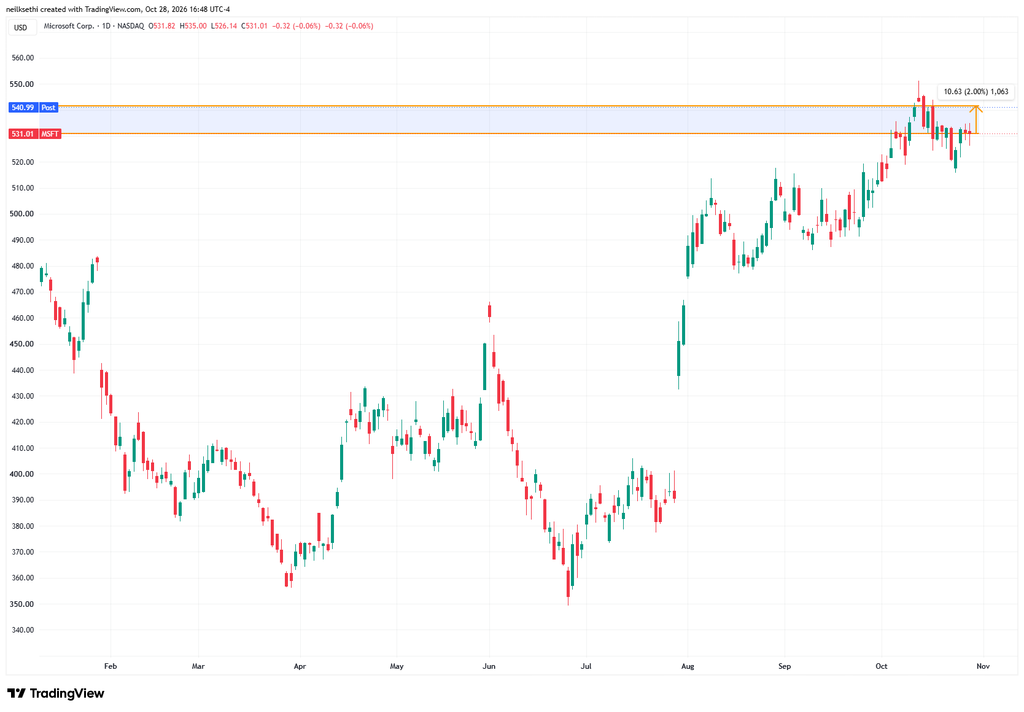
Adjusted earnings came in at $4.89 per share versus the $4.73 consensus, and revenue was $92.28 billion against the $90.69 billion expected, according to TipRanks. Revenue rose 19% year over year and landed $1.33 billion above the top of the company’s own $89.85 billion to $90.95 billion guidance range, per TIKR. GAAP earnings rose 32% to $4.92 per share, including a $207 million net gain from Microsoft’s OpenAI investments, according to the company’s earnings release.
Margins widened even as depreciation climbed. Operating income rose 21% to $45.9 billion, lifting the operating margin to 49.8% from 48.9% a year ago, per the release. Gross margin slipped to 67.8% from 69.0% as depreciation and amortization rose 44%, but operating expenses grew just 6%.
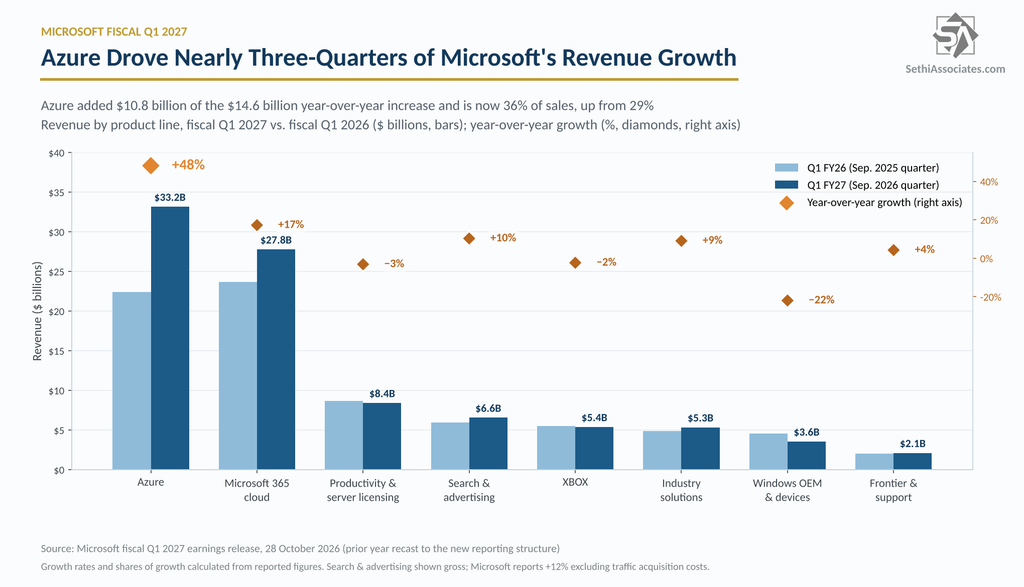
Azure (cloud) revenue grew 48% to $33.17 billion, the first quarter Microsoft has reported Azure in dollars, according to the release. That topped the $32.32 billion analysts expected, per TipRanks, as well as the 44.8% growth rate analysts had modeled, per TheStreet, and the roughly 47% “whisper number” among institutional investors, according to MarketWatch. Azure grew 42% in the June quarter under the new, narrower definition, per CNBC.
Per Claude, Azure supplied $10.8 billion of the $14.6 billion year-over-year revenue increase, or about 74%, and now makes up 36% of total revenue versus 29% a year ago. Revenue outside Azure grew about 7%. Microsoft Cloud revenue rose 30% to $63.9 billion, with Chief Financial Officer Amy Hood noting growth accelerated, per the release. Microsoft 365 cloud revenue of $27.78 billion also topped the $27.37 billion consensus, according to TipRanks. Azure is now Microsoft’s largest product line, ahead of Microsoft 365 cloud.
Capital spending came in about $5 billion below expectations even as Azure beat. Capital expenditures including finance leases rose about 30% to $45.2 billion, short of the $50.67 billion StreetAccount estimate, according to TipRanks, and below the more than $50 billion Microsoft had signaled for the quarter, per TIKR. Cash spending on property and equipment more than doubled to $39.4 billion from $19.4 billion, according to the release. Microsoft attributed the faster growth in cash spending to timing differences between receiving and paying for goods and “a lower mix of finance leases,” according to CNBC.
Free cash flow fell 27% to $18.63 billion but stayed positive, according to TipRanks. By contrast, Alphabet ($GOOGL), which also reported Wednesday, posted negative free cash flow for its quarter, per TipRanks, and shares are down over 8%.
Microsoft returned $10.2 billion to shareholders through dividends and buybacks, per the release.
Commercial backlog stalled sequentially. Commercial remaining performance obligation rose 73% year over year to $677 billion, according to the release, but that was little changed from $678 billion at the end of June, per Quartz, and short of the roughly $706 billion estimate cited by Wall St Engine.
This was the first report under Microsoft’s new two-segment structure. Agents and Infra revenue rose 25% to $76.8 billion, ahead of the $75.6 billion expected, according to Yahoo Finance. Devices and Consumer revenue fell 3% to $15.48 billion but beat the $15.05 billion consensus, according to TipRanks. Within it, Windows OEM and devices fell 22%, which CNBC attributed to higher memory and storage costs pushing up device prices. Xbox content and services fell 2%, while search and advertising revenue excluding traffic acquisition costs rose 12%, per the release.
Microsoft holds its conference call at 5:30 p.m. ET, where it will provide forward guidance, according to the release. Some key items on the call are the fiscal second-quarter Azure growth outlook, whether the capital spending shortfall reflects timing or a slower build, and what explains the flat sequential backlog. Wall Street rates the stock a consensus Strong Buy with an average price target of $611.85, per TipRanks.
Bookings shrunk and backlog did not grow!
The after-market move in Microsoft (MSFT) reminds me of the up move Meta ($META) had based on the print and EPS, before the market figured out the internals — and then hammered the stock.
Obviously Google ($GOOGL) wet the bed too:
https://www.zerohedge.com/markets/msft-rises-azure-beat-bookings-shrink-and-backlog-stalls
Position: None
* Here are my thoughts following the plethora of EPS releases after the close…
With Google’s ($GOOGL) miss (the deceleration in its core business was unanticipated by every panelist on “the show”), Meta’s ($META) continued awful share price action, Nvidia’s ($NVDA) price rollover threatening chart support, Amazon’s ($AMZN) lackluster share price action (and underperformance) and some possible toppiness in Apple’s ($AAPL) share price, we are left with one… Microsoft ($MSFT).
Meanwhile, ServiceNow’s ($NOW) disappointing results (the company cut subscription revenues for the full year) will likely weigh heavily on software stocks (which were market leaders) tomorrow morning.
I remain independent in view.
As I said in response to subscriber jryan, most stocks do not meet my standards to buy and I won’t change my process or discipline — even if Perma Bulls Tom Lee and Dan Ives (confidently) see clear skies ahead…
The S&P Short Range Oscillator registered 1.84% (more overbought than the prior day) and I ended the day with a large short positioin in $SPY.
Position: Short SPY (L)
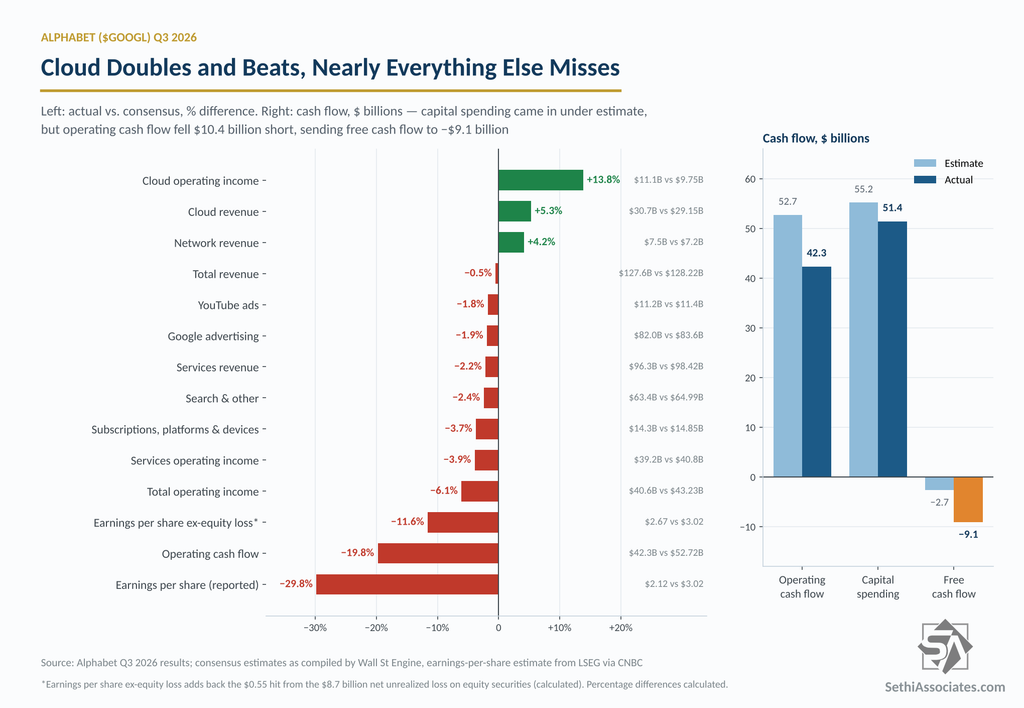
Alphabet ($GOOGL) shares are down over 8% in after-hours trading Wednesday after third-quarter revenue and earnings missed expectations, and a blowout quarter from Google Cloud was overshadowed by softer core advertising which heightened concerns about its search business, and a swing to negative free cash flow.
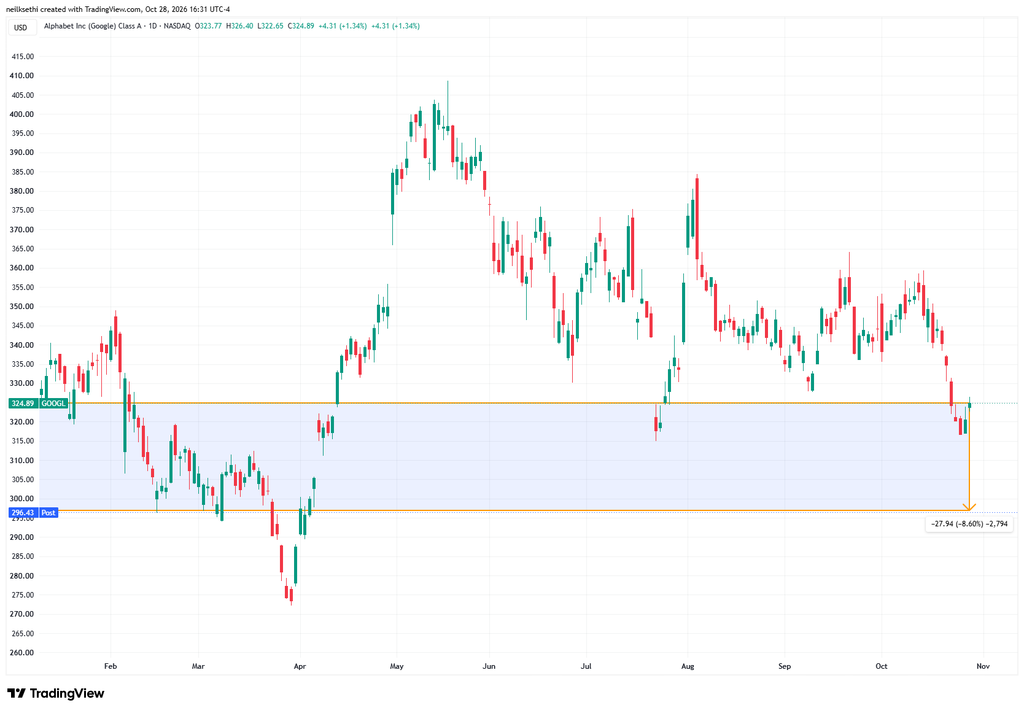
Revenue climbed 24.7% year over year to $127.58 billion, missing expectations of $127.96 billion, according to TipRanks.
Earnings came in at $2.12 a share against the $3.02 consensus estimate. Much of that gap came from about $8.66 billion in losses on stakes Alphabet holds in other companies, which cut 55 cents from earnings per share after taxes. Without that hit, earnings would have been about $2.67 a share, still short of the estimate. That marks a sharp reversal from the second quarter, when other income was a $98.0 billion gain, mostly from gains on its equity holdings that added $6.26 to earnings per share, according to the company’s second-quarter release.
Cloud was the standout. Google Cloud revenue more than doubled to $30.7 billion from $15.16 billion a year earlier, topping the $29.15 billion analysts expected, per TipRanks. The unit’s $11.1 billion in operating income puts its margin at about 36%. The company said its custom-chip business was a “meaningful contributor to revenue growth.”
The rest of the business was mixed. Search revenue rose 12% to $63.35 billion but missed the $64.96 billion estimate, according to CNBC. “This may be the quarter we feared,” Gil Luria from D.A. Davidson told CNBC’s MacKenzie Sigalos
YouTube ad revenue of $11.21 billion fell short of the $11.5 billion Wall Street expected, per TipRanks. Subscriptions, platforms and devices revenue grew 11% to $14.29 billion. Cloud revenue has now climbed past YouTube’s ad revenue, per TipRanks’ segment data.
Operating income still grew 30% to $40.58 billion, even as research and development spending jumped to $20.64 billion from $15.15 billion, TipRanks noted. That operating income figure missed the $43.19 billion FactSet forecast, though, per CNBC.
Cash flow was the sore spot. Capital expenditures more than doubled to $51.36 billion from $23.95 billion a year earlier, and free cash flow fell to negative $9.07 billion, against the negative $2.70 billion analysts expected, according to CNBC. Alphabet bought back no stock in the quarter.
“Google Cloud revenues grew 103%, powered by huge demand for our AI infrastructure and AI solutions,” CEO Sundar Pichai said in the earnings release. He added that the Gemini app has reached 1 billion users, making it the company’s fastest-growing product ever.
I’ll put an update out in the morning if anything notable comes out on the call.
Oracle reassurance moved the market more than the Fed did.
No one has an edge in guessing how a stock will react to earnings. The edge comes from having a plan for every outcome.
SK Hynix and ASM International see tight chip capacity, here comes Fed Chair Kevin Warsh and other headlines moving the market this morning.