Anthropic Rocks Wall Street


The market parties on Anthropic filing (as company warns it might need more cash, and signals AI may take coding jobs and have catastrophic risks to mankind).
The market parties on Anthropic filing (as company warns it might need more cash, and signals AI may take coding jobs and have catastrophic risks to mankind).
Anthropic needs Broadcom guarantees to obtain massive loans.
Anthropic token pricing still needs to halve to match OpenAI.
Anthropic has a non-differentiated product, so it seems inevitable. And OpenAI is still at a big premium to open source. Something tells me this all keeps going down, by a lot!
—
Strap in, the rest of the “More” is a long one.
Two parts.
First on compute prices, then on the coming depreciation bolus and its implications.
Nvidia ($NVDA) and the tech bros are all in lock step with the talking points. Not too different from the political parties who distribute talking points to the media, which nods in bovine agreement, and just repeats them, without thinking, or even caring, due to whatever agenda they personally have. Now the talking point, out of desperation, is “the price of compute is going up.” Here is the latest propaganda, from Nvidia, and echoed by one of the VCs, and this is now all over the place:
This is terribly misleading. Spot is a tiny (and apparently manipulated) market, and the data itself spotty (pun intended) at best. There are anecdotal stories that Nvidia pressures their smaller partners to hold spot rates up (on the surface at least as discounting and other terms will not be captured by these charts if the data is even real to begin with). This may be done to present the notion that chips and equipment are somehow not depreciating assets, such that they can be used as collateral for financing deals. Anyone speculating on chips or lending against chips on the basis of incomplete and misleading spot compute price data deserves to lose their money.
Power is actually the binding constraint for compute. This is why the quoted price for compute, including for older parts, has gone up in theory. Power is the marginal constraint for the marginal market.
But underneath it all the chips and hardware are depreciating like they always do, which is rapidly. It should not be too hard to understand that the price of compute could go up due to power being a constraint, while the underlying hardware is still depreciating. Think of it this way, if the chips and equipment were removed, and sold on the open market, and needed to be placed elsewhere, what value would it have? The value of this stuff is independent of what the price of in place compute with power can be sold for.
But thinking would ruin another Hail Mary story, I guess. It is interesting that power is the marginal constraint, but nobody is talking about paying 100x PE for the local utility company.
Then, of course, nearly all of the revenue in the space is actually on LT contracts, so CoreWeave ($CRWV) et al do not benefit from spot. The credit markets realize this at least. I think spot compute is generally sold by smaller marginal players.
But apparently, one of the big investors in the space does not realize that, or just dissembled, or both. Here is the big cheese at Blackstone ($BX) echoing the spot compute price talking point:
Also, elevated spot pricing will not materially help the CoreWeave’s of the world to sign contracts for new business at higher prices, because big customers do not need CoreWeave to build capacity for them. If the price for compute was set at a level to yield more than a minor return, big players would just build it themselves. The only reason they use CoreWeave to begin with, is CoreWeave basically gives it away, as is evidenced by their lack of P&L and their balance sheet. This is why they report earnings before expenses, and sell their own stock like crazy.
If I remember correctly Blackstone was piling into real estate at the peak in 2008 and also telling us how wonderful the fundamentals were. Bailed out by the Fed, so history repeats. But something tells me this time around the Fed no longer has the dry powder it used to, and Fed Chair Warsh is less inclined to resort to the same money-printing shenanigans.
Spot compute will have to head the way of token prices, in my view. A significant portion of the demand side for spot compute also comes from the aforementioned VC startups that seemingly account for 70-80% of demand, many of whom will likely cease to exist, and before that happens, will have to meaningfully slow their burn rates.
There is excess stuff everywhere as well. There was the story that emerged last week with regard to Amazon ($AMZN) sitting on racks of components and servers in warehouses, with no place to put them. And now this story about companies with so many excess GPUs, they sit idle half of the time:
At any rate, look who agrees with me about the power issue and the price of spot compute, as well as a glut of equipment and chips sitting idle which will be stranded. Chamath Palihapitiya, and Elon Musk of all people! Musk actually indirectly makes my point that the value of chips and equipment are independent of the price of compute quite clear when he talks about if anything is missing, the compute does not work. See the tweets to follow.
“This is a fuller list of the limitations of supercomputer buildout. If anything is missing, however seemingly trivial, the compute doesn’t work.”
I guess Musk is chiming in because he believes he has all the power lined up that he needs. Again, this is part of why is Amazon holding on to a bunch of chips and servers in warehouses. There has been massive forward buying of chips and equipment, that are sitting around doing nothing. This is what Musk is referring to as stranded capacity.
Anyway, spot compute is a tiny market and misleading. The real issue is power. The demand for spot compute is coming from garbage VC startups that won’t be around much longer either. Underneath it all, the chips and equipment are still depreciating rapidly like they always do. The intrinsic value of the chip has nothing to do with spot compute price. And spot compute price, if we even can get accurate data, will soon follow token prices for a variety of reasons. More supply is coming on line regardless, and the demand is coming from a lot of garbage companies that will not be around. End of day, the chips and equipment follow a normal depreciation curve, and using spot compute to suggest otherwise is B.S.
Then CoreWeave at al do not benefit from spot anyway, because their biz is on LT contract. The credit markets, at least, understand this.
Live by the sword, die by the sword with the spot compute charts, that are sketchy at best to begin with. We know where the price of spot compute is going to go next. And you never own these types of stocks when you almost know the 2bd derivative of this stuff is about to go the other way, and then the whole thing will head down. You buy when the data is close to bottoming, not topping.
At any rate, it seems like an ugly situation is on the come for a variety of reasons:
On a related note, below is another great chart and analysis on the amount of depreciation on the come for the big hyperscalers.
Think of all the profits needed to cover the coming increase in depreciation. The amount of depreciation expense that will hit by 2029 exceeds their current combined operating profits. But reality is you can already see this from looking at the balance sheets and cash flow statements. Meta ($META) and Amazon are already cash flow negative. Nvidia earnings are not all they are cracked up to be either, as cash flow tells a different story due to all the money that keeps going out the door as they continue to function as the central bank of Nvidia and lender of last resort to keep buying their own revenue.
Per the chart, as usual the sell-side models at the individual company level are all B.S.
They do not flow enough depreciation into the P&L going forward.
They make up too much revenue on the come in the future.
Then they assume much too high of a margin on that revenue, especially given all the capacity coming on line, that will have to be sold.
It is all made-up crap.
Nobody can win now. There is too much capacity that has been put in place. Prices will have to be cut massively to sell the capacity. Think of the amount of revenue needed to absorb all of this. We are probably at multiples of world GDP at this point.
The whole earnings growth story that has been driving these companies, and equities overall (which is really just these companies), forget about it. With this much depreciation on the come, it is quite challenging for earnings to grow. Stagnant earnings, frankly, would be a good outcome relative to what might actually happen.
Post Script
Apollo’s Torsten Slok warns about the ROIC failure of AI:
And more…
Position: None
AI demand may be booming, but SpaceX’s ability to shift GPU capacity gives it a flexibility most neocloud operators lack.
Meta’s earnings, P&G’s warning and other headlines moving the market this morning.
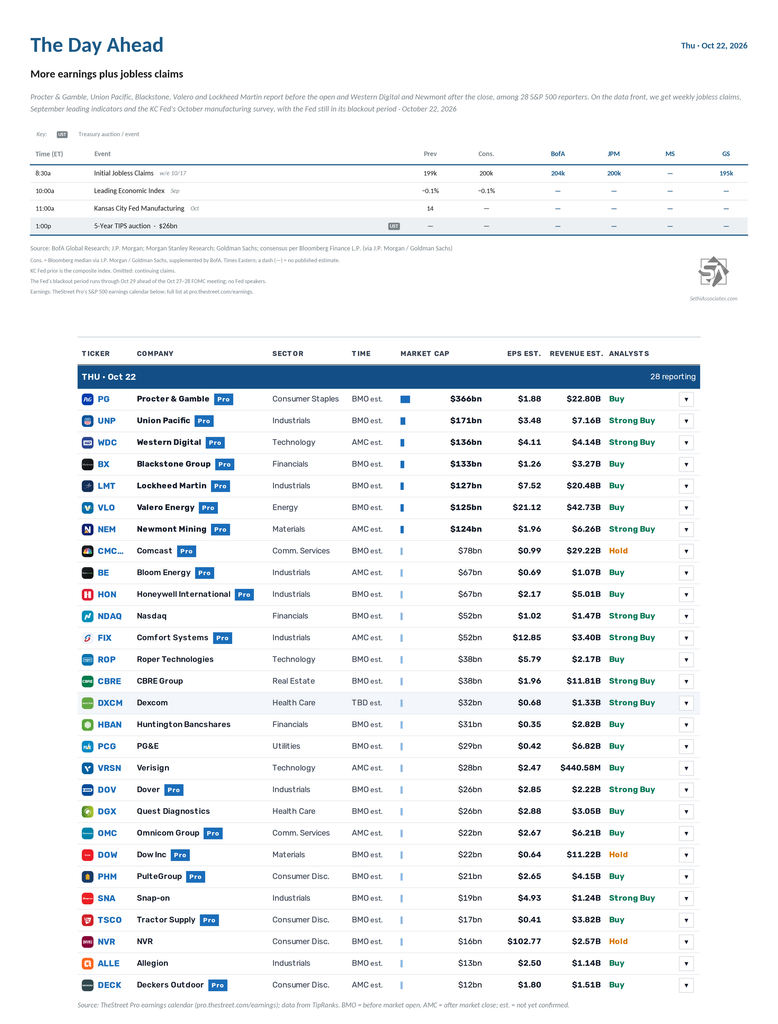
US economic data remains light with weekly jobless claims, September leading and coincident indicators and the Kansas City Fed’s October manufacturing survey.
The Fed remains in its blackout period ahead of next week’s October 27–28 FOMC meeting.
Non-Bill (>1yr in maturity) US Treasury auctions continue with a $26bn 5-year TIPS auction.
Q3 earnings season continues with 27 S&P 500 components: Procter & Gamble ($PG), Union Pacific ($UNP), Western Digital ($WDC), Blackstone ($BX), Valero Energy ($VLO), Lockheed Martin ($LMT), Newmont ($NEM), Comcast ($CMCSA), Norfolk Southern ($NSC), Bloom Energy ($BE), Honeywell ($HON), Nasdaq ($NDAQ), Comfort Systems USA ($FIX), CBRE Group ($CBRE), PG&E ($PCG), Roper Technologies ($ROP), Huntington Bancshares ($HBAN), VeriSign ($VRSN), Quest Diagnostics ($DGX), Dover ($DOV), PulteGroup ($PHM), Dow ($DOW), Snap-on ($SNA), Tractor Supply ($TSCO), NVR ($NVR), Allegion ($ALLE) and Deckers Outdoor ($DECK).
Ex-US highlights are France October business confidence, EU27 September new car registrations, Eurozone October consumer confidence, Canada September industrial product price index, and a policy decision in South Korea.
Blowout SpaceX results lifted a swath of AI names, sending the Nasdaq up over 1%.
Elice differs from the likes of CoreWeave even as its shares descend 32.0% on IPO day.
AI worries are pressuring Tech and sending yields lower as we embark on a heavy earnings week including several names in the cross-hairs.
Another selloff in AI names broadened to encompass most of Tech, sending the Nasdaq-100 to its worst week since April 2025. Five sectors though would finish the week up 2% or more, as 30-year Treasury yields fell the most since April 2025.