3M Rising on Amazon Deal

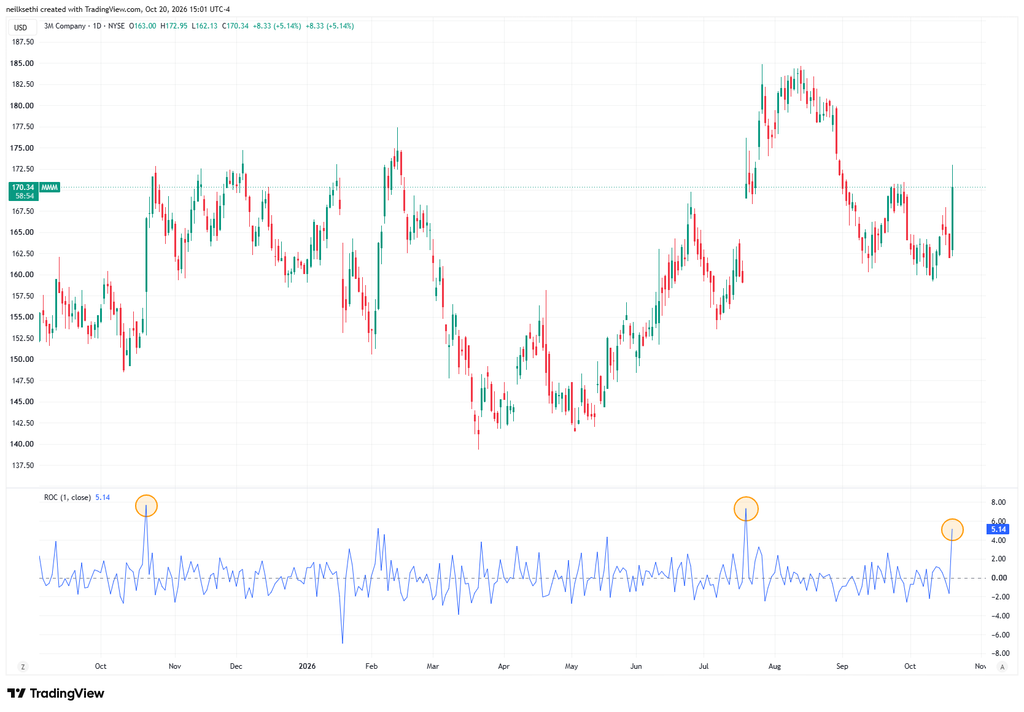
3M ($MMM) is up over 5%, on track for its best day since July, and second best since last October, after expanding its relationship with a wholly owned subsidiary of Amazon.com, Inc. ($AMZN). Under the deal, 3M issued warrants for the purchase of nearly 3.2 million shares of the company over seven years tied to the amount of spending from Amazon on “expanded beam optical ferrules,” which can can connect servers in seconds rather than minutes, taking six months off a data center’s construction time, the company says according to the WSJ.

Eighty-five percent of the warrant shares will vest based on Amazon’s cumulative payments for 3M’s optical connectivity and other data center offerings, with full vesting of that portion once payments reach $6 billion according to TipRanks.

Also helping was a beat on earnings and raise to its full year’s forecast. Adjusted earnings are expected to be $9.10 to $9.15 a share this year, up from a prior range topping out at $8.95. Analysts had anticipated $8.94 a share on average in estimates compiled by Bloomberg.

Tech Bounces Back but Rising Yields Pressure Non-Tech

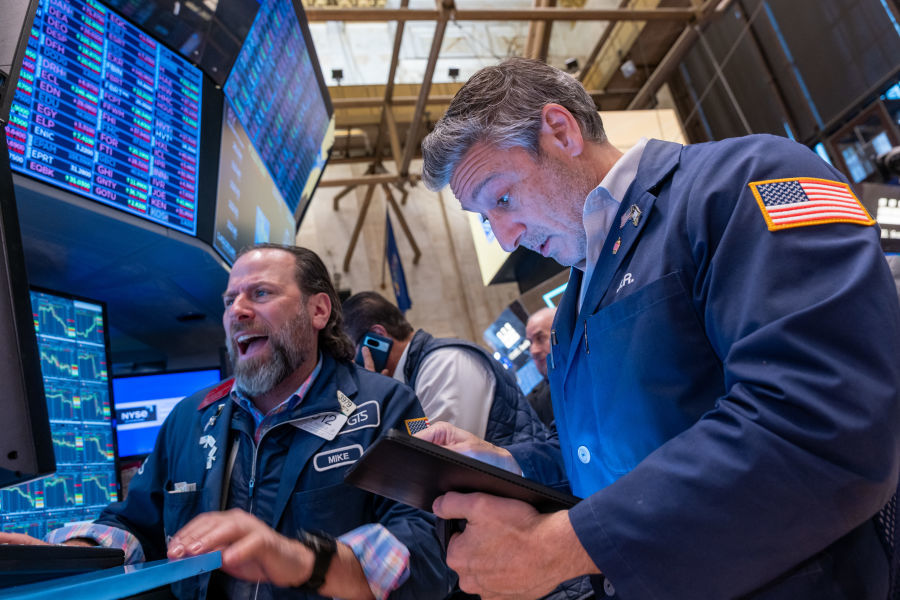
The megacap growth sectors went from worst (Friday) to first (Monday) as chipmakers snapped an eight-session losing streak, but rising Treasury yields left seven sectors, the Dow Jones Industrial Average, and the equal-weight S&P 500 lower.

Regrets I Have Had a Few… Recently

Regrets, I’ve had a few
But then again, too few to mention
I did what I had to do
And saw it through without exemption

I planned each charted course
Each careful step along the byway
And more, much, much more
I did it, I did it my way

– Frank Sinatra, My Way  Frank Sinatra – My Way | Live from The Main Event at Madison Square Garden (1974)

Few in the business take ownership of their losses and missed opportunities (long and short).

Every day I listen/view the B.S. of guests and panelists in the business media — as if they never made an investing or trading boner. Their insistence of buying lows and selling highs is disingenuous.

But I do take ownership of my screwups. 

As I have written, I am often wrong and always in doubt (and I mean that, as they are just not words).

Over the last four weeks I have had my share of blows — most recently in cannabis and Glass House ($GLAS) (which I will be discussing after speaking to management). After profiting and selling near the 52-week high, I sold my PepsiCo ($PEP) prematurely (after buying back near the 52-week low) — missing the last five-day advance from my sale price.

I failed to take advantage of excellent opportunities on the long side — specifically Microsoft ($MSFT) and Amazon ($AMZN), which I was poised to buy, but my ursine predilection held me back.

I also failed to take advantage of the opportunity set of individual short names. I saw “no broadening” and I took a quick and profitable trade shorting the Russell Index ($IWM) right at the highs, but I missed the big move (from $305 to under $280). I took a series of short-term gains in trading $SPY and $QQQ but missed the big (and playable) move down in the Nasdaq.

So…

My national anthem… but you need not rise!

My friends I have made it clear and I have stated my (bearish) case of which I am certain.

I have travelled each and every highway.

But more, more than this I did it my way.

Regrets I have had a few recently.

I grew tall through it all and did it my way.

I’ve loved, laughed and cried

I had my fill, my share of losing.

And now, as the tears subside.

I still don’t find that it’s all so amusing.

I took the blows but did it my way.

Position: Long GLAS (S)

The Fall of 2026 Is Starting to Resemble the Spring of 2000

* But there are important differences which will likely produce more muted downside to the hyperscalers and more muted upside to consumer staples…

“History doesn’t repeat itself, but it often rhymes.”

– (Attributed to) Mark Twain  

The U.S. stock market is starting to look like the spring of 2000 when the dot-com boom came to a halt and technology began a steep slide. At the same time, consumer non-durable (staples) stocks  (as well as Berkshire Hathaway ($BRK.A $BRK.B) have began to perform well both absolutely and relatively.

There are, however, deep differences in both periods of time.

* Today’s large-cap technology stocks (as opposed to the dot-com stocks) have deep moats and though their commitment to massive AI spending has transformed some of the tech equities from capital light to capital intensive, they have maintained  strong operating and profit profiles. Unlike 26 years ago, the Mag 7 represents a large percentage of the indices — which, amid a backdrop of passive products and strategies (ETFs, quants), means that investor inflows go into and directly/steadily support/buoy the shares of Nvidia ($NVDA), Amazon ($AMZN), Microsoft ($MSFT), Alphabet (GOOGL), Micron ($MU), Sandisk (SNDK) and Meta ($META).  

* Today’s defensive consumer staples have faced the competitive threat of generic and unbranded products over the last 15 years. In more recent years, they’ve encountered the introduction of GLP-1 agonists (a new class of medications that can help manage Type 2 diabetes and obesity (by reducing appetite). Unlike 26 years ago, a combination of these two factors are pressuring consumer staples’ top and bottom lines.

As  a result of these differences, the downside to the Mag 7 constituents (and memory and semiconductors) is much more muted than 2 1/2 decades ago (vis a vis dot-com ‘ers). And the upside to the classically defensive consumer non-durables is also more limited than 2 1/2 decades ago.

Importantly, given the rise in the risk-free rate of return (using the 10-year Treasury note) to almost 5.3% suggests to me that rather than find a home in the consumer staples space, it is more likely that market participants will seek refuge in fixed income.

Tactics

Though hyperscalers and semis/memory stocks are beneficiaries of a changed market structure, we own no large-cap tech stocks (and are short some on the periphery of Mag 7) because of our AI reservations and concerns. (See our 260 issues of the  “More Tales From Nvidia” series).

We have previously taken a position in consumer staples — Kimberly-Clark ($KMB), PepsiCo ($PEP), Coca-Cola ($KO) and Procter & Gamble ($PG). But, given the profit threats, we have treated the space more as “trading sardines” and have recently trimmed all four on strength. (Earlier in the week we got lucky and sold the sharp ramp in PEP shares and sold out of the very small balance yesterday on news that KFC has ditched PepsiCo for Coca- Cola.)

Position: Long KMB (VS), KO (VS), PG (VS)