Micron Hits Price Target: Should We Buy, Sell or Hold?


Just one month ago, on May 27, we set a new price target for shares of Micron ($MU). That target of $1,150 was reached on Monday, when shares of the Boise, Idaho-based semiconductor manufacturer soared as high as $1,204.
Micron successfully completed an A-B-C-D pattern that formed over the past three months.
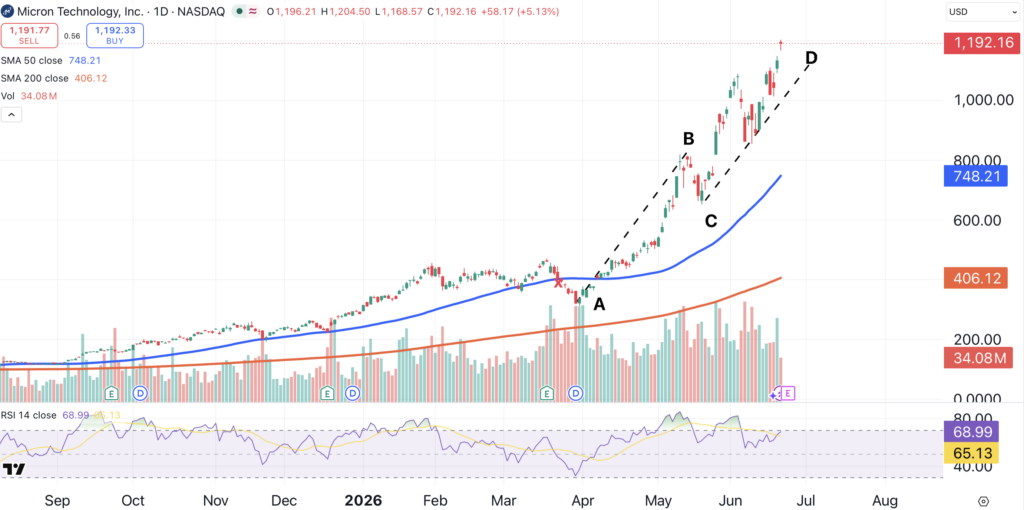
We initially recommended this stock at $127, almost exactly two years ago. Micron has a legitimate chance to 10X that recommendation when it reports earnings after the close on Wednesday.
The numbers on this stock are absolutely stunning:
- A gain of 853% since our initial recommendation on June 28, 2024.
- A 284% year-to-date increase
- A gain of 61% over the past month
Micron Reports Earnings on Wednesday
Are we going to hold the stock into earnings? Absolutely, yes.
Are we going to trim the position ahead of earnings? Also yes. Here’s why:
Imagine a portfolio of 50 investments, each comprising about 2% of the overall portfolio. Some rise and some fall, but one position just keeps running. Eventually, it comprises over 10% of the portfolio.
As long as our mystery position continues to climb, it is pulling the entire portfolio along with it. However, if it reverses, its now-disproportionate size could drag us down.
Strong Stock, Strong Sector, Strong Market
On the other hand, how can you sell at a time like this? The stock is at all-time highs, and sits within the hottest sector. Not just the hottest sector in the market, but the hottest we’ve seen in years.
Meanwhile, stocks remain tantalizingly close to their all-time highs. What if this bull still has a long way to run?
Perhaps we can reach a compromise.
A Sacrifice to the Market Gods
We’re not going to sell a significant amount of our Micron position, but perhaps we can sacrifice just a bit of it to appease the market gods.
Let’s assume we started with 100 shares at $127 per share:
Initial investment = $12,700
Current value = $121,100 (as of Monday’s close).
Why not just eliminate all risk from the trade?
House Money
Assume we sell 11 shares, or 11% of the position. 11 x $1,211 = $13,321. This is slightly greater than our initial investment of $12,700.
You’ve now recouped your initial investment, and the remaining 89 shares are pure profit.
Meanwhile, you still own the vast majority of your position, so additional gains are possible. You can always trim more shares later, if appropriate.
Bottom Line
Some traders have difficulty cutting losses. Others have trouble holding winners. This risk management idea is aimed at the latter group.
There are few things more frustrating than exiting a good position too soon. Psychologically, it’s easier to hang in there if you reduce risk, or if possible, remove it from the trade completely.
At the time of publication, Ponsi was long MU.
