Housing Market Feels Like It’s Built on a Sinkhole


Why do I write so much about housing? The health of the housing market is a key component of consumer sentiment. Home building and housing-related activity, in fact, account for roughly one sixth of U.S. gross domestic product. And yet housing activity has been moribund for four years now. Existing home sales since 2023 have run at their lowest levels since 1995, when the U.S. population was roughly 20% smaller.
We had some genuine hope at the start of 2026 for at least a slightly better housing backdrop. Expectations were that the Federal Reserve would cut the Fed Funds rate twice by a quarter percentage point this year as inflation continued throughout the year. And the 30-year mortgage rate did briefly dip to just below 6% in February.
But, then, the latest misadventure in the Middle East commenced, triggering a big surge in a variety of energy and commodity prices. This has pushed inflation higher with the September producer price index reading being at the highest level since early in 2022. Yields on the 10-Year treasury pushed to its highest threshold since 2002 earlier this month. Thirty-year mortgage rates have shot up past the 7% mark. Condo and single-family home inventories are at their highest levels in more than a decade.
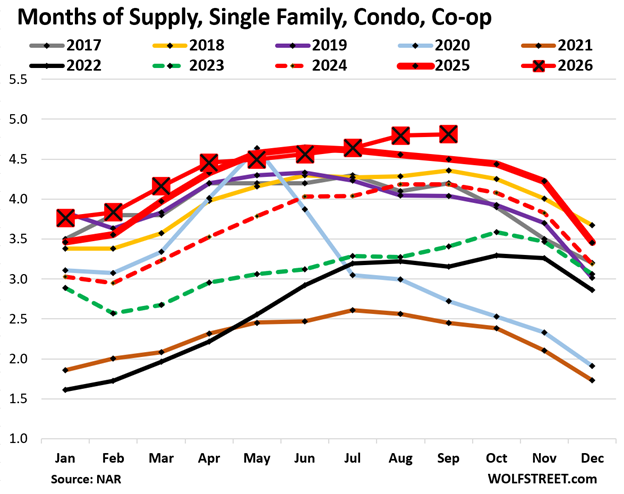
This has resulted in a housing market that has gone from bad to worse. And there have been plenty of signs of this worsening trend this week. September pending home sales hit their lowest levels in a quarter of a century. Housing starts for both August and September fell over 5% on a month-over-month basis. And multi-family starts have fallen sharply from July to September. Home builder sentiment hit a 14½-year low this week. It is a good thing there has been a massive surge in data center buildouts, or there would be significant job losses across the construction industry.
A couple of large home builders reported third-quarter results this week as well. M/I Homes ($MHO) posted Q3, posted on Wednesday, missed on both the top and bottom lines. Revenues fell over 4% year over year and earnings per share were 60 cents below the consensus. Net income fell 37% from the same period a year ago. The stock’s book value is now roughly ten bucks a share above the equity’s current trading level.
It was much the same story at PulteGroup ($PHM) when the giant homebuilder reported its third quarter Thursday showing sales dropped more than 9% from the same period last year. Gross margins declined 140 basis points to 24.8%. Interestingly both these home builder stocks moved up in a dismal tape on Thursday, despite earnings misses. This points to how dismal investment sentiment has become on this sector and might be signaling we are getting closer to a bottom. More likely they rose as the yield on the 10-Year treasury fell sharply yesterday. In fact, it was the biggest single-day plunge in over three years.
At some point we will see some great bargains in both home builder stocks and residential real estate in some regions of the country. Whether that unfolds in 2027 or 2028 is unclear. What is clear is that right now the housing market is deteriorating at an accelerated pace.
At the time of publication, Jensen had no position in any security mentioned.
