Europe Gives a Lesson in the Danger of Relying on Commodity Forward Curves

Europe’s natural gas squeeze is back, and this time a meaningful part of it is self-inflicted. Dutch TTF futures, the continent’s benchmark, topped €100 per megawatt-hour (MWh) on Wednesday for the first time since December 2022, more than triple their level before the Iran war began, before easing to about €98 on Thursday.
While the trigger came from outside Europe with the disruptions in the Strait of Hormuz, Europe had a window this spring to rebuild its buffer at less than half today’s price, and it largely let that window pass.
The Refill Window Europe Let Pass
EU storage came out of last winter at about 28% full in early April, down from 35% a year earlier. Typically this would be cause for much concern, but prices then eased after the April 8 U.S.-Iran ceasefire. TTF fell below $15 per million British thermal units, and front-month futures averaged €45.77/MWh from April through June, by Claude’s calculation from NYMEX daily settlements, with a low of €38.77 on April 17.
That was the time to buy. Instead, injections in early May were running about 20% below a year earlier, and Argus Media found May through July injections ran 14% below the five-year average, with LNG imports from April through July down 5.34 million metric tons from a year earlier.

Why Nobody Filled the Tanks
As become common in recent years, TTF summer-winter spreads turned negative at the start of April, averaging about a negative €1.20/MWh, after the curve had already inverted in January on expectations that a wave of new LNG export capacity, in part from the Mideast, would loosen supply later in 2026. With winter gas priced below summer gas, buyers held off, and the EU has no common mechanism to encourage injections, leaving it to individual member states.
The lesson is a forward curve is a market price, not a forecast. The curve reflected the consensus view that LNG supply would loosen. It could not price the risk of the reclosure of Hormuz, and storage exists precisely to insure against that kind of tail risk. Europe effectively let the forward curve decide how much insurance to buy.
The Lesson Cuts Both Ways
In fairness to Brussels, the rigid alternative was costly too. The EU’s storage regulation, adopted in 2022 after Russia’s invasion of Ukraine, required 90% fill by November 1. Europe hit 95% on November 1, 2022, but TTF averaged about €151/MWh over that April-to-October refill season, by Claude’s calculation. By early 2025, the mandate itself was being blamed for distorting the market: fixed deadlines created forced buyers, and summer 2025 futures traded at a premium approaching €6/MWh over the following winter. The European Commission moved to ease the rules in March 2025, citing market speculation driving up refilling costs.
The result was a 2025 amendment letting member states fall up to 10 percentage points short of the 90% target under “difficult conditions,” including a low seasonal price spread or a high price environment. This year met both conditions, and the bar was effectively lowered to 80%. EU storage stood at 74.62% on October 26, 14.92 points below the five-year average for the date.
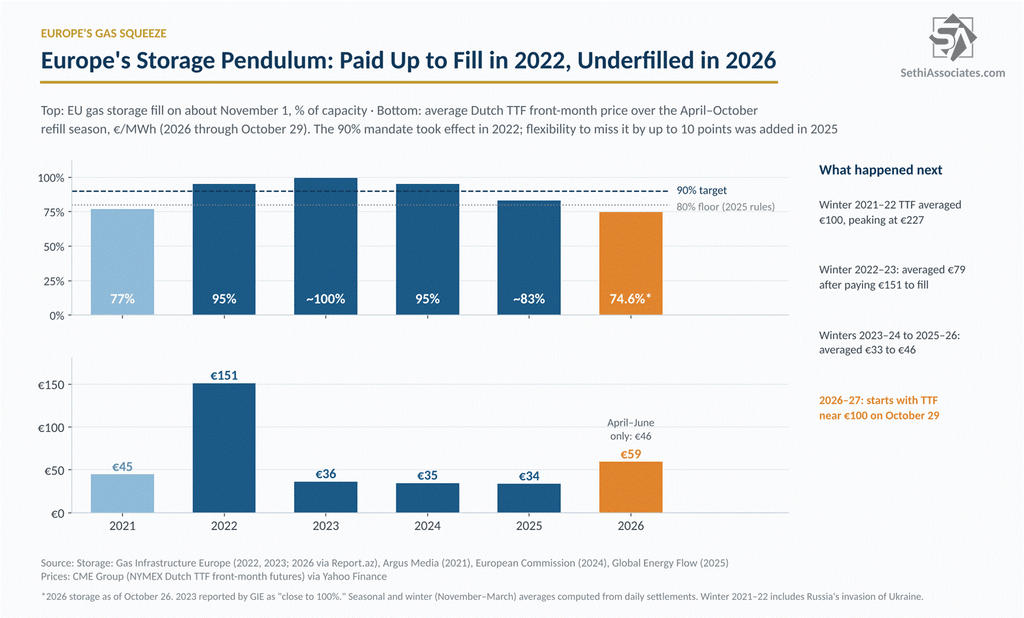
A warm winter, and all is well. But history offers a warning. The last time Europe entered winter this light, at 77% in 2021, TTF averaged about €100/MWh from November through March and peaked at €227, by Claude’s calculation, although Russia’s invasion of Ukraine in February 2022 drove much of that spike. Equinor ($EQNR) CEO Anders Opedal said storage is at its lowest for this time of year since 2011, warning that “there will be competition for LNG between Asia and Europe, especially if the weather turns cold.”
Weather Is Already Going the Wrong Direction
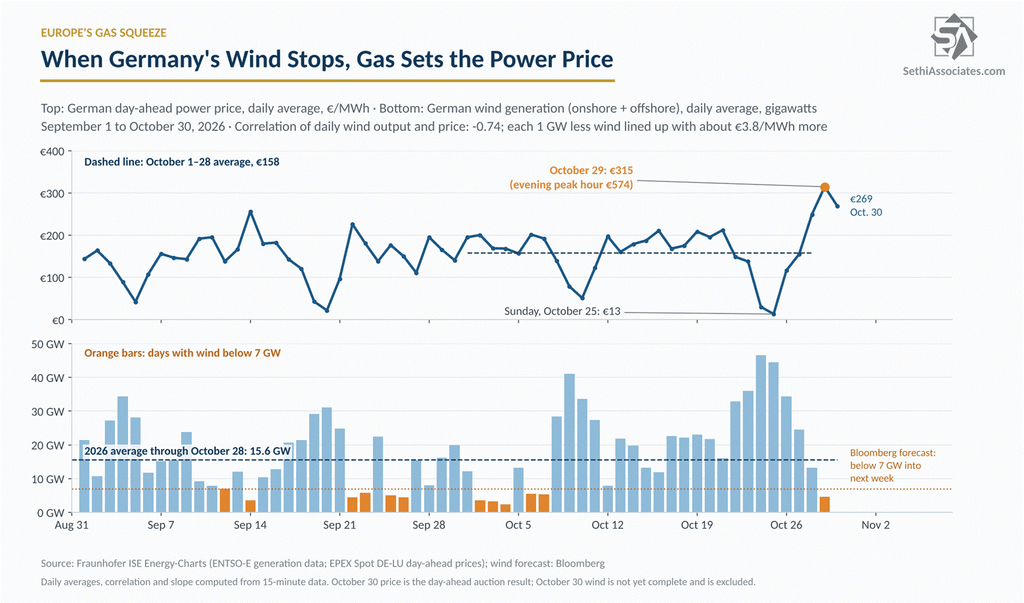
Europe is now in its first “Dunkelflaute” of the season, a stretch of cold, cloudy, windless weather that forces grids to lean on gas-fired backup generation. Bloomberg forecasts German wind output to stay below 7 gigawatts (GW) through next week, less than half the 2026 average of 15.6 GW, according to Fraunhofer ISE Energy-Charts data.
German day-ahead power for Thursday averaged about €315/MWh, roughly double the October average through Wednesday, with the evening peak hour at €574. On Sunday, with wind blowing at 44 GW, it averaged €13. Over September and October, daily German wind output and power prices have had a correlation of −0.74, with each gigawatt less of wind lining up with about €3.80/MWh more on the power price, by Claude’s calculation from Energy-Charts data. When the wind stops, gas sets the price.
What Waiting Cost
A rough sense of the bill: EU storage held about 811 terawatt-hours (TWh) on October 1, versus about 940 TWh a year earlier. Buying that 129 TWh gap at today’s price rather than the April-to-June average works out to roughly €7 billion more, by Claude’s calculation. That is illustrative, since buying that much more gas in spring would itself have pushed spring prices higher, but it shows the order of magnitude.
The downside could be much larger. Citi puts this winter’s TTF prices at €60 to €70/MWh if the Middle East conflict doesn’t escalate, €85 if it escalates without damage to LNG plants and €154 if liquefaction facilities are hit. Energy Aspects has warned that a cold winter with tight supply could push TTF above €200/MWh, against a U.S. equivalent near €8.50. Europe now has to outbid Asian buyers for spot LNG cargoes at more than twice the spring price, with a full ban on Russian LNG due to take effect in January. Applied to the 129 TWh shortfall, that’s anywhere from about €2 billion to more than €20 billion in extra cost compared with spring prices.

Who Benefits
The squeeze is a windfall for suppliers. Norway’s Equinor reported third-quarter adjusted operating income of $12.35 billion on Wednesday, its highest quarterly earnings since 2022, with a realized European gas price of $20 per million British thermal units. Its U.S.-listed shares have roughly doubled this year.
On the U.S. side, Cheniere Energy ($LNG) jumped 7.1% to a record close of $318.94 on Thursday after beating estimates and raising its 2026 guidance. Equinor’s Cheniere supply contract, 1.75 million metric tons per year, has now started. With TTF trading at nearly 12 times U.S. Henry Hub prices on Wednesday, by Claude’s calculation, the arbitrage that feeds U.S. LNG exporters remains wide open.
For investors, the broader point is that insurance never looks valuable when you buy it, but it becomes invaluable when you need it