My Comment of the Day

Dougie Kass
10m ago
I covered my $SPY short for a +$2 profit at $771.43
Positions: None
Dougie Kass
10m ago
I covered my $SPY short for a +$2 profit at $771.43
Positions: None
Positions: None.
* But there are important differences which will likely produce more muted downside to the hyperscalers and more muted upside to consumer staples…
“History doesn’t repeat itself, but it often rhymes.”
– (Attributed to) Mark Twain
The U.S. stock market is starting to look like the spring of 2000 when the dot-com boom came to a halt and technology began a steep slide. At the same time, consumer non-durable (staples) stocks (as well as Berkshire Hathaway ($BRK.A $BRK.B) have began to perform well both absolutely and relatively.
There are, however, deep differences in both periods of time.
* Today’s large-cap technology stocks (as opposed to the dot-com stocks) have deep moats and though their commitment to massive AI spending has transformed some of the tech equities from capital light to capital intensive, they have maintained strong operating and profit profiles. Unlike 26 years ago, the Mag 7 represents a large percentage of the indices — which, amid a backdrop of passive products and strategies (ETFs, quants), means that investor inflows go into and directly/steadily support/buoy the shares of Nvidia ($NVDA), Amazon ($AMZN), Microsoft ($MSFT), Alphabet (GOOGL), Micron ($MU), Sandisk (SNDK) and Meta ($META).
* Today’s defensive consumer staples have faced the competitive threat of generic and unbranded products over the last 15 years. In more recent years, they’ve encountered the introduction of GLP-1 agonists (a new class of medications that can help manage Type 2 diabetes and obesity (by reducing appetite). Unlike 26 years ago, a combination of these two factors are pressuring consumer staples’ top and bottom lines.
As a result of these differences, the downside to the Mag 7 constituents (and memory and semiconductors) is much more muted than 2 1/2 decades ago (vis a vis dot-com ‘ers). And the upside to the classically defensive consumer non-durables is also more limited than 2 1/2 decades ago.
Importantly, given the rise in the risk-free rate of return (using the 10-year Treasury note) to almost 5.3% suggests to me that rather than find a home in the consumer staples space, it is more likely that market participants will seek refuge in fixed income.
Though hyperscalers and semis/memory stocks are beneficiaries of a changed market structure, we own no large-cap tech stocks (and are short some on the periphery of Mag 7) because of our AI reservations and concerns. (See our 260 issues of the “More Tales From Nvidia” series).
We have previously taken a position in consumer staples — Kimberly-Clark ($KMB), PepsiCo ($PEP), Coca-Cola ($KO) and Procter & Gamble ($PG). But, given the profit threats, we have treated the space more as “trading sardines” and have recently trimmed all four on strength. (Earlier in the week we got lucky and sold the sharp ramp in PEP shares and sold out of the very small balance yesterday on news that KFC has ditched PepsiCo for Coca- Cola.)
Position: Long KMB (VS), KO (VS), PG (VS)
$KKR: Morgan Stanley lowered the firm’s price target on KKR to $138 from $147 and keeps an Overweight rating on the shares. With alts down about 27% year-to-date and positioning light, the firm sees upside for alternative asset managers despite near-term realization headwinds. Easing wealth redemption requests, robust institutional demand and resilient fee growth support the firm’s 2027 outlook and re-rating, the analyst tells investors in a research note.
$BX: Morgan Stanley analyst Michael Cyprys lowered the firm’s price target on Blackstone to $165 from $184 and keeps an Overweight rating on the shares. With alts down about 27% year-to-date and positioning light, the firm sees upside for alternative asset managers despite near-term realization headwinds. Easing wealth redemption requests, robust institutional demand and resilient fee growth support the firm’s 2027 outlook and re-rating, the analyst tells investors in a research note.
$APO: Morgan Stanley lowered the firm’s price target on Apollo Global to $150 from $164 and keeps an Overweight rating on the shares. With alts down about 27% year-to-date and positioning light, the firm sees upside for alternative asset managers despite near-term realization headwinds. Easing wealth redemption requests, robust institutional demand and resilient fee growth support the firm’s 2027 outlook and re-rating, the analyst tells investors in a research note.
$AAPL: UBS tells investors in a research note that Apple iPhone availability data shows year-over-year wait times down about 4 days for the Pro and flat for Pro Max, with recent week-over-week declines of 1 and 5 days, respectively, signaling limited estimate upside and potential demand elasticity concerns following Apple’s price increases. The firm maintains a Neutral rating and $296 price target.
$TSLA: JPMorgan keeps a Neutral rating on Tesla after the company unveiled its second-generation Roadster. The car “combines conventional automotive engineering with rocket propulsion technology,” the analyst tells investors in a research note. JPMorgan says production is targeted for 2028, compared with the original 2020 delivery target announced when the vehicle was first unveiled in 2017. Tesla did not disclose final pricing, battery capacity, driving range or anticipated production volumes, adds the firm. It points out that Tesla indicated the Roadster would eventually become its only manually driven vehicle as the broader portfolio transitions toward full autonomy.
$KO: Barclays raised the firm’s price target on Coca-Cola to $98 from $93 and keeps an Overweight rating on the shares. The firm adjusted targets in the consumer staples group as part of a Q3 earnings preview. The “band of interest” within consumer staples remains “quite narrow” as few companies offer a “dependably defensive outlook and attractive valuation,” the analyst tells investors in a research note.
Note: I covered all of my private equity shorts ($BX, $KKR and $APO) on Wednesday at lower prices than Thursday’s close. Yesterday I sold down my small $KO long on the Kentucky Fried Chicken/Pepsico news and as the shares of Coca Cola hit an all-time high.
Positions: Long KO VS
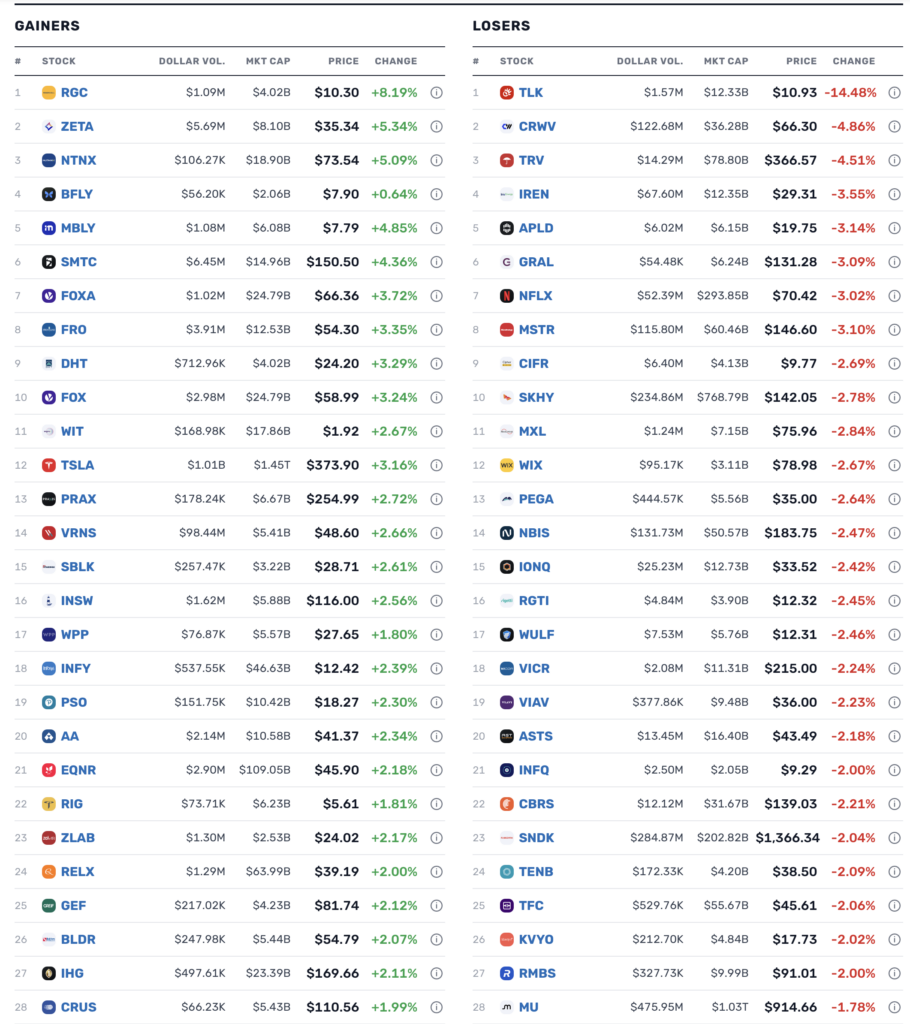
– $TCRT +25.0% (extends its surge after closing a PAH-focused biotech acquisition and securing about $350M of financing)
– $NCPL +19.0% (regains Nasdaq minimum-bid compliance)
– $SITC +18.0% (declares a $3.00 special cash distribution after an asset sale and plans to delist from the NYSE)
– $FFR +9.0% (launches the $2,490 FF Nova humanoid robot and outlines a proposed roughly $200M robotics combination)
– $ASM +6.5% (Roth/MKM upgrades to Buy from Neutral and raises its target to $8)
– $SMTC +4.0% (raises Q3 sales, operating-margin and EPS outlooks at its data-center analyst day)
– $TSLA +3.0% (unveils a redesigned Roadster featuring rocket-style thrusters)
– $STLA +3.0% (better-than-feared Q3 shipment update showed consolidated volumes down just 1% year over year)
– $FRO +3.0% (tanker shares rebound as geopolitical disruption continues to support shipping rates)
– $RBRK +3.0%, $VRNS +2.5% (cybersecurity names rise after VRNS agreed to a $6.3B all-cash acquisition)
– $NOK +2.5%, $AAOI +2.0% (networking and optical names gain after SMTC raised its data-center outlook)
– GUTS -53.0% (REMAIN-1 met its six-month co-primary endpoint, but 5.1% weight regain versus 8.2% for sham and a still-pending one-year co-primary fell short of elevated expectations)
– $JAGX -29.0% (special preferred-stock dividend was paid, with each preferred share set to convert into five common shares on November 2, intensifying dilution concerns)
– $MDXH -17.0% (suspends FY revenue guidance after preliminary Q3 revenue of about $22.7M)
– $TLK -15.0% (Indonesia ADR slumps after a warning that the country could face an emerging-market index downgrade)
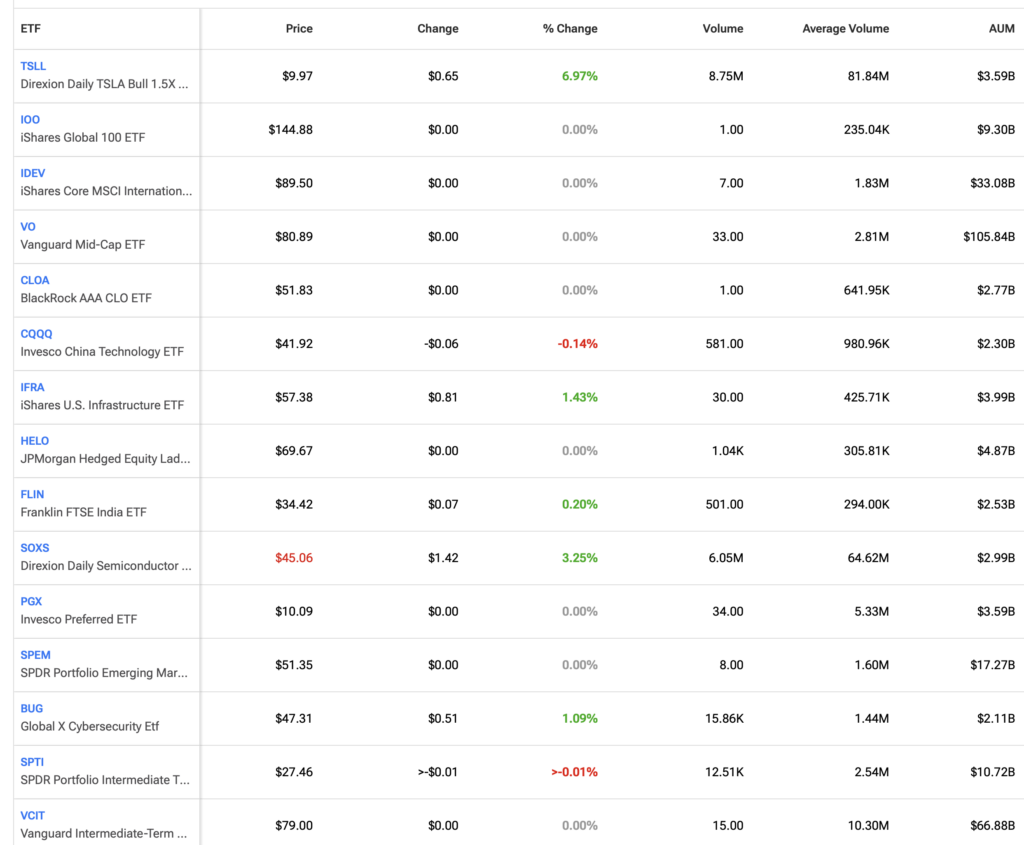
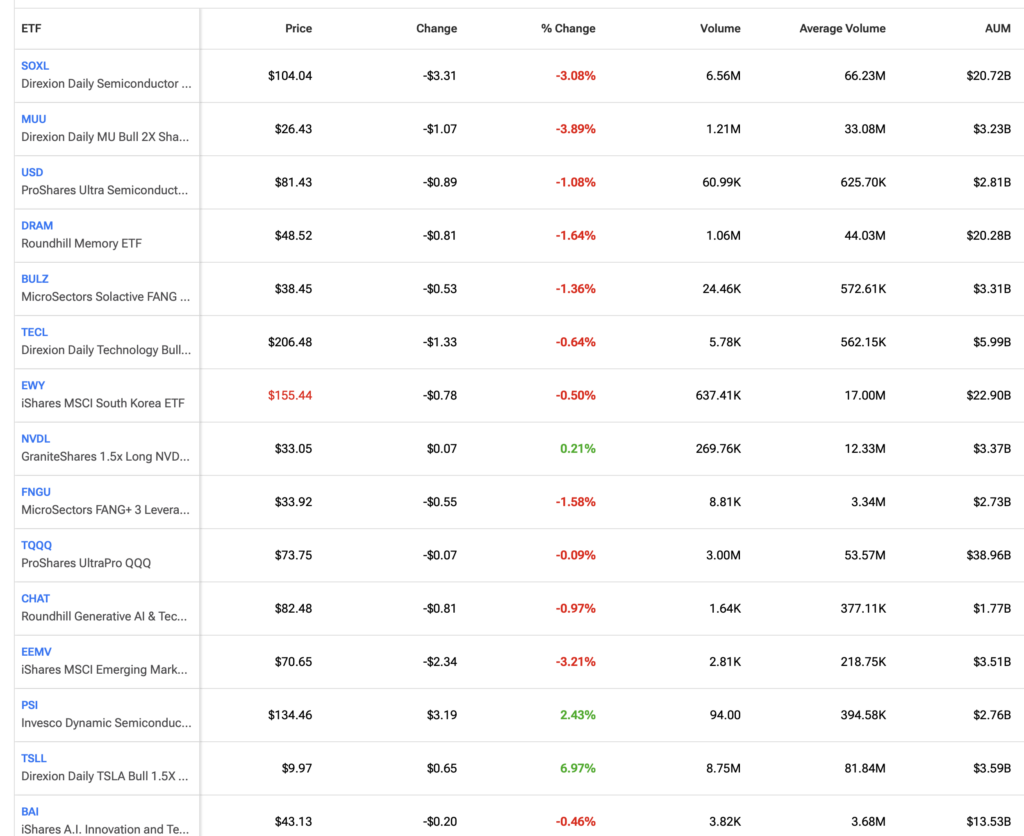
– $CRWV -5.0%, $IREN -3.5%, $NBIS -2.5% (AI-infrastructure names extend their selloff on debt-funded buildout and profitability concerns)
– $TRV -4.0% (Q3 beat with lower-than-expected catastrophe losses, but shares sell the news after elevated expectations)
– $SKHY -3.5%, $SNDK -2.5%, $MU -2.5%, $ALAB -2.5%, $WDC -2.0%, $AMD -2.0% (chip and storage names weaken as the AI trade de-risks amid higher-rate concerns)
– $IONQ -2.5%, $ASTS -2.5% (speculative long-duration growth names weaken as rate-hike expectations rise)
– $MSTR -2.5%, $HUT -2.0%, $CRCL -1.5% (crypto-linked shares trade lower amid broad risk-off positioning)
Source: TheStreet Pro
Source: TheStreet Pro
Position: None