Doug Kass is a world-renowned hedge fund manager with decades of experience and success navigating through some of the most turbulent periods in market history. He is known for his time-tested analytical skills and ability to look past the current noise and herd mentality.
On TheStreet Pro, Kass provides frequent market commentary and investing ideas for active investors throughout each trading day in Doug’s Daily Diary. He also serves as president of Seabreeze Partners Management Inc. Previously, he served as a senior manager at Omega Advisors, a $6 billion investment partnership. He co-authored a book with Ralph Nader and the Center for the Study of Responsive Law called “Citibank: The Ralph Nader Report” and can be found as a guest host on CNBC's "Squawk Box."
A Note from Doug: Current strategies and actionable trade ideas -- all on one dynamic platform built exclusively for active trades. From sudden sell-offs to sudden spikes, TheStreet Pro arms you with crucial analysis -- at a rapid fire, professional pace -- to help you make sound trading decisions -- every day, every hour, and every minute. Join me and my team of professional traders for unique perspectives and breakthrough investment opportunities.
… the 3-month realised correlation of the S&P 500 and its own equal weight version has fallen to 0.598, the lowest in its 15-year series and more than 4 standard deviations below the 0.93 average. In other words, the index is no longer representative of the average stock within the index. Back in August, Goldman had noted the most negative correlation between its broad AI basket and the S&P excluding AI. The 3-month realised correlation of the S&P to oil is -0.58 vs a 15-year average of +0.23, while the correlation to the 10-year yield is -0.56 vs a 15-year average of +0.24. Goldman says the index now behaves like “a self-contained asset class, driven less by traditional macro transmission and more by (a) narrow set of forces dominating index returns (AI vs non-AI), wreaking maximum frustration for the aggressive investor community”. In my mind, the low and negative correlations all indicate that money is being sucked out of every other asset class, and every other sector, to finance AI. Unless AI can function without these other inputs, it tells us that it is a bubble, and that it will eventually run out of other people’s money – (other sectors or asset classes money) with which to fund itself.
When it comes to investing in emerging markets, the first priority is getting the politics right. The first round election results yesterday in Brazil (there will be a runoff on October 25th) is a potential game changer for their markets, economy and currency if Flavio Bolsonaro wins again. It would also follow a shift right in other parts of Latin America, particularly in Argentina and away from the messy (and really ugly if we look to Venezuela) history of socialistic economic policies.
Kalshi currently is pricing in an 81% chance that Bolsonaro wins in 3 weeks and if this is right, Brazil should be a really fun investing playground. We’re long Brazilian stocks via EWZ (up 11% pre-market) and Brazilian local currency bonds via a few EM funds we own and have been believing that even if Lula was reelected, there wasn’t much downside but with the asymmetry higher if Bolsonaro pulls it out, which it seems he will.
Usually with developed markets, voting one’s politics is typically the wrong thing to do because markets will do their own thing regardless. At least right now, the political, budgetary and societal chaos going on in France, is an exception to that rule.
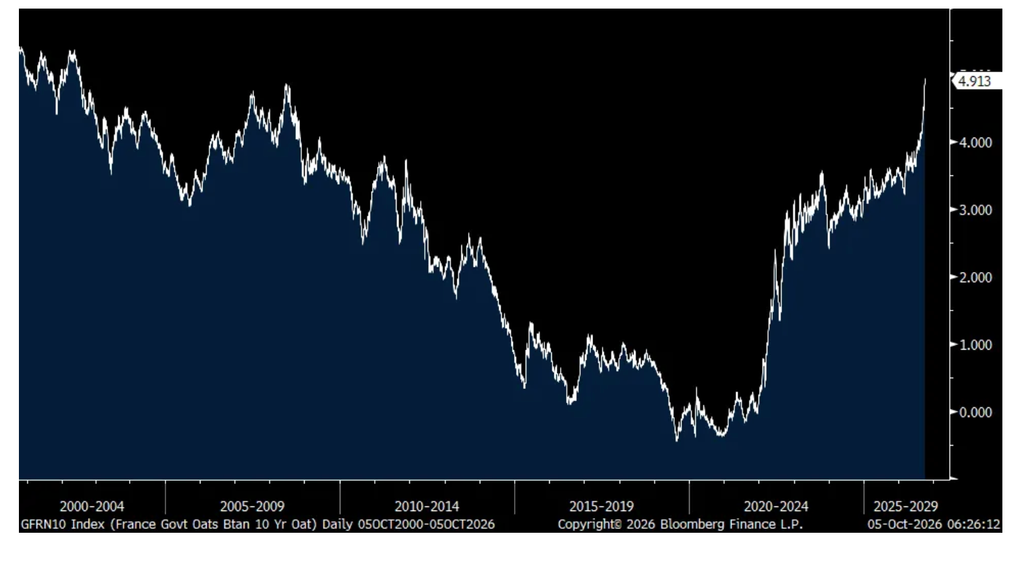
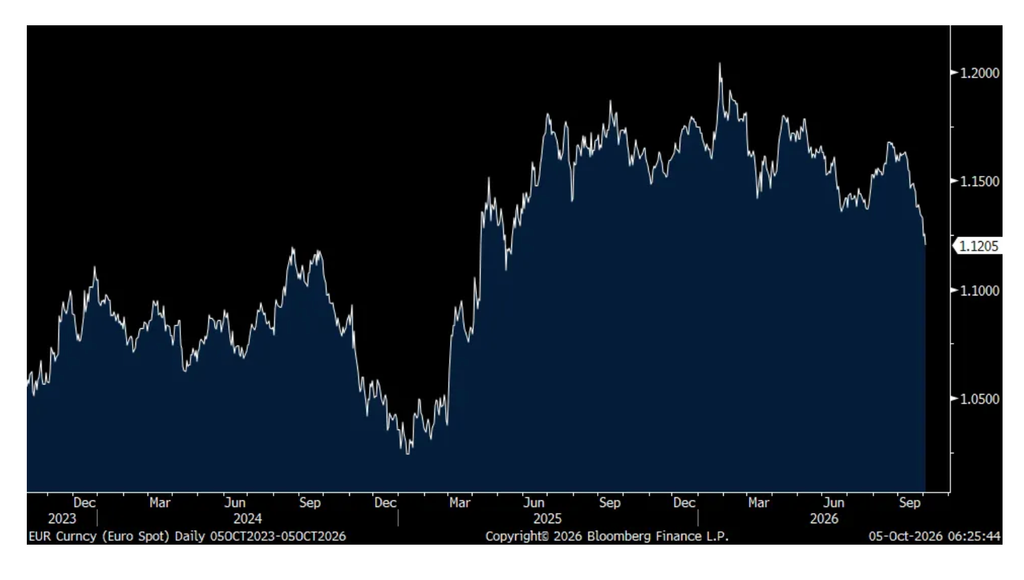
After a brief respite late last week, the French 10 yr yield is back to 24 yr highs and the euro is all of a sudden at the weakest level vs the US dollar since May 2025. The CAC is lower by 1% and down by 4% year to date.
Budgetarily, it seems that France might have run out of taxing road and tough spending cut decisions now have to be made instead in order to calm markets. After seeing the proposed budget last Thursday, there is still a combination of both but only to get to a budget deficit relative to GDP to 5%.
Which then makes the US budget deficit north of that stand out like a sore thumb which is currently at 5.4% for the 12 months ended 8/31.
I mentioned late last week that German bunds all of a sudden became a European sovereign bond safe haven in the face of also Italian yields shooting higher and that is again the case today as their yields are unchanged while its regional peers are all higher.
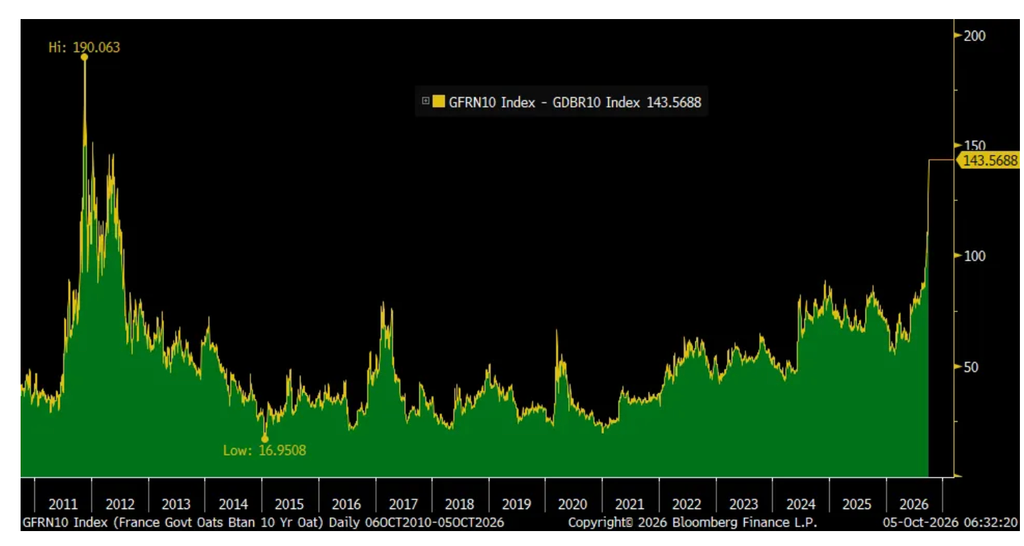
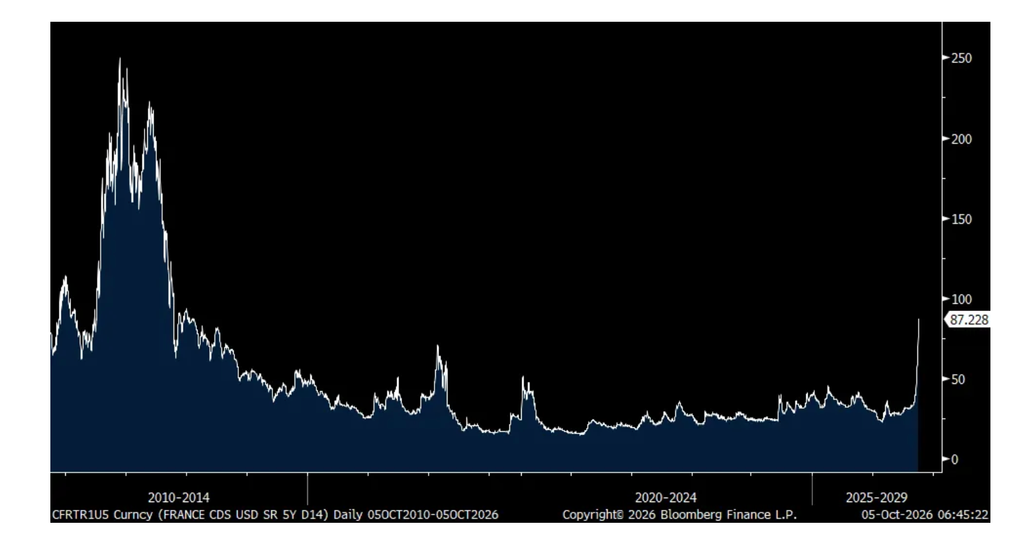
The German/French 10 yr yield spread is now up to 144 bps. The French 5 yr CDS has widened out to 87 bps, the highest since 2012 when the regional bond blow up occurred that triggered Mario Draghi’s ‘Whatever it takes’ approach.
French 10 yr Yield
Euro
French 10 yr yield spread relative to German 10 yr yield
France 5 yr CDS
Another foreign market we own stocks in is Singapore and its September PMI remained well above 50 but a bit less so at 58.1 vs 59.4 in August. S&P Global said, “Another sharp rise in new work inflows led business activity to increase at a faster pace. Firms also raised their purchasing and hiring activity amid sustained optimism.”
The caveat though, “Supply conditions notably worsened for companies, however, while cost burdens mounted, which resulted in firms raising output charges at one of the fastest rates on record.”
Singapore stands out for both its political and economic stability in that small city/state.
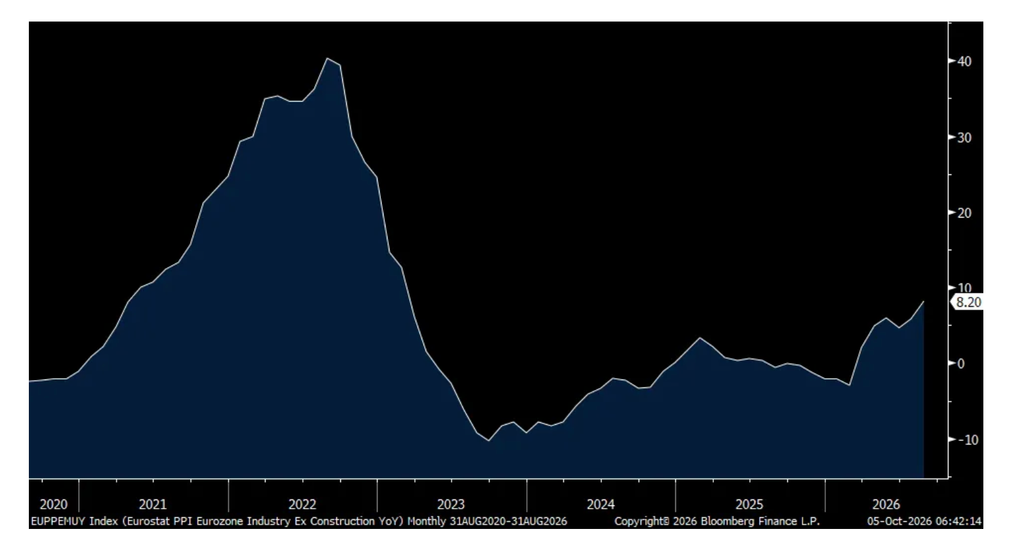
Back to Europe for a moment, last week we saw the September CPI which rose by 3.8% y/o/y headline and 2.5% core. Today, their August PPI was up by 8.2% y/o/y, above the estimate of 7.6%. It was mostly driven by the 21% rise in energy prices but still up by 3.4% ex energy.
I’ll argue again that a complete inflation analysis must include wholesale prices and the particularly difficult cost pressures many businesses are currently facing and where many can’t pass on the higher costs to the rest of us.