Doug Kass is a world-renowned hedge fund manager with decades of experience and success navigating through some of the most turbulent periods in market history. He is known for his time-tested analytical skills and ability to look past the current noise and herd mentality.
On TheStreet Pro, Kass provides frequent market commentary and investing ideas for active investors throughout each trading day in Doug’s Daily Diary. He also serves as president of Seabreeze Partners Management Inc. Previously, he served as a senior manager at Omega Advisors, a $6 billion investment partnership. He co-authored a book with Ralph Nader and the Center for the Study of Responsive Law called “Citibank: The Ralph Nader Report” and can be found as a guest host on CNBC's "Squawk Box."
A Note from Doug: Current strategies and actionable trade ideas -- all on one dynamic platform built exclusively for active trades. From sudden sell-offs to sudden spikes, TheStreet Pro arms you with crucial analysis -- at a rapid fire, professional pace -- to help you make sound trading decisions -- every day, every hour, and every minute. Join me and my team of professional traders for unique perspectives and breakthrough investment opportunities.
I would continue to avoid buying (and “bottom fishing”) in Netflix ($NFLX) for the reasons I have previously mentioned:
* Netflix has nearly saturated the domestic market (as well as many other developed countries). These markets are significantly more profitable than the non developed arena.
* Future Netflix sales/profit growth will come from developing country markets that provide substantially less revenue (and income) per subscriber.
* Netflix’s original content programming has been unspectacular over the last 12 months (or more) — and existing content has suffered.
In the past I have been short NFLX, but it is no longer priced as an attractive short.
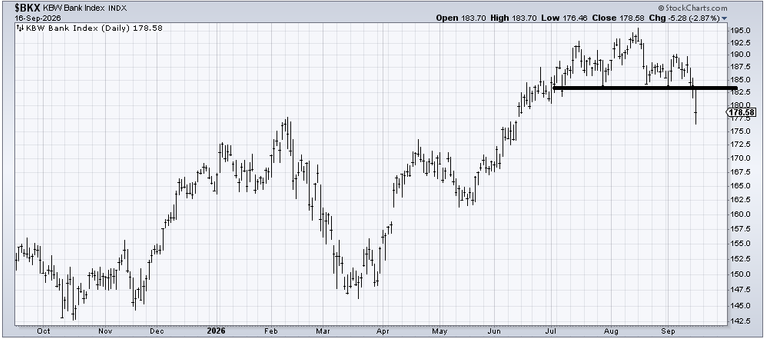
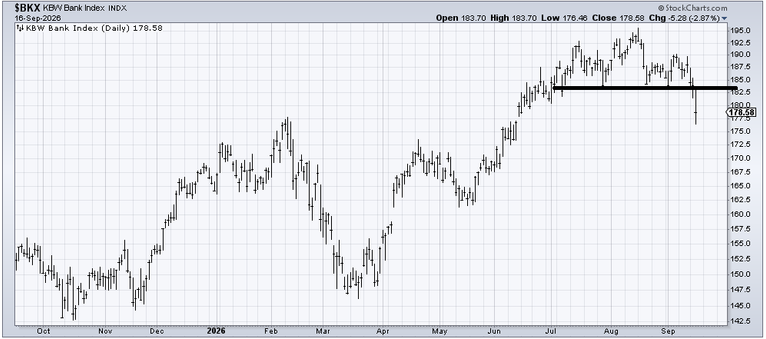
In early Summer the "broadening out" thesis was the dominant and consensus view in the business media. "Talking heads" were uber confident and almost universal in view. The rollover in $BKX$MDY$RSP and $IWM over the last three to four months – as I have consistently observed…
So much for mkt strength broadening. There are MTD gains among the S&P Sectors only in $XLK tech and $XLC (essentially $META). The other 9 are a rich shade of red. pic.twitter.com/pd5WacQFyn
“On Wednesday, the banks finally broke, and folks finally noticed how weak they have been. There is a short-term measured target on the Bank Index around 175, but look at all that resistance it has left overhead now.”
My warning to subscribers remains the same: do not confuse the price blinking on your screen with some immutable statement about economic reality.
This isn’t the stock market of the 1980s or 1990s. We now have zero day options, enormous passive vehicles, algorithmic strategies, volatility products, dealer gamma hedging and trillions of dollars responding mechanically to price.
After more than a decade of zero rates, QE and monetary intervention, I increasingly think we’re staring at a financial mirage, a fiat driven, QE induced hallucination where price temporarily becomes its own justification.
Nothing feels particularly real anymore.
But that’s the funny thing about a mirage, it all looks perfectly real right up until you try to drink the water.
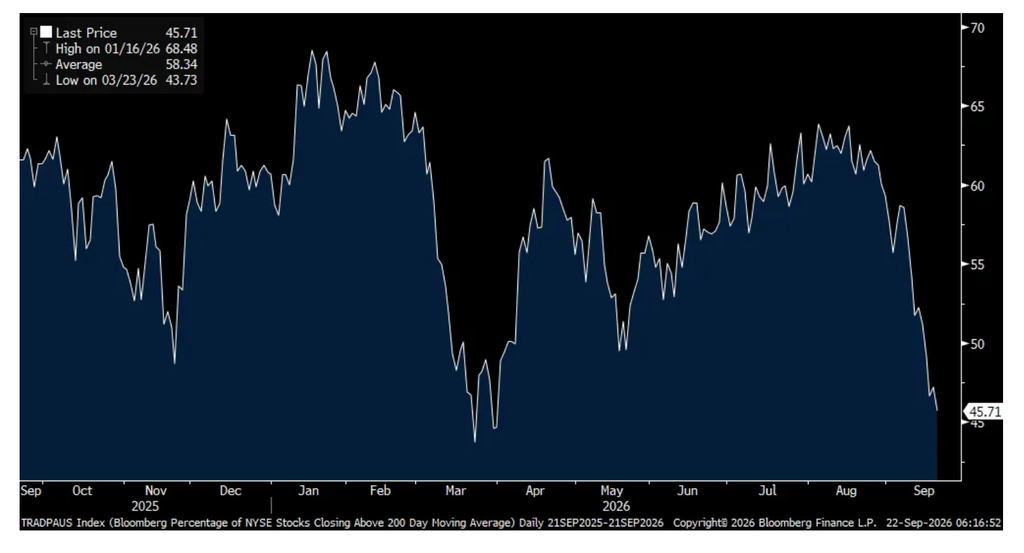
I wish there were more people invited to this party. The excitement around the AI trade and now the potential of agents being our personal assistant I get but it comes with apathy towards most everything else. I say this because yesterday just 46% of the stocks that trade on the NYSE closed above its 200 day moving average. That was down from Friday, lower from about 64% one month ago and the least since March.
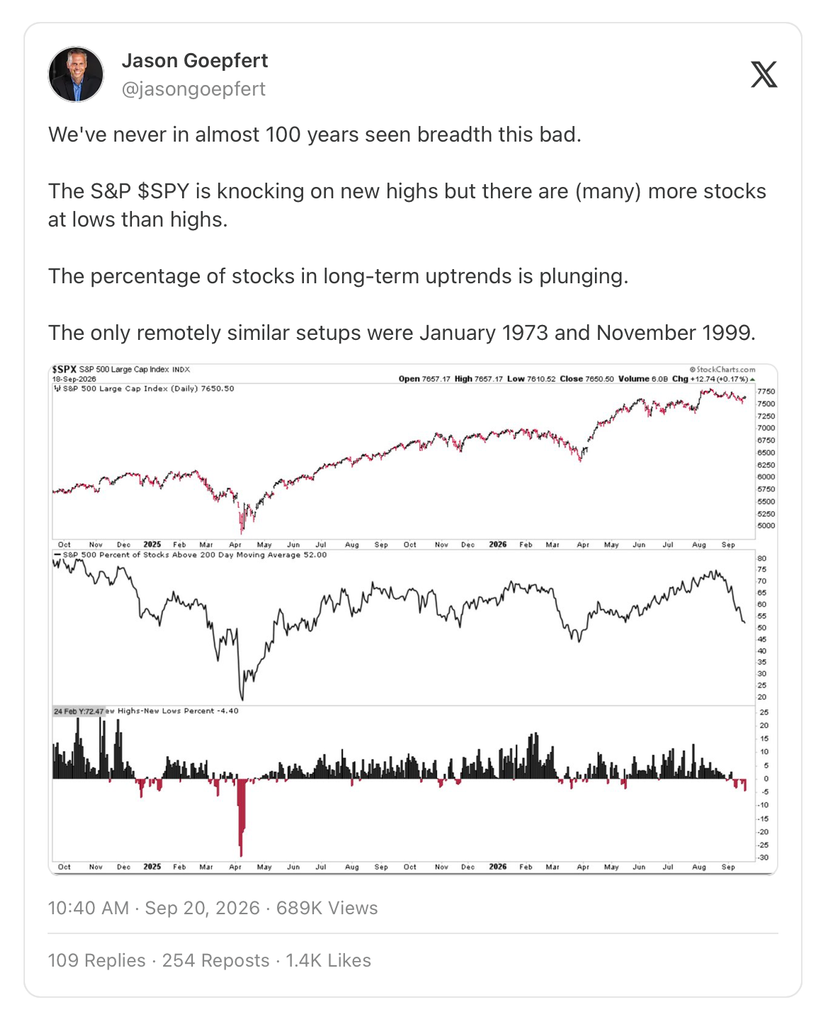
Also, I saw this tweet from the very good data miner Jason Goepfert:
In addition to owning some AI stocks, as a holder of many stocks that aren’t, I certainly hope that the laggards catch up rather than the leaders catch down.
% of NYSE Stocks trading above its 200 day moving average
I mentioned yesterday the price increase that Old Dominion Freight announced. Also out yesterday were price increase announcements on different acetyl chemicals by Celanese of about 4.5%. This chemical ends up in clothing, skincare/cosmetics, pharma products, paints, glues, lumber to name a bunch.
This gets to my point again that wholesale inflation is throughout the supply chain but pricing power of the business that sells direct to the consumer is the determining factor as to the flow thru to consumer prices.
Ahead of the Trump/Xi gathering, I’ll just say this. I think it’s a good thing that the two largest economies get along and unhindered trade takes place between our two nations as we both need each other. That said, we know China has been doing its best to rely less on the US ever since Tariff War 1.0 was launched against them in 2018. The US as we know has only now realized it needs to rely less on China, particularly with rare earth magnets and other key things like pharma ingredients.
Further evidence today of China’s growing presence on the global tech stage, “Alibaba Group Holding has introduced what it called China’s most powerful artificial intelligence chip and teased plans to train an AI model with up to 10 trillion parameters, as top executives reaffirmed the tech giant’s ambition to pursue artificial superintelligence (ASI)” said the South China Morning Post today.
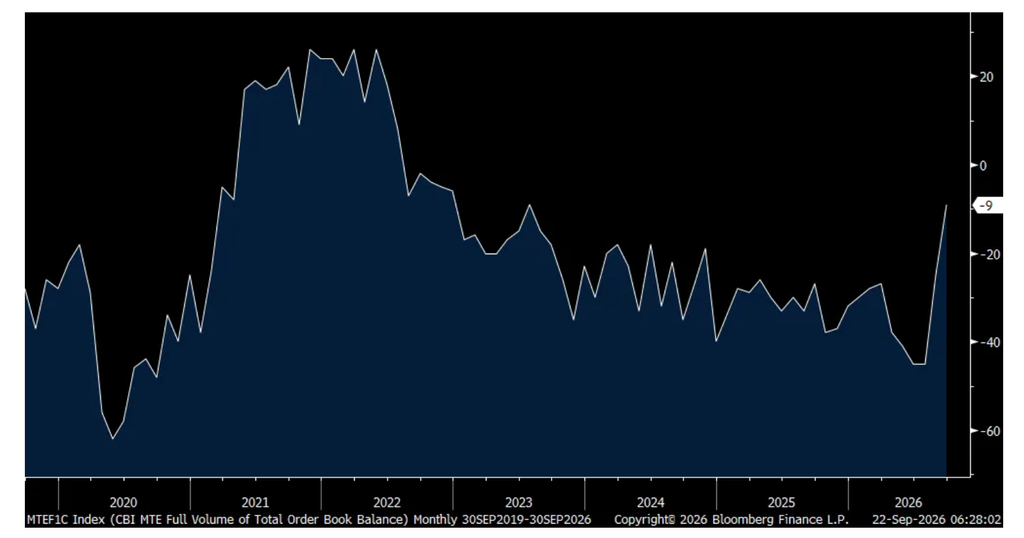
We’ve seen a global manufacturing recovery take place this year after about 3 years of contraction and that was further confirmed today by the nice lift in the UK CBI Industrial Orders index for September which rose to -9 from -25. The estimate was for weakness to -35.
CBI said “There are growing signs that conditions are stabilizing for manufacturers, with a marked improvement in order books for the 2nd consecutive month – taking them to their strongest in more than three years. Output is also now falling only marginally and selling price expectations have eased considerably from the highs seen following the outbreak of conflict in the Middle East.”
That said, “While these are encouraging signs, it is still too early to call this a sustained recovery, with manufacturers continuing to face high supply chain, energy and employment costs.”