With 30 years of cross-industry experience, Chris Versace brings his thematic investing lens to TheStreet Pro Portfolio (formerly Action Alerts PLUS) each day as lead portfolio manager. His daily insights, analysis, and recommendations provide the foundation for TheStreet's Pro Portfolio.
Versace began his career in equity research before founding Versace Management in 2005. He joined TheStreet team in 2011 as a Real Money contributor before becoming portfolio manager of Action Alerts PLUS in 2021. He holds an MBA from Fordham Gabelli School of Business and has co-authored a book called “Cocktail Investing - Distilling Everyday Noise into Clear Investing Signals for Better Returns.”
With a passion for teaching others about investing, Versace spent 9 years as an Assistant Professor of Finance at NJCU School of Business. When he’s not contributing to TheStreet’s premium services, he can be found speaking at industry conferences or at a Bruce Springsteen concert (he’s seen him 50 times and counting!).
Law firm Latham & Watkins has bought its own Nvidia GPU servers and started customising AI models, an expensive and technically demanding set-up that shows how much the technology is changing Big Law’s business model.
Latham, the US’s second-largest law firm with $8.3bn in revenue last year, has in recent years purchased several servers, each of which holds multiple GPUs, the powerful computer chips that run AI models.
It is the first public example of a big law firm buying its own AI hardware and fine-tuning models. It makes Latham responsible for cyber security and operating the servers but gives it the ability to keep clients’ sensitive data entirely within its own systems…
The move stands in contrast to other law firms’ approaches. Latham’s larger rival Kirkland & Ellis is working with Palantir to develop AI tools, while A&O Shearman has worked with legal tech start-up Harvey, and Freshfields this year announced a deal to work with Anthropic.
Latham is still using AI products and services from large tech companies alongside building its own technology. It declined to say how much it has invested or is planning to invest in the new approach, which it has been working on for the past few years.
As you read the below keep in mind that this is as of May, then think about where mortgage rates, inflation, and disposable income have gone since then. And people are surprised that August Existing Home Sales came in below the market consensus…
I see it as more support for the Portfolio’s decision to exit our position in Builders FirstSource ($BLDR) earlier this month.
The Atlanta Fed calculates that as of May, a household would need income of $124,674 a year to afford a median-priced home … that is 45% more than the median household makes@WSJpic.twitter.com/eJEgxBCqNx
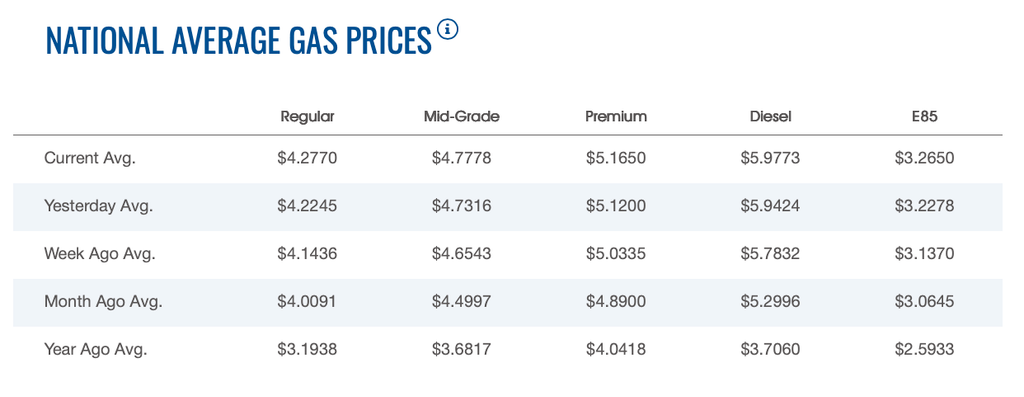
Last night Pres. Trump suggested we will see a sharp drop in oil and gas prices following the mid-term elections, and while many (including me) raised our eyebrows at that, other reports this morning, including this one form Bloomberg, suggest the conflict will be a protracted one:
Iran and the US are digging in for a protracted war, with little sign of a near-term ceasefire or return to normal Middle East energy flows even if hostilities remain at a low intensity.
Tehran’s leaders are resolved to keep fighting despite mounting economic costs as they see the conflict as an existential threat, Bloomberg reported, citing a senior Iranian official. The country has been able to rebuild its missile capabilities and will escalate strikes on US and Gulf assets if Washington intensifies its own attacks, the official said.
Top White House advisers including Vice President JD Vance and Secretary of State Marco Rubio have told President Donald Trump that the war could drag on through the remainder of his term, which runs until January 2029, the Wall Street Journal reported, citing US officials.
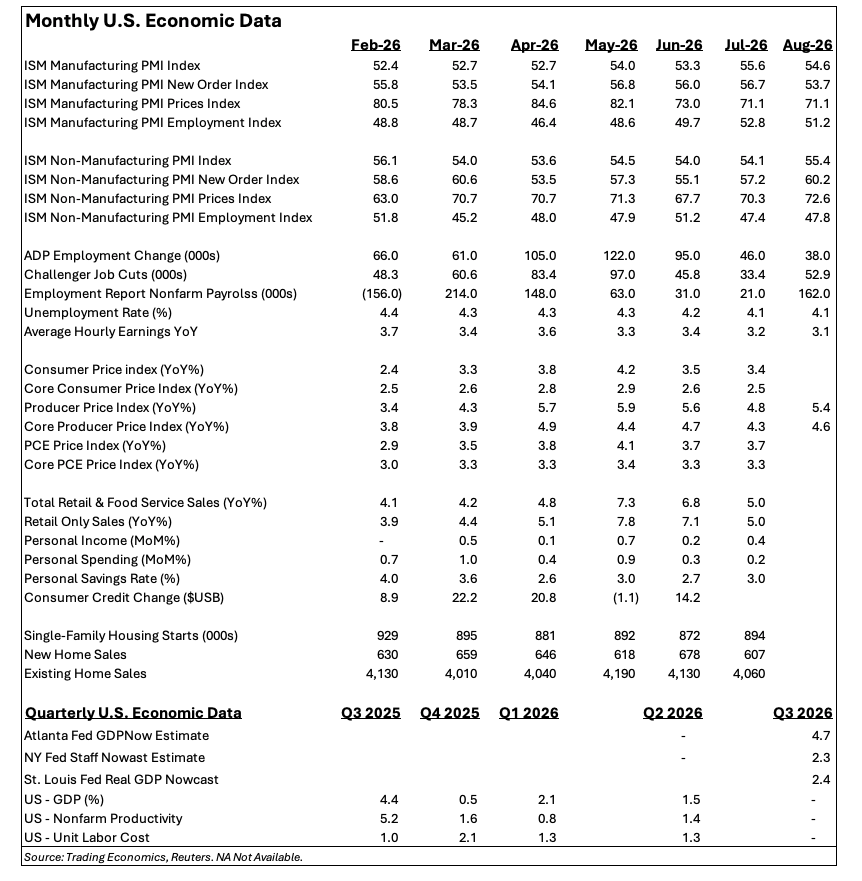
The nutshell take is Visa ($V) now sees 2026 GDP for the U.S. coming in at 2.2%, with the same figure for next year. While that isn’t too far off the forecasts for this year from the New York Fed’s Nowcast Model and the St. Louis Fed’s Read GDP Nowcast one, it suggests the Atlanta’s Fed’s GDPNow model figure of 4.7% GDP for the current quarter is more than a bit aggressive. We’re not quite half way through all the economic data for Q3 2026, but the further oil, diesel and gas prices head, the more downside risk to the Atlanta Fed’s forecast we see.
Now here’s what Visa had to say and we’ll follow that with our update macro data table, the one we publish each week in the Pro Portfolio’s Weekly Roundup:
The economic data over the last month continues to reflect an economy weathering higher inflation pressures. The August employment report showed the U.S. labor market was still on a strong footing, with employers adding 162,000 jobs for the month and wage growth holding firm. Even with solid wage gains, real (inflation-adjusted) income growth is contracting, but continued stock market gains have helped to prop up spending for some consumers, at least for now. As a result, we foresee consumer spending continuing but at a more modest pace this quarter at 2.1 percent on a year-over-year (YoY) basis. Continued robust AI investment should also help support business investment growth this quarter.
Headwinds are emerging, however, that could limit growth over the next few quarters. Inflation is likely to reaccelerate through the end of this year as the Middle East conflict pushes diesel and fertilizer prices higher, while the effects of El Niño weigh on global crop supplies and food prices more broadly. The addition of tariffs on key U.S. trading partners could also push prices higher.
As a result of these dynamics, it is looking more like a bumpy path forward for interest rates over the coming months. For starters, long-term interest rates have risen in recent weeks due to several factors, including investors seeking higher yielding alternatives, expectations that inflation will remain elevated for longer, and ongoing debt issuance due to higher budget deficits. The upward movement in long-term rates has delayed the need for the Federal Reserve to step in and contain inflation, but there are signs from recent speeches and meeting minutes that their patience may be wearing thin. We now think a rate hike before year-end is the base case (see more details in the full report).
With these changes to our outlook this month, we have downwardly revised our outlook for GDP growth for this year to 2.2 percent YoY while leaving our forecast for 2027 unchanged at 2.2 percent. GDP growth will likely begin to moderate in Q4 with more modest inflation-adjusted consumer spending. Inflation and interest rates should ease enough to support 2.1 percent GDP growth in 2028.
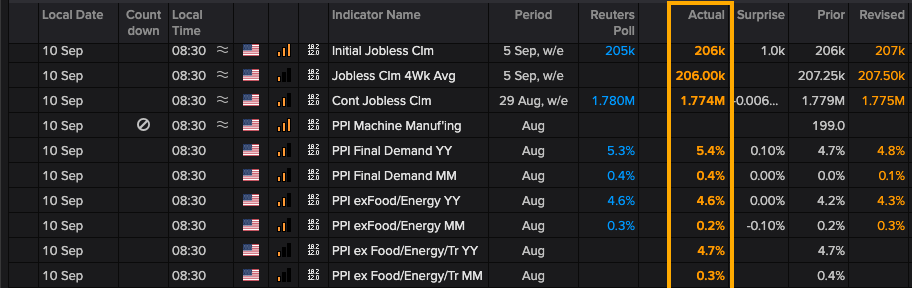
The August producer price index report is out and headline PPI came in a tad hotter than expected at 5.4% year over year vs. the 5.3% consensus and 4.7% in July. Core inflation came its expected, up 4.6% year over year from 4.2% in July.
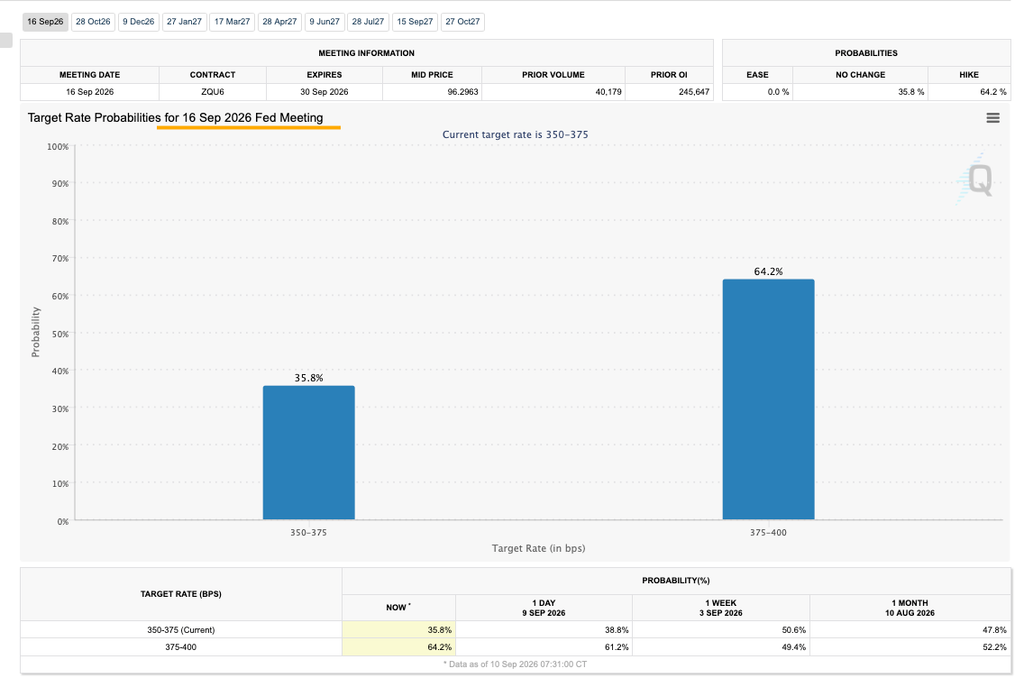
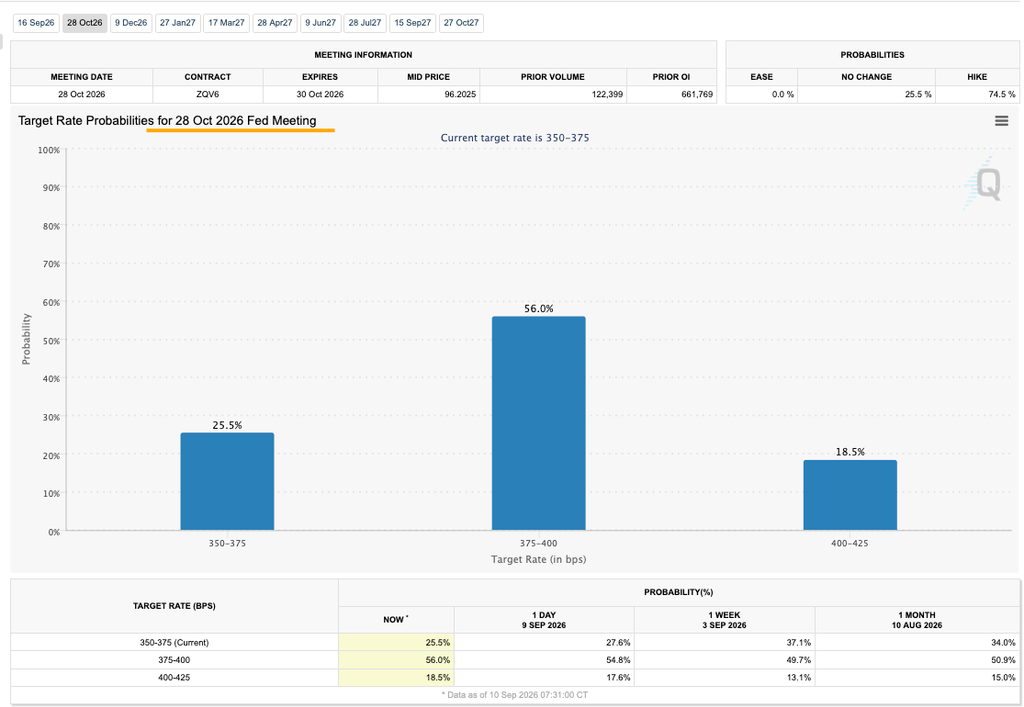
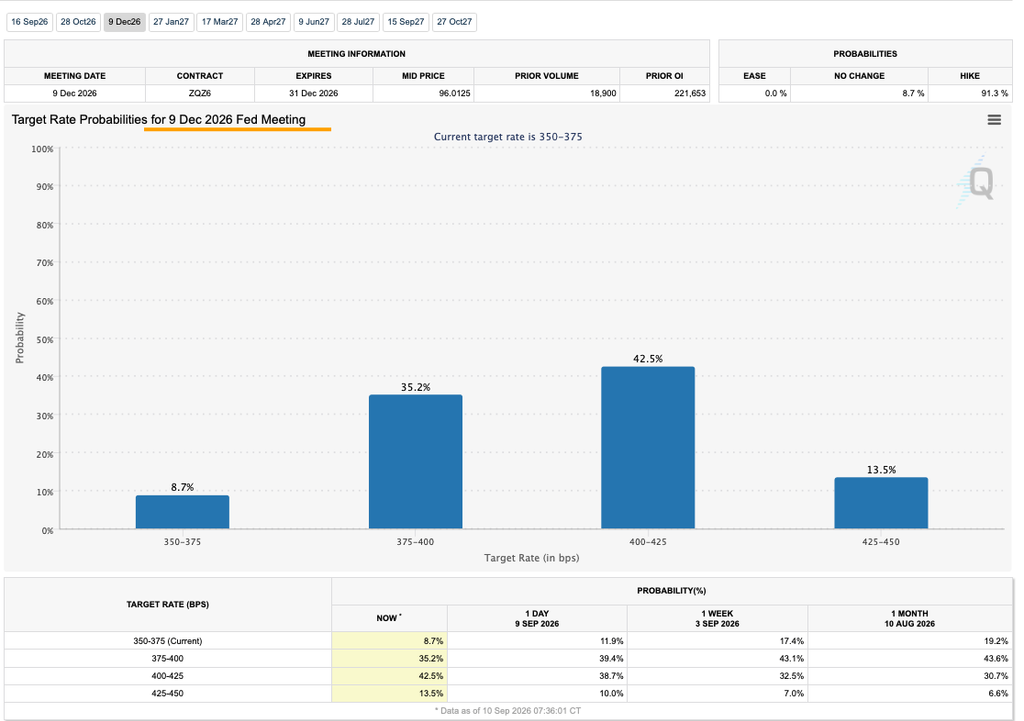
In response, the 10-year Treasury yield is moving higher, approaching 4.9% and the rate hike expectations tracked by the CME FedWatch Tool are likely to move higher. We’ll get a snap of those expectations as the market has a chance to digest more of this morning’s PPI data.
The Financial Times is reporting that Starbucks ($SBUX) is investing (betting?) $1 billion in transforming some 9,000 cafes into what is being referred to as “community lounges.”
This sounds like something we might have heard from former CEO Howard Schultz and his “third place concept,” but that was before the rise of mobile ordering.
How that $1 billion squares with current CEO Brian Niccol’s target of taking $2 billion out of the business in cost savings over the next two years is just one of the questions folks are likely to have. Another is with the rise of Dutch Bros ($BROS) and others that offer quick service, is the Starbucks notion of “community lounges” outdated?
Here’s an early look at what Wall Street firms are saying after having some time to digest Apple’s ($AAPL) Surprise and Shine event, which, in our view, largely delivered on what was speculated.
Citi keeps a Buy rating on Apple with a $365 price target after the company launched a new foldable iPhone. The Duo is Apple’s biggest new hardware category since the watch and Airpods, the analyst tells investors in a research note. Citi adds that Apple repriced the iPhone 16 and 17 by at least $100 to offset higher memory component prices. It views the iPhone 18 specifics and foldable phone selling price as in-line with expectations.
BofA analyst Wamsi Mohan lowered the firm’s price target on Apple to $370 from $380 and keeps a Buy rating on the shares, stating that the first major product launch under new CEO John Ternus helped “showcase his focus on Apple’s core values and continuing to create products that delight customers.” Pricing on the new iPhones came in lower than the firm had expected, which can drive higher units but put some pressure on gross margins given higher memory and component costs, adds the analyst, who adjusted estimates accordingly.
Rosenblatt keeps a Neutral rating on Apple with a $303 price target following the company’s product launch event. Apple’s “light touch” on pricing could weigh on its gross margins due to rising memory costs., the analyst tells investors in a research note. The firm says Apple revealed the foldable Duo, new iPhone Pro and Pro Maxes with better battery life and improved cameras, and new entries in Apple Watches, AirPods, and Siri AI.
JPMorgan says Apple’s fall product launch was largely inline with expectations. Apple’s pricing is inline with JPMorgan’s base case of a $100 like-for-like increase, taking the iPhone 18 Pro and 18 Pro Max to $1,199 and $1,299, the analyst tells investors in a research note. However, the numbers are below the larger increases some investors had anticipated on account of memory cost inflation, contends JPMorgan. The firm believes Apple “walks the fine balance” of absorbing memory costs while keeping the opportunity for a positive volume cycle. It keeps an Overweight rating on the shares.
Position: TheStreet Pro Portfolio is long AAPL shares.