An Unprecedented Whipsaw in Investor ‘Fear’

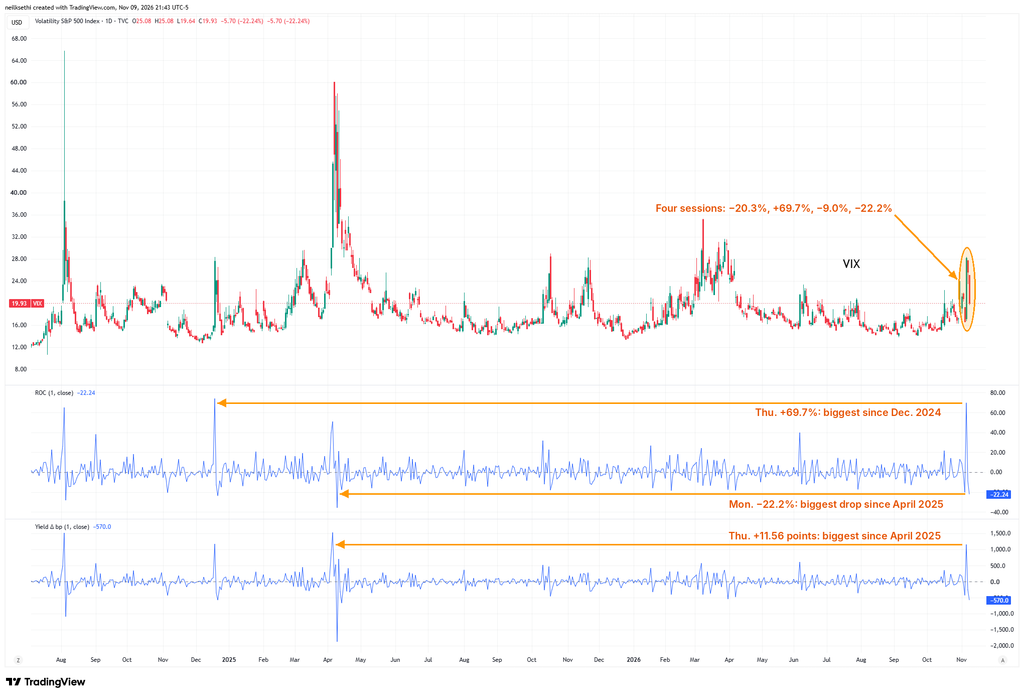
The Cboe Volatility Index ($VIX) fell 22.2% to 19.93 Monday. That’s its biggest one-day drop since April 9, 2025, just topping last Wednesday’s 20.3% drop (Investor ‘Fear’ Is Dropping the Most Since April 2025). In between, it jumped 69.7% Thursday, its biggest gain since December 2024 (Wall Street’s ‘Fear Gauges’ Just Jumped the Most in Years. Here’s What Usually Came Next.).
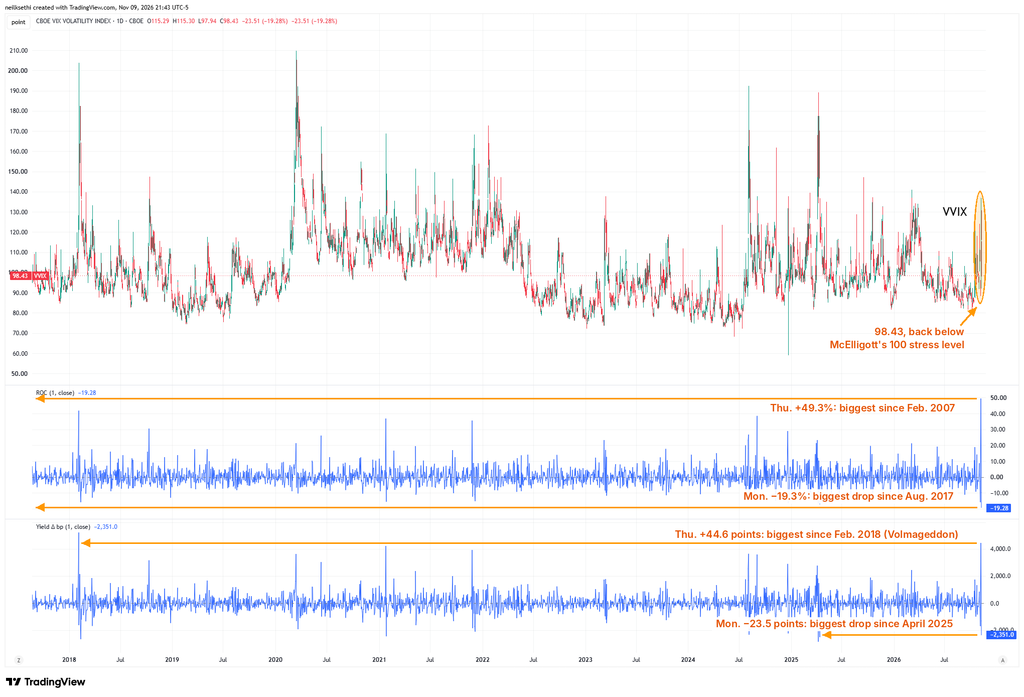
VVIX, which tracks expected swings in the VIX itself, fell 19.3% to 98.43. That’s its biggest drop since August 14, 2017, and the second-largest in data going back to 2007. That followed Thursday’s 69.7% jump, its biggest since December 2024.
One Precedent
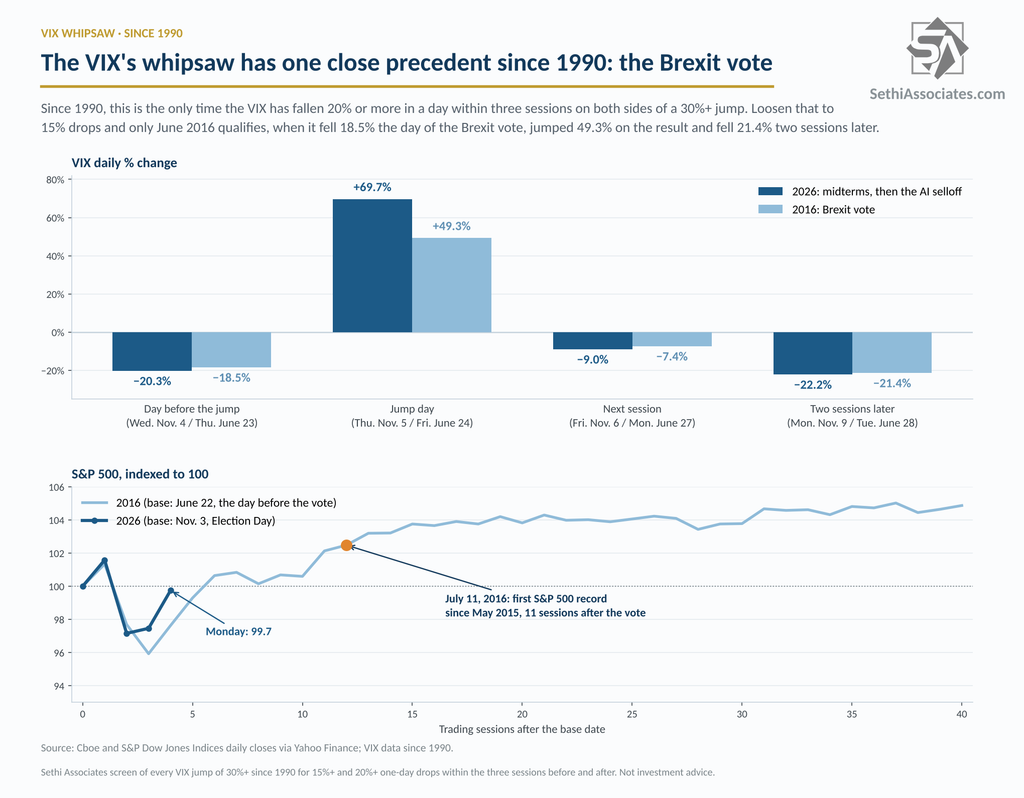
Cboe’s data begins in 1990, and since then this is the only time the VIX has fallen 20% or more in a day within three sessions on both sides of a 30%-plus jump.
You have to loosen that to 15% drops to find another episode that qualifies: the Brexit vote in June 2016.
What Happened With Brexit
The setup also was a historic election. On June 23, 2016, the U.K. voted on whether to leave the European Union, and markets bet that it would stay. The S&P 500 rose 1.3% that day, and the VIX fell 18.5% to 17.25.
Then Leave won. On June 24, the pound fell 7.8% to $1.36, its lowest since 1985, and the S&P 500 fell 3.6%, its worst day since August 2015. The VIX jumped 49.3% to 25.76. Stocks fell another 1.8% the next session, a two-day drop of 5.3%, but the VIX was already easing. On June 28 it fell 21.4% to 18.75 as the S&P 500 rose 1.8%.
June 27 turned out to be the low. The S&P 500 was back above its pre-vote close by July 8. On July 11 it closed at its first record since May 2015, just 11 sessions after the vote. From June 28 (two sessions after the jump, like Monday), the index was up 6.6% a month later and 6.1% three months later. The VIX was down to 13.20 by July 8, and on August 19 it closed at 11.34, its lowest since July 2014.
Two things helped. The 10-year Treasury yield fell to a then-record low of 1.37% in early July. And the Fed, which hadn’t raised rates since December 2015, waited until December 2016 to hike again. The pound didn’t join the rebound, though, and slid to $1.29 by July 6.
What’s Different This Time
Today policy is tightening, not loosening. In 2016, yields hit record lows as the Fed pushed off rate hikes. Now the Fed appears unconcerned about the market volatility, and Monday’s rally pushed the odds of a December hike to 85% from 77% Friday, according to CME FedWatch. The S&P 500 also still has work to do: it’s 1.8% below Wednesday’s close and 3.4% below its October 6 record.