After Overnight Selloff, Where Are the Indexes Headed Next?


Stocks were down before the sun came up on Thursday. The S&P 500 futures were down more than 80 points, while Nasdaq 100 futures fell by about 550 points.
The selloff started overnight in Asia, with semiconductor manufacturers Tokyo Electron losing 6%, and Korea’s SK Hynix falling 5.7%.
Tesla ($TSLA) also played a role here, as revenue from auto sales dropped 3% year over year. The market still sees Tesla primarily as an auto manufacturer, rather than an AI and robotics company.
2 Choices
When stocks sell off as they did on Thursday morning, we have two choices. We can simply wait it out, or we can use the selloff as an opportunity to hunt for bargains.
First, let’s see where stocks are likely to bounce. If a deeper selloff occurs, where will we buy? We’re using futures charts below in order to reflect Thursday’s pre-opening selloff.
I’m not predicting that the major indexes will fall to the following price levels. I’m creating a plan of action in case they do fall to these levels.
S&P 500
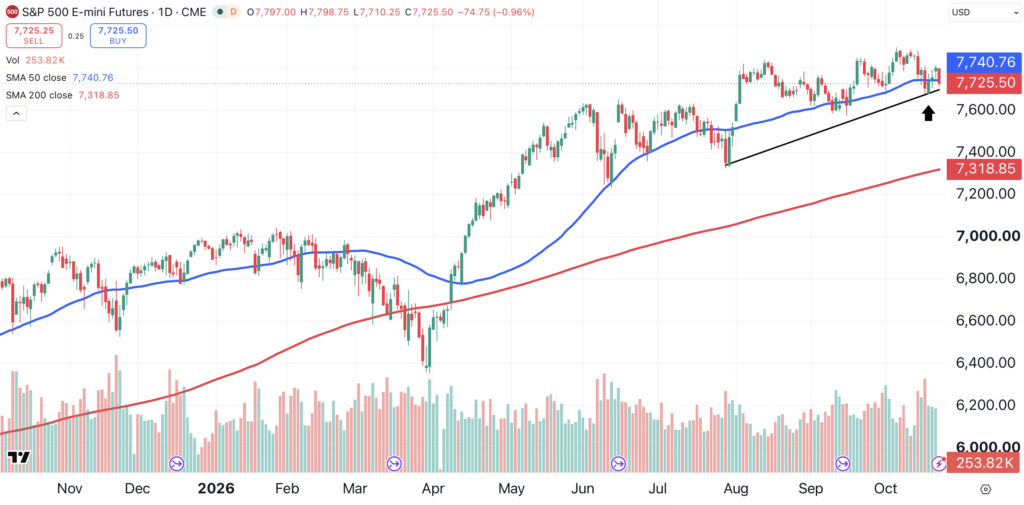
The S&P 500 futures have fallen below their 50-day moving average (blue), but that’s not unusual. S&P futures have straddled the 50-day MA for the past two months.
On the bright side, a three-month old bullish trendline remains intact (black line). Futures for the large-cap index remain above Friday’s low of 7677 (arrow). The cash low remains 7,631.
The bottom line here is that despite this selloff, stocks are still in a bull trend. Friday’s cash low of 7,631 will be my trigger point for buying stocks on the S&P 500.
Nasdaq 100
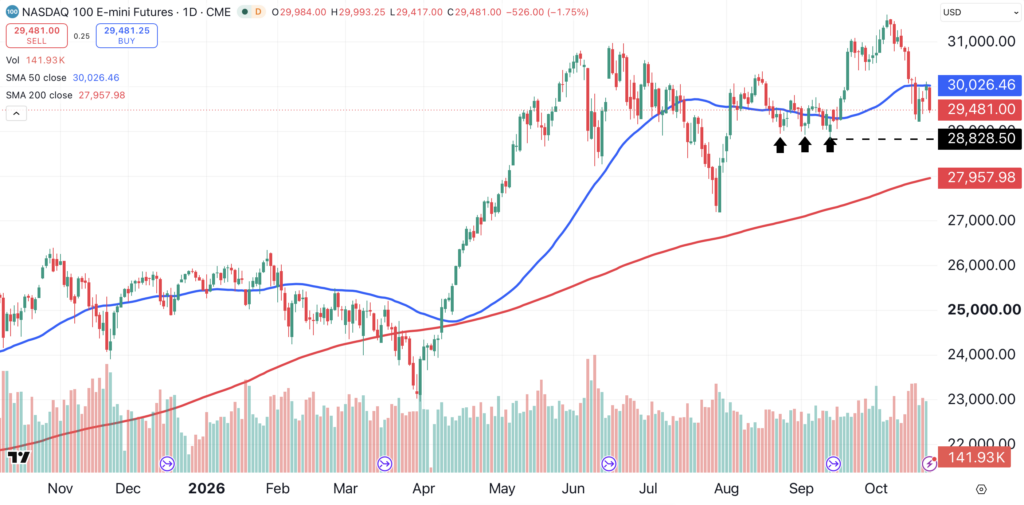
The Nasdaq 100 futures have an area of strong support extending from about 29,000 to 28,800 (black dotted line), with several solid bounces from that vicinity over the past two months (arrows). Despite the selloff, Nasdaq 100 futures are still trading about 200 points above Monday’s low of 29,226.
In the cash market, the support levels on the Nasdaq 100 translate to 29,050 to 28,750. That zone will serve as my trigger point for buying tech stocks, if any opportunities should arise.
Dow Jones Industrial Average
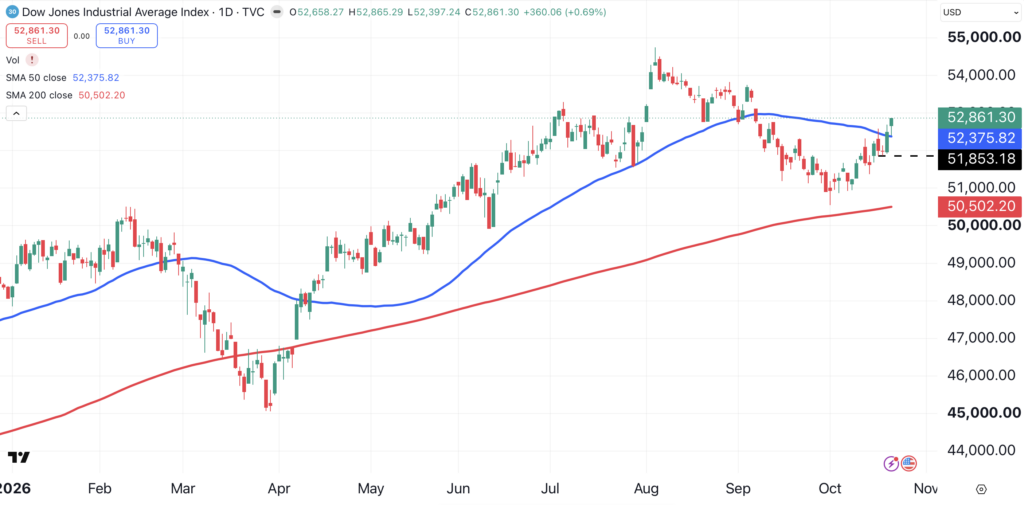
Of the three major indexes, the Dow Jones Industrial Average is the only one still trading above its 50-day moving average after the overnight selloff. As of this writing, the Dow was still trading above the previous day’s low.
As a result, Thursday morning’s downturn barely registers as a selloff for the Dow. There is a minor area of support near 51,850 on the cash index based on the past week’s trading activity (black dotted line). That figure will be my trigger point for buying stocks on the venerable index.
Bottom Line
In recent articles, I warned about adding to tech stocks in this environment and explained why energy stocks were a safer trade. On Thursday morning, despite the selloff in the broader markets, energy names like APA and EOG Resources were bid higher before the open.
Investors are becoming increasingly wary of AI-focused names, and money is flowing into more traditional, less volatile areas. This is evident in the recent resilience of the Dow Jones Industrial Average when compared to the other major indexes.
At the time of publication, Ponsi was long APA and EOG.
