Quoth The Dougie

* Doug Kass: The AI Funding Boom Has Peaked
From Quoth The Raven:
Doug Kass: The AI Funding Boom Has Peaked
I’ve known Doug Kass for a while now. He’s a veteran investor, and someone readers of TheStreet will know well from his years of sharp, independent market commentary. He also writes a great blog, and this week I read one of his better pieces yet on the artificial intelligence boom.
I thought it would be a great supplement to my recent piece on why I think the AI crash could start as soon as this year:
The Real AI Crash Will Start This Year
In his note, Doug makes it clear that he believes the funding cycle for artificial intelligence may already have peaked. Doug thinks that one of the clearest signals is the apparent urgency with which OpenAI and Anthropic are moving toward the public markets.
After years in which AI companies enjoyed abundant private capital, rapidly rising valuations, enormous strategic investments, and relatively little quarterly financial scrutiny, the obvious question is: Why the rush to go public now?
I’ll do my best to sum up Doug’s note. His concern is that beneath the extraordinary valuations and breathtaking capital expenditures, the economics of the AI business may be becoming considerably less attractive. Token growth is slowing, token prices are falling dramatically, competition is increasing, open-source models are improving, and the amount of capital required to keep the ecosystem expanding is staggering. This chart and writeup from Zero Hedge confirms this:
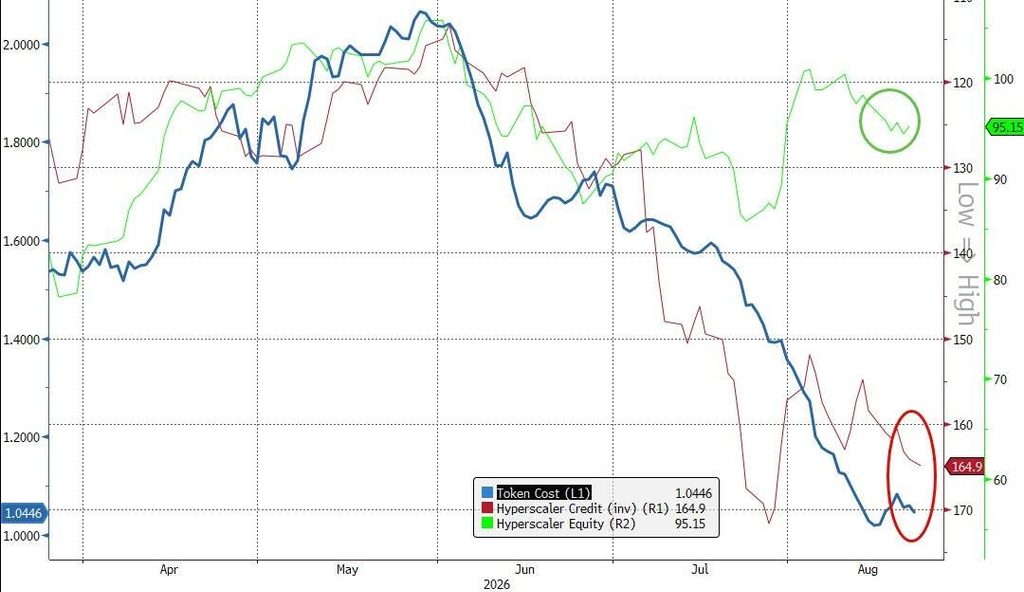
Token Cost Chart via Zero Hedge
That makes the IPO race particularly important. These companies need enormous amounts of capital to sustain their current spending, but going public would also expose their economics to a level of scrutiny they have largely avoided as private companies. Once OpenAI or Anthropic is publicly traded, investors will be able to examine revenue growth, operating losses, cash burn, capital requirements, and customer economics quarter after quarter. The story will have to collide with the numbers.
There is also a compelling explanation for why the AI trade accelerated again after initially appearing to lose momentum. Massive government support for AI infrastructure helped provide one catalyst. So did soaring equity valuations and extraordinary levels of circular financing throughout the industry. Higher valuations encouraged more investment. More investment generated more spending. More spending created revenue for AI infrastructure companies. That revenue then helped justify still higher valuations.
The result was a reflexive investment and stock-price momentum boom. The problem with reflexive booms is that the feedback loop must continue for the boom to sustain itself, and several parts of that loop now appear to be weakening. Political enthusiasm for massive AI infrastructure investment is encountering resistance. Hyperscalers are spending astonishing amounts of money. Debt and off-balance-sheet commitments are growing. AI-related companies continue issuing both debt and equity. And the aggregate market capitalization attached to the ecosystem has become enormous.
At some point, somebody has to finance all of it.
That is why the funding cycle matters more than whether AI itself succeeds or fails. The argument isn’t that artificial intelligence is going away. It is that the rate at which incremental capital can continue flooding into AI may have peaked. In market terms, the second derivative may be turning negative. Even if investment and spending remain enormous in absolute terms, a slowdown in their rate of growth can have major consequences for valuations built around expectations of continued acceleration.
Another underappreciated issue is the industry’s use of ARR, or annualized recurring revenue. Wall Street generally places a premium on genuinely recurring revenue because subscription businesses tend to have predictable customer relationships, contractual commitments, meaningful switching costs, and relatively durable cash flows. Those characteristics can justify much higher valuation multiples.
But it is far from clear that frontier AI revenue deserves to be treated the same way.
Customers can switch models. Open-source alternatives continue to improve. Prices are falling. Workloads that run on one frontier model today could potentially migrate somewhere else tomorrow. Technological improvements could also produce smaller and cheaper models that dramatically reduce the need for gigantic frontier models. Revenue generated under those circumstances may be valuable, but it doesn’t necessarily possess the characteristics investors normally associate with an annuity-like recurring revenue stream.
That distinction becomes especially important if frontier AI companies are preparing IPOs. Whether Wall Street treats billions of dollars of AI sales as ordinary revenue or high-quality recurring revenue could have an enormous impact on the multiples investors are willing to pay.
All of which brings the argument back to the original question: Why now?

If frontier AI economics are rapidly improving, demand is exploding, pricing is durable, competitive advantages are strengthening, and these businesses are heading toward tremendous profitability, there should theoretically be less urgency to access the public markets. The apparent rush itself may therefore be telling us something about where the industry’s funding cycle stands.
The larger point extends well beyond any individual IPO. Markets rarely turn because investors collectively decide that an important new technology is worthless. The internet didn’t disappear when the dot-com bubble burst. Fiber-optic networks didn’t disappear. E-commerce didn’t disappear. Many of those technologies ultimately became even more important than their biggest boosters imagined.
What disappeared was the willingness to finance virtually anything associated with those technologies at virtually any price.
That is the distinction investors need to understand today. AI can change the world and still be an investment bubble. And if the marginal dollar available to finance that bubble has already peaked, the consequences could extend far beyond OpenAI and Anthropic. Kass concluded:
My view, the revenue the frontier models have is no different than the revenue Netscape, Yahoo, We Work, Nike, Kodak, Zerox, Polaroid, Mikes Buggy Whip Company or Pete’s Vinyl Record Company had. It is not ARR and should not be quoted that way. Nor should the auditors or bankers allow for that in my opinion.
Further, I have argued (above) that these companies do not belong public and should not be public but are rushing to go public because they (and their investors including the circular ones) have all of the exact same concerns I do. I ask again, what is the rush? I think their own behavior in this regard speaks volumes.
For the most part, I agree with Doug. AI can be revolutionary technology while the financial ecosystem surrounding it can still be batshit insane. When companies invest in one another, buy from one another, lend to one another, and then point to the resulting revenue as proof that everybody deserves a higher valuation, you don’t have to be Jim Simons, barefoot, smoking a cigarette and pacing around the Renaissance offices to understand why the math may not be sustainable…
Where I’d push back slightly is on timing. Doug knows this, but I’ll say it anyway. Ponzi schemes can run for years. Credit has an almost supernatural ability to materialize whenever enough bankers, investors and politicians need the casino to stay open. Just look at our national debt. “This can’t go on forever” is almost always true. The problem is that forever has a remarkable ability to get refinanced.
So I think Doug is right to keep asking, “What is the rush?”. I’ve already gone on record and said Nvidia could be the market’s next black swan and that I’d never in a million years own CoreWeave. If the economics are really this magnificent, why is everybody suddenly racing for the exits marked IPO? But bubbles don’t end because a few people notice the math looks “a little questionable”. They end when somebody is bludgeoned in the face with reality, when they finally ask for their money back and they discover hoping for a check from the next guy’s checkbook was the entire business model. Wall Street is exceptionally talented at finding one more dollar to keep the machine running, right up until the morning it suddenly can’t.
You can follow Doug Kass’ blog here.
