Boockvar: It’s Not Just Vera Rubin, Uncrustables Are Winning Too

From Peter Boockvar:
The main macro news of note was the 25 bps rate hike by the Bank of Korea but as expected and where the Governor said with respect to their reaction to inflation worries, “There’s a Korean saying that if you fail to stop something with a hoe, you’ll end up having to stop it with a shovel, meaning the cost of responding too late is much greater.”
Also of importance, seemingly laying the groundwork for a September rate hike, the BoJ Deputy Governor Himino said today “We should pay greater attention to the upside risk to prices than in the past. In-depth deliberations should be held at each monetary policy meeting with these perspectives in mind.” The 2 yr JGB yield though was unchanged as market odds of a hike are already at 82%. It was 25% right before the latest FX intervention the day before the last BoJ meeting, subsequently joined by the US.
On to the micro, though we know Nvidia’s business has major macro implications.
Nvidia of course put up another incredible quarter and that fiscal ‘28 (Jan ‘28) figure was quite the surprise. With some uncertainty as to how many data centers will get built in the US over the coming years due to the community pushback, I wonder how they have that kind of visibility but I guess at least for the construction being done next year it is already locked in and their business is expanding well past just the US hyperscalers.
The negative is that it seems that profit margins have peaked at 75% and the guidance down from here by a touch with the higher cost of memory the issue now and I believe ever more competition later. Also, their accounts receivable jumped by 55% sequentially vs the 18% rise in revenue from the prior quarter.
As for the existential question for all the spending going on, ‘if you build it, will they come?’ in terms of GenAI customer usage that will make this massive level of CapEx eventually worth it. We just don’t know yet.
From Nvidia:
“The surge in AI demand is driving a global infrastructure buildout, supported by an expanding and diverse set of growth opportunities spanning hyperscalers, AI labs, AI natives, enterprises, and sovereign customers. We expect to grow revenue by approximately 70% in fiscal 2028. This is a supply constrained outlook.”
And Jensen highlighted his view on where the next wave of compute power is coming from. “First of all, the large language models are larger than ever because they’re smarter than ever. And these agents go through reasoning and planning, multiple turns of tool use. The amount of compute necessary for an agent versus a human using it is probably 15x to 100x, depending on the type of problem you’re trying to solve. And so, the amount of compute necessary is just extraordinary.”
As for the spenders, “With cloud industry backlog now greater than $2 trillion, CapEx by the top five hyperscalers is expected to reach nearly $800 billion in 2026 and $1.3 trillion in 2027.”
I’ll add, so that is the baseline expected CapEx spend this year and next and that I’ve seen forecasted from others too and the thus hurdle rate for those companies receiving that money.
“Although we will work to close the supply-demand gap, we expect supply to remain a bottleneck at last through the end of fiscal year ‘28.”
“Many of you have expressed concerns regarding our gross margins as component costs have risen significantly. As you are already aware, we are experiencing extreme pricing conditions in memory. The magnitude of the price increase has exceeded our prior expectations and are headed even higher into next year.”
From this, they moderated gross margin expectations and “We expect margins to bottom in Q4 in the 71% to 72% range before settling at 72% to 73% in fiscal ‘28 as executed price increases take effect in Q1…Memory scarcity today is being driven in large part by the AI buildout itself and unlike a component that simply raises our costs with no offsetting benefit. Tighter memory supply is a symptom of the same demand surge that’s driving our own growth.”
Shifting to a less exciting business, the maker of the always delicious Uncrustables, Jiffy peanut butter, twinkies, coffee and pet food, JM Smucker said this:
“net sales increased 5%, including a 1 percentage point contribution from volume/mix” with the balance driven by higher prices of 4%, “primarily driven by higher net pricing for coffee.”
Uncrustables by the way saw 12% sales growth which is great for a consumer products food brand with most driven by volume/mix.
With costs, “We are experiencing mid-single digit inflation as you isolate the effects of green coffee, tariffs, and tariff refunds. And when you think of that sort of underlying mid-single digit inflation, we’re seeing an increase from our initial expectations coming into the year, largely driven by freight and some commodity and other ingredients, and that’s been factored into our guidance for the balance of the year.”
Remember I mentioned trucking freight costs just yesterday after highlighting a lot over the past few months.
They are seeing some softness in their convenience store channel. “The traffic dynamic seems to be somewhat persistent. It’s hard to really pin down exactly what’s driving it, but I would submit that gas prices are part of that. Right where folks are filling up their tanks, but not necessarily continuing on into the store. I think that is part of the dynamic on the traffic.”
From Williams Sonoma, up 1.2% yesterday:
Comps grew by 6.2% with all divisions higher. “Newness and innovation delivered, supported by our product pipeline strategy.”
They mentioned maneuvering “through a volatile environment, which includes war, ever changing tariffs, rising interest rates and broader macro uncertainty. We continue to compound results quarter after quarter, despite the stagnant housing market and the other uncertain macroeconomic events of today.”
“The home furnishings industry was essentially flat in the quarter. So effectively, all our growth was market share gain, and we took that share while increasing our penetration of full price selling. We are driving growth and market share gains without discounting.”
From Kohl’s, up 1.5% yesterday:
“We are operating in an challenging macroeconomic environment where our customers are experiencing persistent financial pressures from inflation in their everyday expenses like gas and food. While their day-to-day priorities may change, the consumer is consistently looking for value, a compelling assortment, and an inspiring experience.”
From Abercrombie & Fitch and whose stock trading like a meme one yesterday with its 36% rally and no, their jeans did not cure cancer:
“While we benefited from tariff refunds in the quarter, we beat our outlook by more than the refund on both operating margin and earnings per share.”
Both Abercrombie and Hollister brands saw record Q2 net sales.
Back to tech, this was from HP and whose stock is lower pre-market:
While sales rose 18% in its PC business, unit shipments actually dropped by 16% with the difference all price because of rising component costs.
“Looking ahead to the remainder of our fiscal year, we continue to expect input costs to rise, putting near term pressure on our operating margins, particularly in Personal Systems…Given the impact of commodity driven price increases, we expect below seasonal revenue performance in Q4.”
And, “We continue to expect memory and storage costs to increase further as a percentage of the bill of materials. And as we signaled last quarter, we expect our Q4 margin to be below Q3 levels and then to sequentially improve as we look ahead into FY27.”
“Turning to print. Revenue was down 2% y/o/y in what continues to be a competitive market.”
From Salesforce and whose stock is up about 10% pre-market:
The biggest message from Marc Benioff, “This nonsense of this SaaSpocalypse, I think it’s time to stop.”
“AI is delivering value across every layer of our platform. We’re seeing incredible demand for our AI and data products, with ARR about to cross $4 billion.” For context, their total company revenue for the full yr FY27 is expected to be about $46 billion.
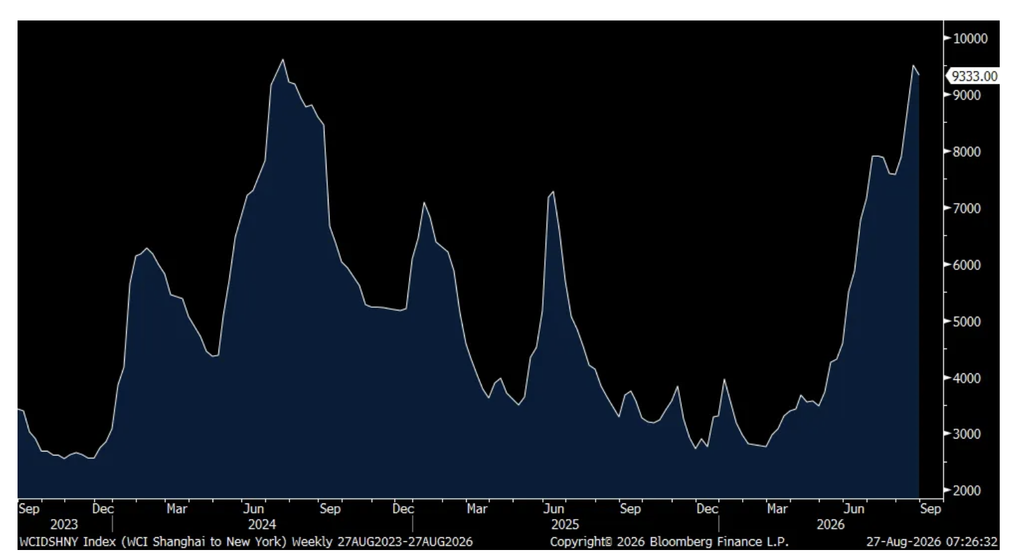
I’ll finish with an update on container pricing. After a further acceleration over the prior three weeks of 25%, the price of a 40 foot container from Shanghai to NY fell 1.8% w/o/w. To LA they were little changed, up .2% and higher by 19% in August from July at $6,818 which compares to $2,191 at the end of February.
WCI Shanghai to NY