Boockvar on the ‘New Normal’

The following is from Peter Boockvar:
A new normal we can’t escape/The symptom of the disease/31 years ago/Earnings notables/BoJ
As there still is no deal between the US and Iran with Iran instead talking to Oman over the terms of controlling the Strait, it’s becoming more and more apparent that ‘muddle along’ is the best we’re going to get with no full resolution. But, with still a dramatic reduction in the rate of ships passing through and the comments from Saudi Aramco last week ringing in my ears that the easy inventory replenishment to fill the supply gaps has mostly been released from existing inventory sources, the hourglass of time to continue to paper over the lost barrels of more than 1 billion, among other stuff coming out of the Strait, is something we really need to watch closely.
I continue to believe that a factor in the reduced pace of hiring over the past few months where the 3 month private sector average from the BLS is just 40k is the ‘productivity enhancements’ NOT from AI but from a cost cut response to still major cost pressures that not all companies can now pass on to the rest of us. And that ‘productivity’ is from a reduced pace of hiring and a slower rate at which they are raising wages for their employees. To state again, consumer price inflation stats is NOT the full picture on inflation. One must also look at the wholesale level for a full picture on inflation. For example, let’s just say CPI eventually gets to 2% but PPI, at the time, is running at 4%, has the Fed reached its inflation target comfortably? No, I say.
For July, to be seen this week, headline PPI is expected to be 160 bps above CPI. Finally here, inflation is the disease that still exists and a slower pace of hiring is the symptom as companies do their best to manage costs and maintain margins .
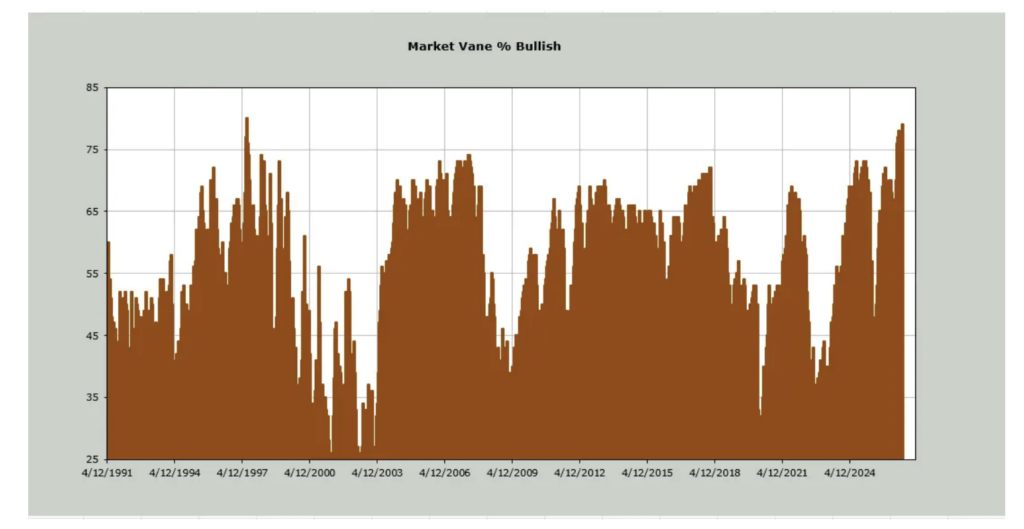
Last week I mentioned that the number of Bears in the weekly II data fell to match the lowest since October 2025. My friend Helene Meisler on X highlighted a few days ago that the Market Vane measure of Bulls rose to the most since the summer of 1997, months before the Asian financial crisis took place. Yes, 1997.
To some notable earnings comments last week:
From Under Armour, a stock we own:
“Consumer demand remains softer than we expected, particularly in North America and Asia Pacific.”
From Ralph Lauren, where the upper income consumer continues to spend on:
“Revenues increased 13%, including double digit growth in both Asia and North America, and mid single digit growth in Europe.”
“In North America retail, 1st quarter comps increased 9%, led by our full price channels. Digital comps increased 8%, reflecting solid traffic trends” among other things.” Wholesale was strong too.
From Restaurant Brands:
Burger King seems to be taking share from McDonald’s and others with a US comp gain of 8.5%, “beating the burger QSR industry by over 9 points.”
Popeyes was weak with comps down 5.2% y/o/y while Firehouse Subs had comps up .4% y/o/y. Tim Horton’s, mostly in Canada, had flattish comps too. On Canada, “I would say overall, the macro picture in Canada has been relatively stable.”
In terms of pricing, particularly with Burger King, “we’re really trying to be disciplined on menu pricing…we understand very clearly that one of the things we provide to our guests is value for money. I think that menu price increases have been running probably low single digits, but I think we’ve been pretty restrained on those. There are things like beef inflation that have been a bit of a headwind, but there are some other things that are offsets to it.”
From Papa John’s:
“we felt the impacts of the softer consumer backdrop and highly promotional QSR environment which have continued to challenge our financial performance.”
“I think the consumer is very cautious in making choices with their hard earned dollars. In an environment where you want to make sure every one of your dollars works as hard as possible for yourself, you do kind of go back to your tried-and-true favorites that you know can deliver on the experience and not disappoint.”
US comps fell 8.3% y/o/y, “driven by reduced order volume and continued pressure from lower customer acquisition.”
International did better with comps up 1.5% “even as we saw pressure in the markets directly impacted by the Middle East conflict.”
To some real estate talk from Barry Sternlicht and Starwood Property Trust, a stock we own:
“Almost all the real estate asset classes here and in Europe are in repair. I mean, everything is getting better.”
“If you just look at all the equity REITs in the multi-family sector, logistics sector, self-storage, senior housing, everything is getting better. That’s basically driven by steady demand and rapidly deteriorating or non-existent supply.”
“I think retail construction is like less than 1%, office is at historic lows. If you take out built-to suit, there’s almost nothing being built in this country. Apartment starts have dropped 70%, logistics starts down 70%. So, you’re beginning to see improvements in rent in the multi-sector, in the Sunbelt cities and it’s pretty strong on the two coasts, given nobody was building in California or New York City. And now, it’s even harder with the prospects of rent control in those markets.”
“So, the bad news for the whole sector on the legacy books are the flattening of the yield curve, that interest rates have gone up. So, we have a lot of multi’s that borrowers were saying, I’ll survive till 2025, lower rates will allow me to refinance and I can hold on for what we know will be pretty good years if you listen to Camden or UDR or Avalon or Essex. I mean, they’re all different geographies, but they’re all talking about a pretty good year in back half of 2026 and really good in ‘27 and stupendous in ‘28 is the kind of comments from those management teams.”
“A lot of borrowers were holding on for that. They’re not making a lot of money. They didn’t, but they’re paying their debt service. And now it’s getting a little more challenging for these guys because they’re not refinancing the 300 bps over SOFR, they’re refinancing 400 bps.”
From Bob’s Discount Furniture and where “value is always in vogue”:
Comps rose 2.3% “Against a challenging macro backdrop and strong prior year comparison.” The gain “was driven primarily by higher average order value, reflecting continued mix shift from good into better and best categories, along with some incremental targeted pricing actions taken in Q2.” They saw “softer industry traffic.”
More on customer visits, they “continued to be a headwind in the 2nd quarter, although our traffic trends outpaced the industry. So we’re very pleased to be taking market share in that regard. We are seeing maybe a little bit of flattening out of that traffic decline that we’ve seen in for the prior quarters, but it’s certainly too early to call the bottom.”
From Six Flags, with the ticker ‘fun’ but whose stock fell 16% on the day they reported last week:
“Attendance increased approximately 449,000 visits or 4%, driven by continued strength in season pass visitation among other commercial initiatives…Per capita spending declined modestly by less than 1%, primarily because seasons pass and membership visits represented a larger share of attendance. This is a mix and revenue recognition effect, not weaker pricing.”
“like-for-like pricing increased across our admission products. Guest spending remained healthy across food and beverage, extra charge attractions and our other in-park experiences.”
From RXO, the trucker, telling us what others have told us:
“Capacity continues to leave the market, spurring a supply driven recovery, and we’re clearly in the early innings of it.”
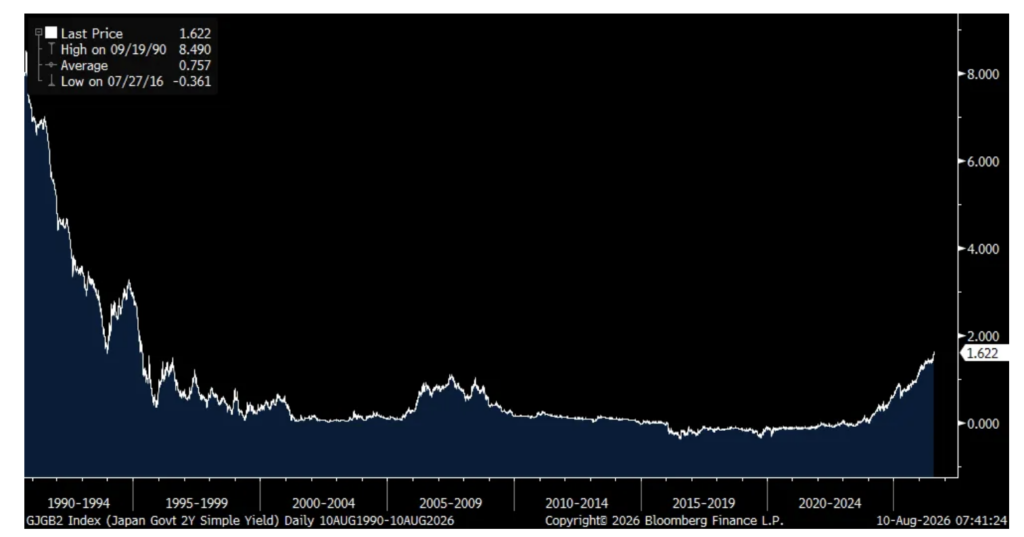
Finally, the Japanese 2 yr yield closed at a fresh 21 year high after summary of comments from their July meeting came out and where one BoJ board member, that was not named, said “it could be considered that the pace of policy interest rate hikes will be faster than market expectations.” The yen though is lower after the recent rally.
2 yr JGB yield
Positions: None.
