Boockvar on the Yen, Apple, Other Earnings

The following is from Peter Boockvar:
Yen, Apple, Other Earnings
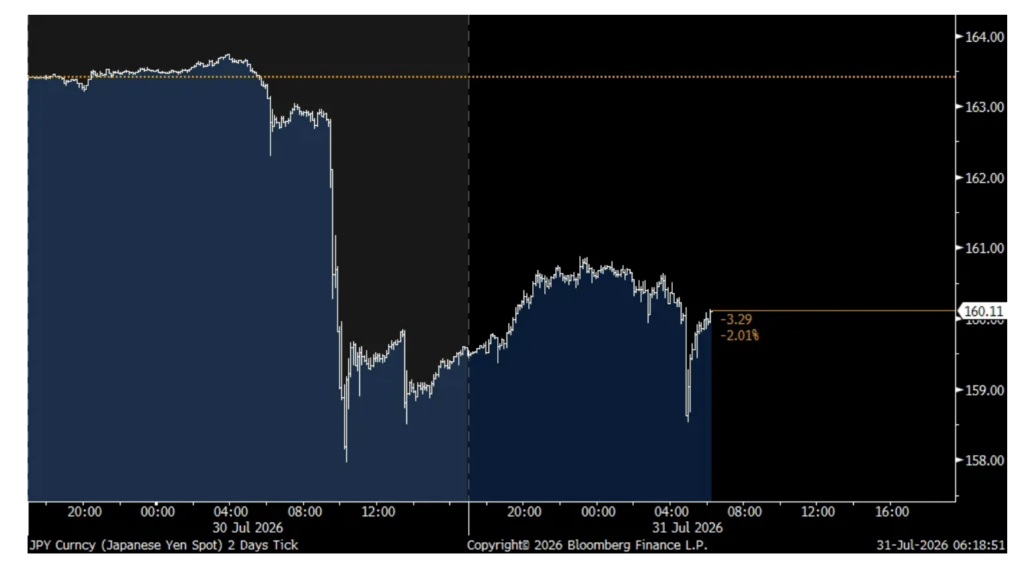
The setup for defense of the yen was perfect. Intervene, check one. Follow up with a rate increase, fail. While the BoJ raised rates in June, I’m perplexed that while no one expected it today, they didn’t raise rates, especially after the sharp yen rally due to intervention which they supposedly spent about $50 billion according to Bloomberg. It would have been a perfect mix to get the yen to SUSTAINABLY rally. That said, the commentary was hawkish and September is real possibility of a hike. This was said from Governor Ueda:
“Given that underlying inflation is approaching our 2% target, we must scrutinize upside price risks more than ever. We will debate our policy from our next meeting onward with this point in mind.”
“Among factors I am particularly focusing on are several data on medium to long-term inflation expectations, some of which are solid or rising…If we feel that monetary conditions are accommodative, there is a chance we could speed up the pace of interest rate hikes.”
Risk management and getting ahead of the curve is clearly not a focus of theirs as while Ueda acknowledges the currency risks, he does little about it. This was said on the FX influence. “The impact of currency volatility on inflation may be becoming bigger than in the past. We have also seen significant weakening of the yen in the past year. Given underlying inflation is nearing 2%, we must focus on upside price risks unlike in the past…With underlying inflation so close to 2%, the damage from such inflation risk materializing would be huge. We laid out three factors as risks to inflation, with currency move among them.“ I bolded to highlight.
And he says this but still doesn’t hike, “If we fail in our pursuit of stable price growth, we could be forced to raise rates rapidly. That would cause nominal rates to rise significantly and destabilize markets. That would be negative for sound economic growth. Price stability is also important to promote investment.”
The JGB reaction is something to take note as the odds of a September rate increase is now up to about 40%, up from 20% yesterday. Kalshi has the odds of a hike then at 35% vs 28% yesterday. The 2 yr yield was up about 1 bp, while the back end was little changed. The yen response has been all over the place, initially selling off on the lack of a hike, then rallying on the hawkish talk and is back lower again.
All this as Tokyo said July CPI ex food and energy rose 2% as expected. Over the past four years, when inflation really got going, core/core CPI has averaged 2.6%.
Displeasure with inflation that the BoJ is dragging its feet in addressing (though has rooted for now for years) has resulted in Japanese PM Takaichi’s approval rating to fall to a still good 57% but below the peak of 69% last month.
I keep highlighting the goings on in Japan because as the 3rd largest creditor nation in the world with $3.5 trillion of foreign asset holdings above what foreigners own of theirs, their capital flows matter. Especially as holders of $1.2 trillion of US Treasuries and where JGBs are becoming more competition.
2 day Yen Move
Meanwhile, the moves in the Kospi remain wild. The index is down on the week but if you didn’t go to bed last Sunday and just woke up after today’s close what a ride. It fell 17% Tuesday thru Thursday, only to jump 18% today. Samsung was up 20% today and SK Hynix was higher by 25%.
To the earnings of note.
From Amazon, jumping sharply pre-market:
It was all about AWS as people forget sometimes that they are a massive retailer too. “I’ll start with AWS, which is booming right now” said Andy Jassy.
“Revenue growth of 36.7% y/o/y, accelerating for the fifth straight quarter, our fastest growth in 18 quarters back when AWS was less than half its current revenue size…And our backlog stands at $496 billion, growing triple digits y/o/y.”
“Our chips business now has an annual revenue run rate of over $25 billion, growing triple digit percentages y/o/y.”
“Our AI revenue run rate climbed significantly q/o/q and is now also over $25 billion, growing triple digit percentages y/o/y.”
CapEx we know is massive and they raised it to $220 billion, “the higher cost of memory pushing this number up from our prior estimate of about $200 billion” and Jassy said this, “Let me talk for a second about how we see this investment playing out. Earlier this year, we said we plan to invest approximately $200 billion in cash CapEx in 2026, the majority of which to support AI and AWS. At this level of spend and higher, we have clear line of sight to strong financial returns. I’ll explain why. There are two major parts of the investment, the data centers and the servers and networking equipment that go into them. These have different capital cycles. Data center capital is spent starting two years before we can put servers into them to start monetizing. Once a data center opens with servers plugged in, we start generating significant revenue right away and then get to monetize these data centers for 30 plus years without having to spend that start up capital again.”
“Servers and networking equipment operate on a shorter cycle. We typically purchase these a few months before putting them into service, so we have strong visibility into customer demand before we trigger the spend. If the demand isn’t there, we won’t spend the capital. For servers and networking equipment, on average, it takes a little less than three years to break even on that investment.”
“This means in the short term, when demand is necessitating so many data centers being built simultaneously in advance of when we can start monetizing them, we’ll spend a lot of CapEx and encounter free cash flow headwinds until these data centers come online, can be monetized and we get a few years into these servers being utilized.”
“That as we get a few years out and the revenue growth outpaces the incremental CapEx growth, which will happen at some point, the resulting revenue, free cash flow and return on invested capital is very compelling.”
So that is the bull case for Amazon with all this spend. In the meantime, free cash flow is expected to be -$18.7 billion this year vs +$7.7 billion in 2025 and $32.9 billion in 2024.
Oh, on retail, “Prime remains a key pillar of our business, and our double digit y/o/y membership growth reflects the value our offerings deliver at scale.” On the entire conference call, there was just one question on retail asking about ‘fast commerce.’
From Apple and that is down sharply pre-market as it seems there was a pull forward of phone buying ahead of expected price increases which thus lowered September quarter guidance, along with component procurement issues and costs a problem for them too. Also, services growth slowed with revenue growth of just 12%:
They expect an FX hit of 2.5 percentage points in the September quarter from June and “we expect the impact from supply constraints to increase significantly sequentially. The projected supply constraints in the September quarter affect iPhone, Mac, and iPad.”
Live entertainment continues to be an economic bright spot. From Live Nation, a stock we own:
“In a world of endless screens and AI generated everything, the one thing that can’t be copied is being there…More than 143 million tickets have sold through mid-July, over 14 million ahead of last year’s pace, with mid-teens ticket sales growth across all large venue types: stadiums, arenas, and amphitheaters.”
I was a customer last night, seeing Rush at MSG. A must see if you’re a fan.
To a question on demand, “as you can see from our numbers, we’ve seen no consumer issues to date in terms of purchasing numbers which are up across the board, whether it’s international, America, clubs, amphitheaters, stadiums, all genres, all venues and all geographies right now, up over 10% in terms of fan count. So we’re seeing consumers buy at record levels.”
“Our food and beverage is up this year y/o/y across all of our own and operated. So they’re coming to the venue, and they’re consuming, and we’re providing better menus and better options, but we’re seeing no pullback there. Liquor is up y/o/y. So, we’re not actually seeing any of those stories about the consumer not drinking as much. They seem to look at the two hour night out at the concert is probably the night they’re not cutting back. So, we’re not seeing any pullback.”
And, “we have fewer cancellations this year than ever. We’re running below historic lows at 1.1% cancellations versus 1.6% average.”
From Hershey:
“Our categories continue to perform well globally, supported by resilient consumer demand for snacks that deliver either emotional or functional benefits. Retail category growth for confection increased approximately 5%, permissible Salty Snacks grew 17%, Nutrition Bars were up 12%, and our business continued to deliver solid results across most International Markets in the first half.”
“Consumer behavior, while dynamic week-to-week, is tracking largely as we anticipated. US consumer sentiment remains soft and shoppers continue to be value oriented and selective in their spending. The first half impact to our categories from SNAP program changes were very modest. While more state waivers are now in place, household spending reductions have been more moderate than initially observed earlier in the year.”
“Evolving Health and Wellness trends, including GLP-1 adoption, are also tracking in line with our expectations.”
“Net price realization of approximately 12% in the second quarter was in line with expectations, reflecting our strategic pricing actions in the North America Confectionery and International segments. Volume declined approximately 8 points, primarily reflecting elasticity impacts in North America Confectionery and International, partially offset by growth in North America Salty Snacks.” I bolded to highlight.
From Yum Brands:
Overall comps rose 4% and “This capped a solid first half of the year with KFC delivering a first half development record. Taco Bell, meaningfully outperforming the QSR industry in same store sales and Habit delivering 4% same store sales growth.”
As for Taco Bell in particular which makes up 43% of profits, the lettuce situation was a problem and “the brand has seen a meaningful near term sales impact” but should be temporary.
From Mastercard and who rallied 2.5% yesterday:
“The macro environment remains supportive. Consumers and businesses are healthy and continue to spend, supported by job growth, low unemployment and real purchasing power in many major economies. At the same time, we continue to monitor our geopolitical uncertainty and its potential economic impacts.”
I’ll add, they also are benefiting in the US at least by tax refunds, the World Cup and higher fuel prices as gas pump charges go higher.
Something I also keep saying about analyzing the numbers of the credit card companies, “There is significant runway to digitize consumer and commercial flows for many years to come.”
From Group One Automotive, the auto dealer and whose stock plunged by 17% yesterday after they missed on earnings:
“Persistent affordability challenges for the automotive consumer, challenges sourcing used vehicles and short term disruption from our largely completed corporate rebranding efforts combined to lower our new and used vehicle volumes.”
SAIA, the trucker, had a tough day too, down 11% due to higher than expected expenses. They said of note:
“Shipments per workday, which were a record for a second quarter, increased by 4.4%, and pricing and mix management efforts drove an increase in revenue per shipment, excluding fuel surcharge, of 1.5% compared to the prior year.”
The higher expenses were in labor and insurance costs with the latter a particular issue for the industry.
“While external metrics continue to point to an improving demand environment, the macro landscape continues to be dynamic.”
From Builders FirstSource, in the tough space of housing and down 2.6% after falling 8% Wednesday:
“Ongoing geopolitical uncertainty, persistent inflation and elevated interest rates continue to weigh on affordability and consumer sentiment, creating a challenging demand environment for new residential construction. In response, we have lowered our full year guidance to reflect a more cautious view of housing starts.”
I’ll finish overseas.
China’s July manufacturing PMI fell under 50 at 49.2 from 50.3 and below the estimate of 50.1. Non-manufacturing was soft too at 49 vs 50.2. Talk about a bifurcated economy too there. High tech and industrial manufacturing like autos remain strong but other parts of that space are softer. The consumer continues to be circumspect with their spend, particularly with the still weak, but less so, housing market.
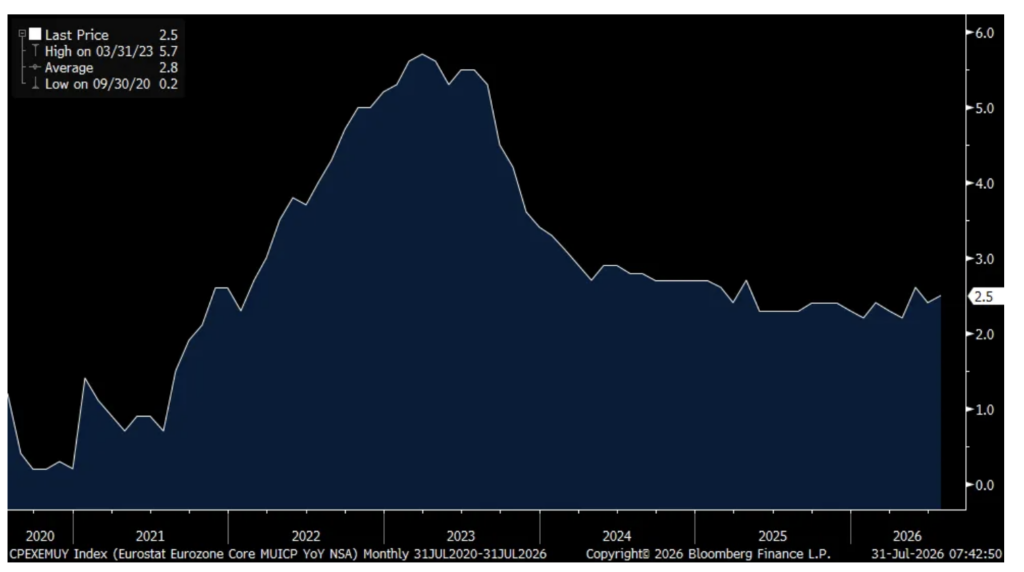
In Europe, July headline CPI rose 2.9% as expected vs 2.8% in June while the core rate rose to 2.5% from 2.4% and that was one tenth above the estimate. European yields are moving higher today.
All central banks right now are watching closely for the secondary impacts from higher energy prices. If they show up, they will hike.
The German jobs data was softer as the number of employed rose by 6k, though about as expected and their unemployment rate ticked up to 6.4% from 6.3%.
Eurozone core CPI y/o/y
Position: None
