There’s No Gold in Them Thar Hills Today

Position: None
Position: None
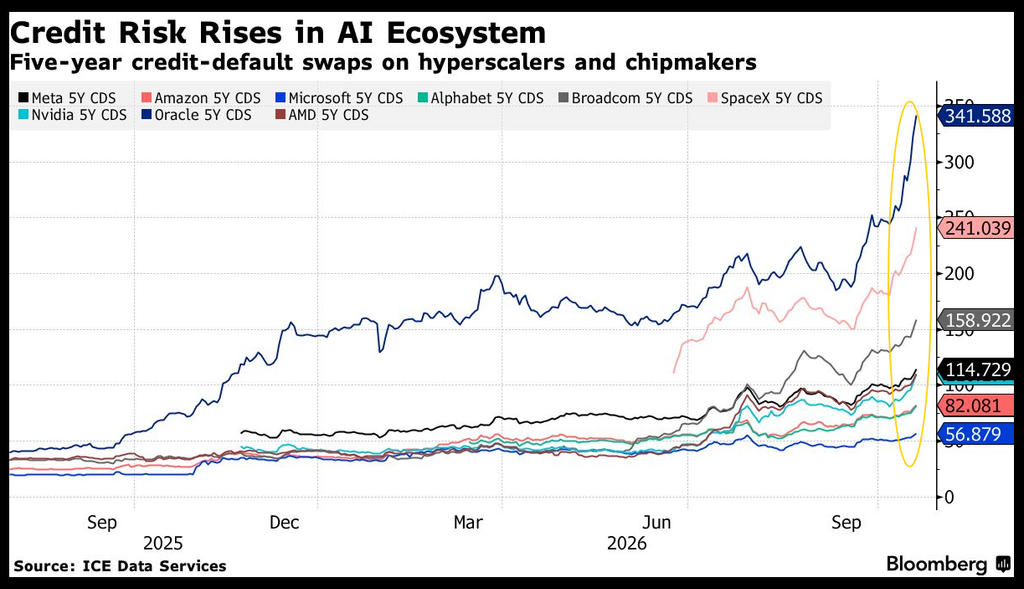
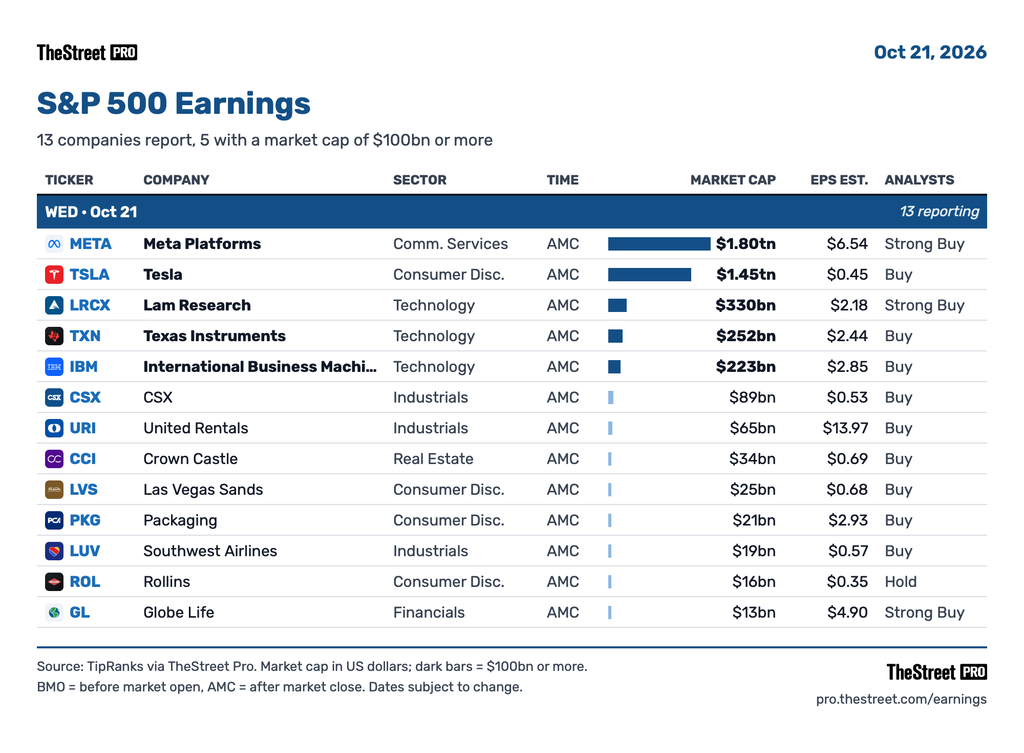
Ahead of Meta’s ($META) earnings, 5-year credit default swaps hit new record highs on Tuesday across a range of the largest Tech companies.
“Credit default swaps tied to Oracle Corp. ($ORCL), broadly seen as a barometer for AI debt risk, traded as high as a record 343 basis points, ICE Data Services data shows. A gauge of Meta’s credit risk has also touched an all-time high, soaring as much as 6.3 basis points to 114.8 basis points ahead of its earnings report Wednesday, the data shows.”
“We have yet to find some kind of a landing zone for the level of debt issuance that the market needs to absorb,” said Lotfi Karoui, multi-asset credit strategist at Pacific Investment Management Co in an interview Tuesday. “There’s still a wide range of estimates as how much debt capital this build out will end up consuming in general.”
That comes after $451 million of hyperscaler bonds were bought on Monday, the highest net buying since mid-September — likely a result of investors selling hyperscaler debt due to supply and demand concerns, according to Bank of America.
With the rise in funding costs there hasn’t been a hyperscaler bond deal in two months. We’ll see if we get news of one from Meta who previously said in April they would not issue again until the fourth quarter. Notably, Meta has moved up its normal last Wednesday of October reporting date a week, many think to do just that.
Source: Bloomberg
My instincts tell me $META beats consensus and offers good guidance.
And then it announces a primary offering of stock…
Position: None
French 10-year bond yields join the U.S. in the 5% club, hitting that mark for the first time since July 2002.
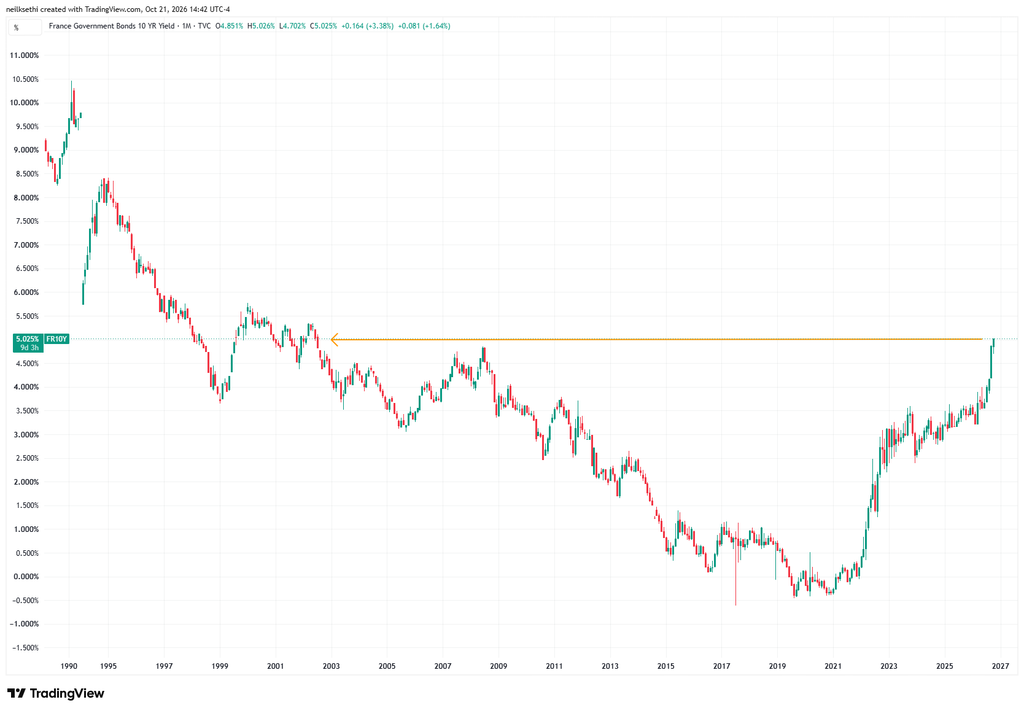
While bond yields are rising globally, France has been hit especially hard by concerns over its precarious fiscal position, made worse by higher energy prices. Leadership there faces growing discontent over cost-of-living issues that have sparked violent protests, with similar unrest flaring in Italy, Belgium and Portugal. But its options are limited with the debt ratio already near 120% of GDP, almost twice Germany’s. Some investors are going so far as to draw parallels with Greece, the epicenter of the crisis that nearly splintered the euro zone early last decade.
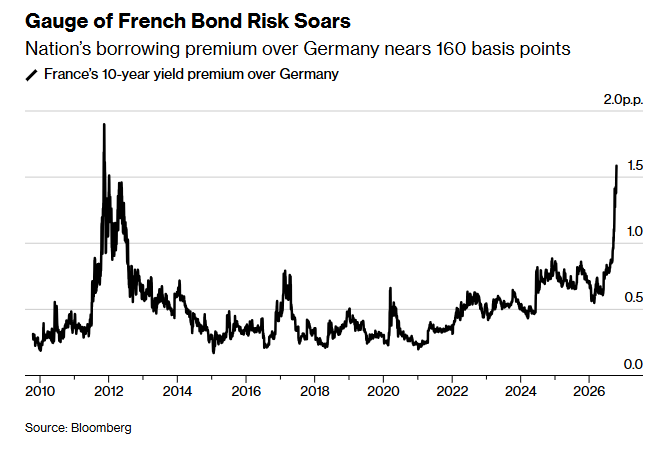
Those worries have pushed the gap between French and German yields to nearly 160 basis points, the most in 15 years (chart via Bloomberg). That has forced policymakers to more seriously consider a proposed 2027 budget with about €43 billion ($48 billion) in deficit-cutting measures, but Prime Minister Sébastien Lecornu still lacks a majority to pass it. Moody’s is also due to rule on France’s credit rating Friday, with most economists expecting a downgrade. Oh, and presidential elections are just six months away.
I covered half of my $SPY short for a small profit (at $770.66) — moving from S to VS.
Position: Short SPY (VS)
$TLT at the day’s low and now negative on the day.
Position: None
I am forever astonished what Elon Musk gets away with:
Position: None
Position: None
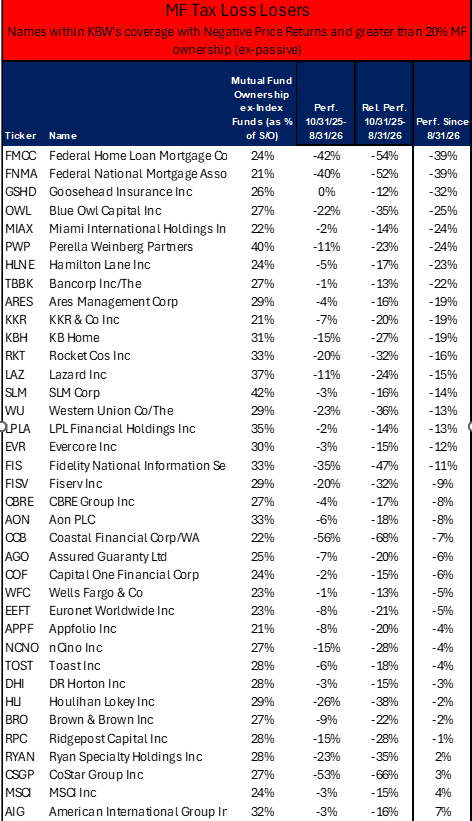
Here is a good menu for possible January bounces in the financial sector (after tax selling over the next two months):
Position: None
