Boockvar on Calming Comments by the Fed’s John Williams

The following is from Peter Boockvar:
John Williams calms move in short end/Housing & autos/Cruising/Overseas data
I think the John Williams comments, the president of the NY Fed, yesterday really matters and assuming no data surprises from now until the October 28th meeting, I don’t think they raise rates again at that gathering, especially right before the midterm elections. If they do hike again by year end, it would be more likely December. The 2 yr yield is down 6 bps since he spoke, and this is what it responded to from him, “With the policy action we took at our September meeting, there is no need for urgency, and we have time to gather more information.” Certainly doesn’t sound like a guy who is for a rapid rate hike cycle.
But he still kept another rate increase on the table by saying “If the economy evolves in a manner broadly consistent with my forecast, one further upward adjustment of the federal funds target range may be appropriate late this year to support a timelier return of inflation to target.”
I’ll argue again that the market is already doing the Fed’s work, among reacting to other things too, and it is not all on the Fed here to respond. A rate tweaking cycle we are under I’ll say again, I believe. And this is what Kevin Warsh wants and told us so, he wants to give room for the market to express itself, and it certaintly is doing so.
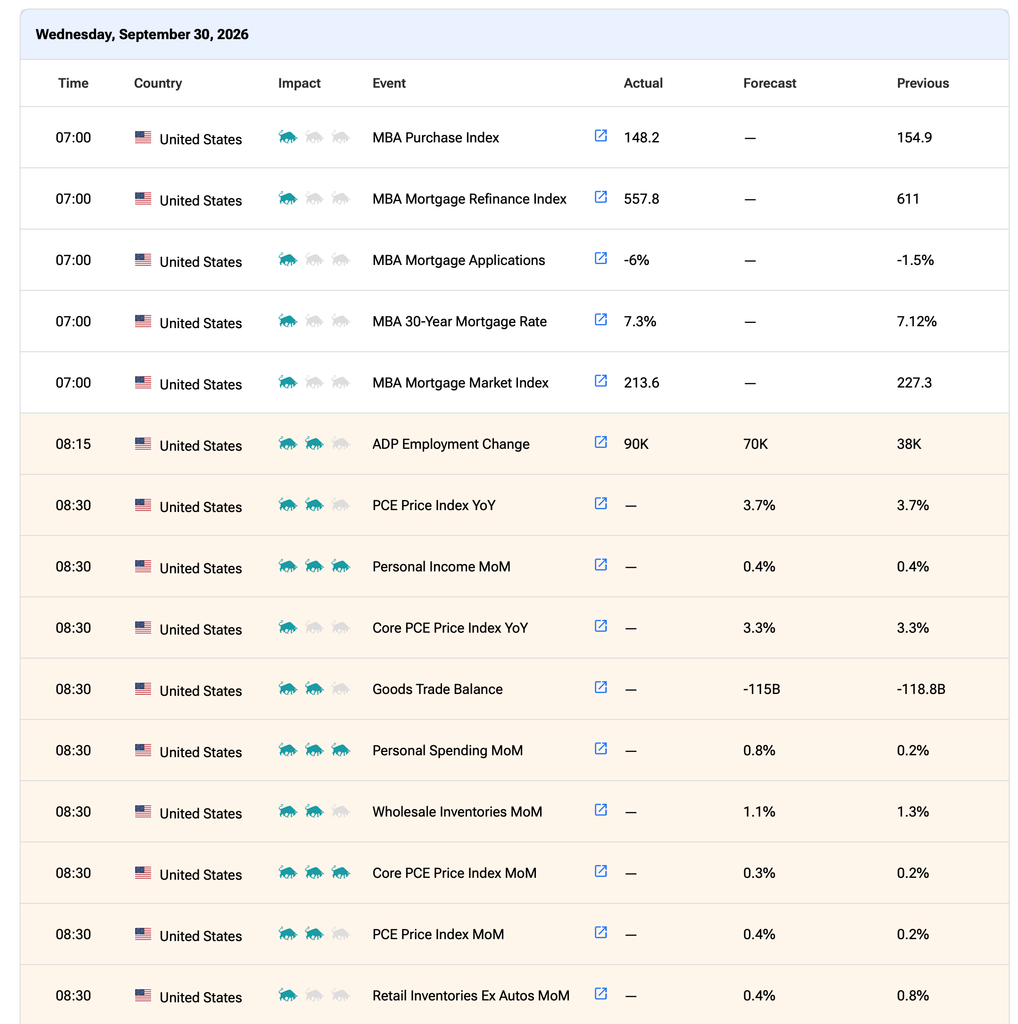
The most interest rate sensitive sector in the economy we know is housing. The MBA said the average 30 yr mortgage rate rose to 7.3% from 7.12% in the week before and vs 6.79% one month ago. In response, purchase applications fell 4.3% w/o/w and down 14% y/o/y. Refi’s were lower for a 6th straight week, down 8.7% w/o/w and by 56% y/o/y. I guess no surprise, however difficult the current rate environment is for the housing industry which remains hugely challenged.
These were earnings call comments of note from CarMax in the other highly interest rate sensitive business of selling used cars. With a relatively new CEO, there is some self help here that drove the stock up almost 5% yesterday.
“Used unit comps grew 13%, driven largely by improved price competitiveness.”
Still, the average selling price was up 6.3% y/o/y.
With respect to its CarMax Auto Finance business, “The observed credit performance in this space continues to be in line with our original expectations.” They did though see a reduction in Tier 1 lending (those with the best credit) as “Increased funding costs driven by the interest rate environment resulted in CAF increasing rates in Tier 1 where customers have more funding alternatives, including cash or financing through credit unions. We view this as a normal response to the higher interest rate environment versus a structural change in behavior from CarMax customers.” They saw continued growth in Tier 2 lending.
On their consumer, “affordability is on everyone’s mind. If you look at every single discussion around that…and our focus on having incredibly competitive pricing. And the other word I would say about the consumer is resilient, at the end of the day. Across all the different spectrums, at the lower end consumer to the higher end consumer, we’re definitely seeing resiliency there. I mean, the broader industry is down 1% or flat to 1%, and we posted comps at 13%. So I think having great cars, great vehicles, at great pricing and making it easy to work with will drive continued growth and performance in the business.”
Carnival had a good quarter as cruising continues to be the travel of choice for some. Its stock rallied by 13.4% yesterday. From them:
“The improvement in booking trends we highlighted on our last call continued to build throughout the quarter, with better close-in demand translating into higher revenues. That momentum also enabled us to raise our yield expectations for the fourth quarter.”
They don’t hedge their fuel costs but seemingly managed the cost increases well “as our teams continued to find ways to use less.”
With guidance, “For full year 2027, we are already half booked, with both occupancy and pricing at record levels. Bookings taken over our third quarter solidified this position, as we saw very healthy increases compared to last year’s levels.”
“Demand remains broad-based, including very healthy demand for our peak summer European deployments. 2028 is also off to an excellent start at higher occupancy and even higher prices y/o/y. And our booking curve is further out than it has ever been at this point in the year.”
Shifting gears to the overseas data. The August 3.6% gain in Australia’s trimmed mean CPI validated the rate hike seen yesterday to 4.6% by the RBA.
China’s more private sector weighted PMI improved in September with manufacturing at 52.1 from 51.5 and services up a touch to 51.6 from 51.4. With the former, Rating Dog said “Growth in manufacturing production accelerated amid rising demand from both domestic and overseas customers.” And, “rising cost pressures led to a renewed increase in output prices in September.”
Helping services was a lift in new orders “supported by successful business development efforts among firms and a broad improvement in demand conditions. The survey data also pointed to stronger external demand, as growth of new export business accelerated for the first time in 3 months.”
Separate from this data, China took a step yesterday to improve the demand for housing with the announced subsidies for mortgage payments. I think ending the decline in home prices is crucial to stabilizing household wealth and consumer spending.
On the heels of seeing yesterday’s higher than expected Spanish CPI for September, France today said its headline CPI rose 3.4% y/o/y, up from 2.6% in August and 2 tenths above the estimate. They also said that in August, PPI was higher by 4.8% y/o/y. Italy’s CPI was higher by 4.1% y/o/y vs 3.2% last month and above the forecast of 3.7%.
Expect more ECB rate increases as their deposit rate is still at only 2.5%.