2 Trade Targets for Crude Oil Using a Conditional Order


On June 30, we wrote that West Texas Intermediate crude oil would trade down at least to $67 per barrel. On July 2, the August 2026 NYMEX contract (CLQ26) touched $67.04. This means that the gap that occurred in early March (point A) has been only partially filled.
Since then, August crude oil has climbed to the $72.50 area. That bounce was due to a resumption of hostilities in the Middle East, but it also informs us that buyers were active in that $67 area.
In order to completely fill that gap, the August WTI contract needs to trade down to $66.29. This will figure prominently in our strategy.
The August contract reached a high of $100.10 (point B) on May 18, and it’s been in a bearish trend ever since. However, oil could bounce again from this area of support.
Conditional Entry Order
We want that gap to fill completely, or get close to it, so we’re looking for the contract to come down to $66.50. If it drops to $66.50, we’ll place a conditional buy stop order at $66.75.
Why use a conditional order, instead of simply buying at $66.50? Imagine crude oil drops to $66.50. Two things could happen. Oil could bounce immediately, or keep falling.
If the price keeps falling from $66.50, the buy order won’t be filled. If it continues to fall to $65.50 or lower, we can cancel the buy order with no gain or loss.
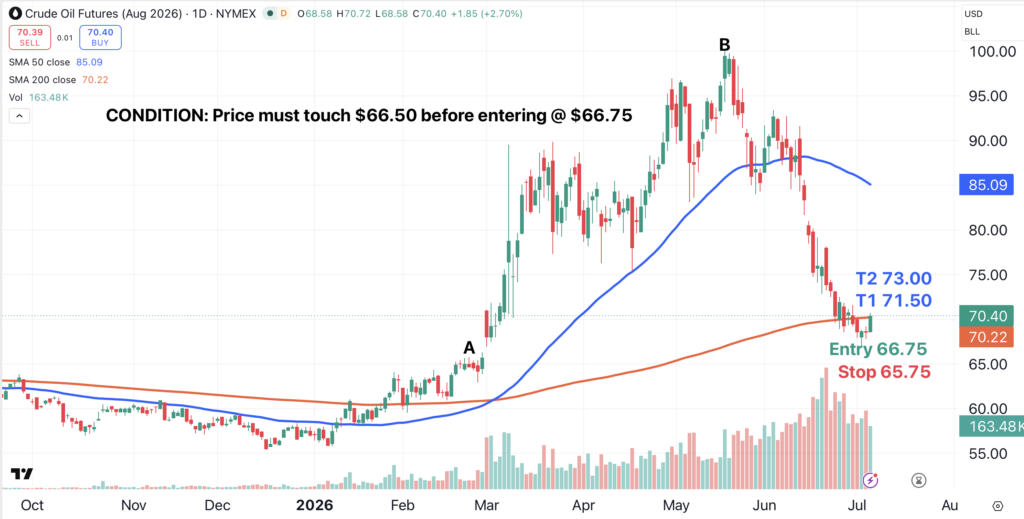
On the other hand, if the price does bounce from $66.50 up to $66.75 or higher, the order should be filled. If that happens, our stop will be located at $65.75, for a risk of $1 per contract.
We’ll use two targets, T1 and T2. T1 will be located at $71.50 (blue), which is just below the high of June 30. T2 will be located at $73 even (blue), just below the high of June 26.
After renewed tensions between the U.S. and Iran emerged early on Wednesday morning, impacting energy prices, this trade setup is still valid, though we might have to wait longer for it to take effect.
Position Size
Using two targets will necessitate the purchase of at least two contracts. Any even number of contracts can be used.
To reduce risk, those contracts can be micro contracts, which are one-tenth the size of mini contracts. The symbol for crude oil is CL, but for micro contracts, it’s MCL.
Additional Details
Use the same number of contracts for both targets. If the first target is hit, raise the stop from $65.75 to $66.75 to reduce risk on the remainder of the position. Always check that the size of the stop matches the size of the position, especially after a partial exit.
Bottom Line
The entire trade is predicated on an anticipated gap fill, which may or may not occur. If it occurs, the reward:risk ratio will be 4.75:1 on the first target, and 6.25:1 on the second.
