Initial Jobless Claims Drop Back to Joint-Lowest Since 1969

- Initial jobless claims for the week ending October 31st: 189,000 (estimate 196,000; previous 194,000; revised previous 195,000)
- Continuing claims for the week ending October 24th: 1,718,000 (estimate 1,710,000; previous 1,701,000; revised previous 1,695,000).
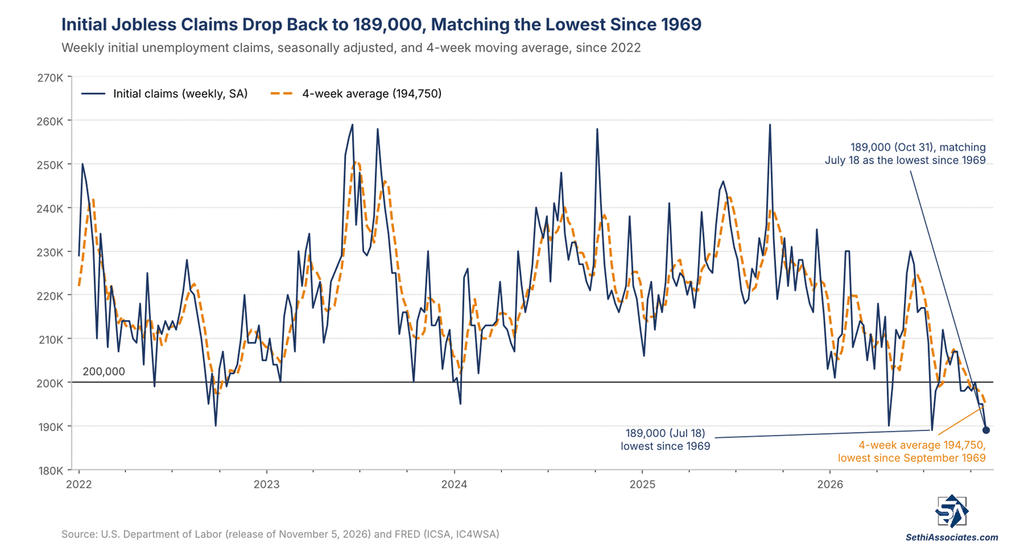
After bottoming at 189,000 in mid-July — the lowest reading since 1969 — initial jobless claims had barely budged, and in the week through October 31st fell 6,000, the most since September 12, right back to 189,000, matching that July 18 low (from an upwardly revised 195,000 the prior week). That makes it now the 18th week below 200,000 since 1969, and the third straight week under that mark (the four-week run from September 12 through October 3 was the longest since 1969), leaving claims at cycle lows at the bottom of the relatively narrow range that has held since November 2021.
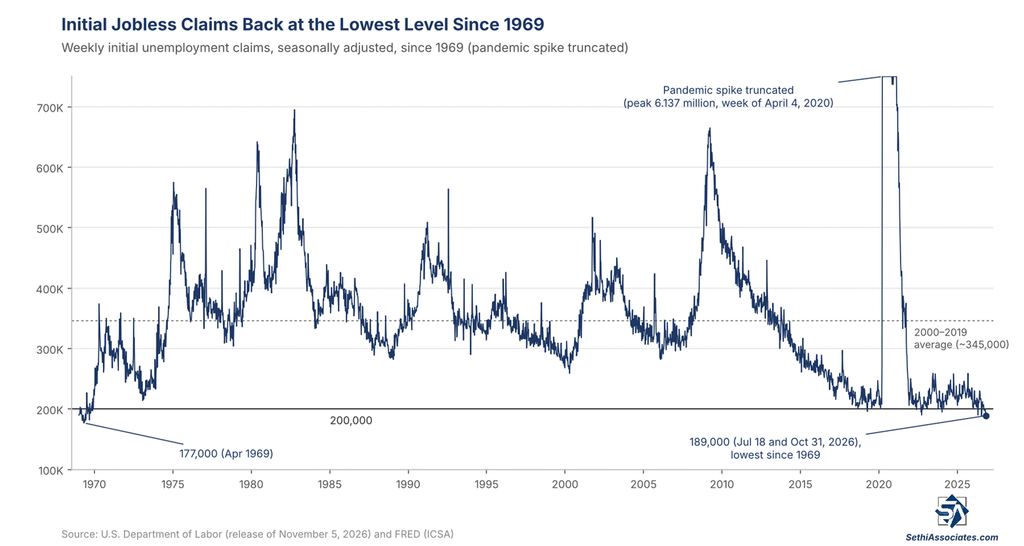
The four-week average fell 2,250 to 194,750, the lowest since September 1969 (30,750 lower year-over-year).
Continuing claims (seasonally adjusted) in the week through October 24th (one week lagged) rose 23,000, the largest weekly increase since February, to 1,718,000, but only after the prior week was revised down 6,000 to 1,695,000, the lowest since April 2023. That leaves them towards the bottom of the roughly 1.70 million to 2.0 million range that has held since mid-2023 — historically low, though not as low as initial claims.
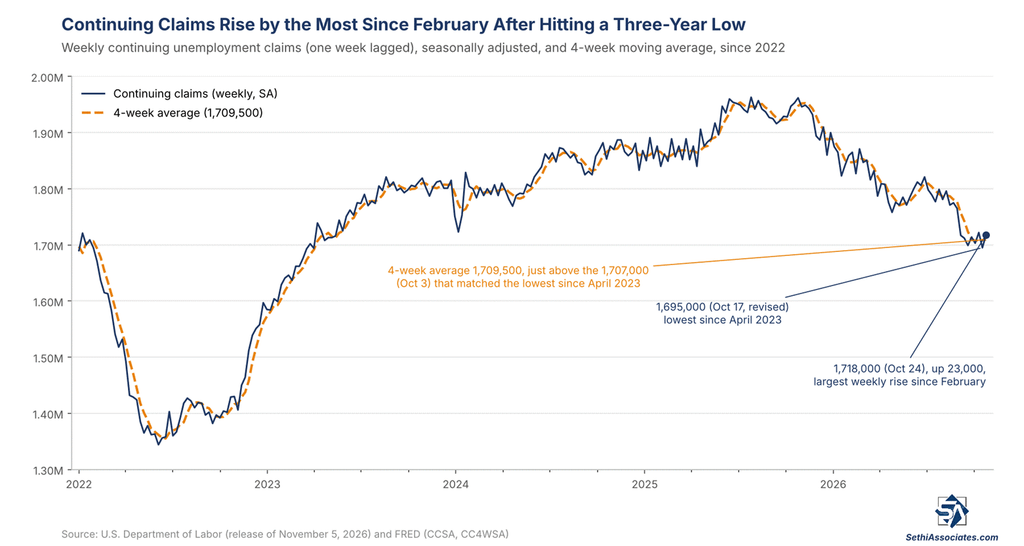
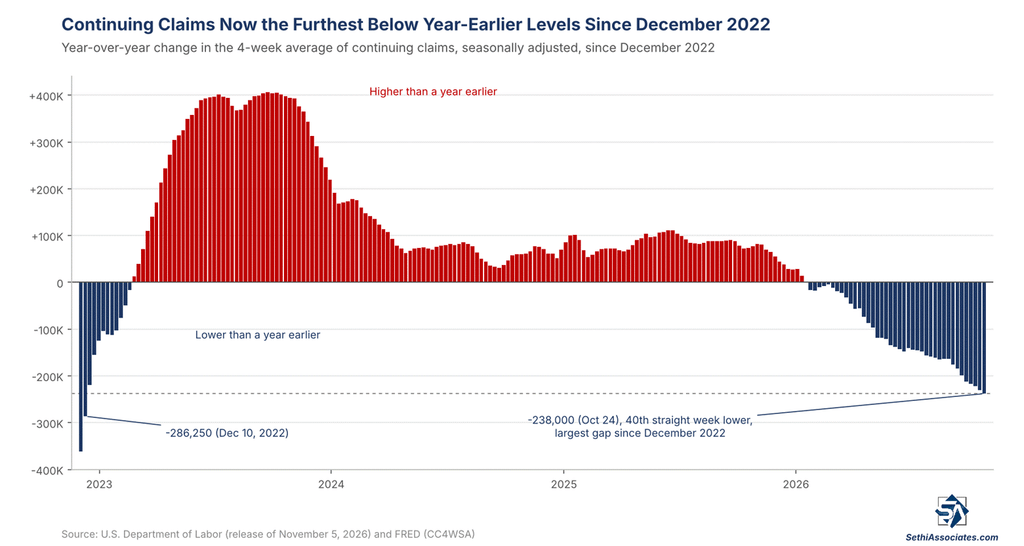
The four-week average of continuing claims rose 1,000 to 1,709,500 (after a 1,500 downward revision to the prior week), just above the 1,707,000 three weeks earlier that matched the lowest since April 2023, and remains lower year-over-year for a 40th straight week (down 238,000) — the largest such gap since December 2022.
The 20-year pre-pandemic average for initial claims is 345,000 and continuing claims roughly 2.9 million.