We’re Building Up Our Semi Cap Exposure With This Buy


We continue to see chip capacity tightness ahead, creating an even bigger industry pain point.
We continue to see chip capacity tightness ahead, creating an even bigger industry pain point.
Some interesting thoughts and context on the AI and data center build out from Capital Current:
In Q2 2026, the Bureau of Economic Analysis recorded $752 billion in annualized investment in information-processing equipment and data centers. Residential investment came in at $748 billion. Adam Shapiro, vice president at the San Francisco Fed, posted the chart and called it simply: “The AI investment boom is massive.”
A four-billion-dollar gap. Thin. But the lines crossed. And they’re moving apart.
Data center construction spending hit a record annualized rate of $75.2 billion in July. That is 57% higher than a year ago. Year-to-date starts through June reached $81.5 billion, already topping the full-year 2025 total. Housing, meanwhile, sits 18% below its 2021 peak.
Rystad expects 2026 to go further. Data center investment is on pace to match the entire oil and gas value chain this year. A sector that barely appeared in BEA data five years ago now moves more capital than the industry that powered the twentieth century.
Where is Capital Current going with this?
Because every server rack draws power. A house needs 1.2 kilowatts on average. A high-density AI rack needs 100. The capital goes into chips. The chips need a grid. And the grid takes a decade to build.
That final comment keeps us bullish on the Pro Portfolio’s position in Eaton ($ETN), and it also explains some of the nuclear power deals being inked by some of the hyperscalers and others. With the VanEck Uranium and Nuclear ETF ($NLR) knocking on an oversold condition like it did back in mid-July, it may be time to put it back in the Pro Portfolio’s Bullpen.
Position: TheStreet Pro Portfolio was long ETN
Diary #12
Today’s meaningful downgrades courtesy of TheFly:
BofA downgraded PayPal ($PYPL) to Underperform from Neutral with a $53 price target. The firm sees a “weak” Q3 setup and argues that “every transformation lever is a 2027+ story.”
StoneX downgraded Spotify ($SPOT) to Hold from Buy and removed the firm’s previous price target. While the firm remains “strongly convinced” of Spotify’s long-term network effects and subsequent product and services scale advantages, it is downgrading the shares on what it views as difficult “financial optics” in the next twelve months.
JPMorgan downgraded Albertsons ($ACI) to Neutral from Overweight with an unchanged price target of $14 following the fiscal Q2 report. While the shares trade at a sizable discount to other U.S. food retailers, this could be warranted given Albertsons’ ongoing operational challenges and its acknowledgement this week that its self-help initiatives have not been as effective as it planned, the firm tells investors in a research note. Goldman Sachs also downgraded Albertsons to Neutral from Buy with a price target of $13, down from $16.
KeyBanc downgraded Cirrus Logic ($CRUS) to Sector Weight from Overweight without a price target. Apple (APPL) supplier cuts indicate iPhone units are likely to decline in 2027 and 80% of Cirrus Logic’s revenues are tied to Apple, the firm tells investors in a research note.
Goldman Sachs downgraded Par Pacific ($PARR) to Neutral from Buy with a price target of $94, up from $90. The firm sees downside risk to 2027 consensus estimates from elevated freight rates.
Position: None
The materials/equipment company has layed out big plans but is yet to be rewarded.
Bloomberg: Signet Jewelers ($SIG) may join consortium to purchase De Beers with Richemont, owner of Cartier
Position: None
Taiwan Semiconductor, which just released earnings, is humming and guidance is excellent. But the stock? That’s another story.
TD analyst Derrick Wood said the following on $MSFT today:
Datacenter capacity growth supports our estimated 35% Azure revenue CAGR through FY31. We model capacity rising from ~11.5 GW in FY26 to ~36.6 GW in FY31, adding about 16 GW of GPU capacity and 9 GW of CPU capacity.
We think Azure revenue reaches $461B as AI becomes most of the business. We forecast Azure revenue increasing from $102B in FY26 to $461B in FY31. AI revenue is expected to grow at a 60% CAGR to $284B, lifting its share of Azure revenue from 27% to 62%.
Our GPU monetization assumptions leave room for upside. Annualized revenue per new GPU GW rises in our model from about $14B to $22.5B.
We expect Capex rises but free cash flow remains positive. Capex increases from $145B in FY26 to $333B in FY31. Our model shows FCF margin troughing at 7% in FY27 and recovering to ~25% in FY31 as growth outpaces incremental spending. Execution and compute allocation remain key risks. Power and hardware constraints, permitting delays, changes to the OpenAI partnership, and greater investment in frontier models could affect capacity timing, Azure growth, and capex. The model assumes about 70% of GPU capacity serves Azure.” TD Cowen reiterates Buy with a $625 price target.
Position: TheStreet Pro is long MSFT
Initial claims came in at 199,000, only the 11th week below 200,000 since 1969, while the four-week average of continuing claims fell to its lowest level since April 2023.
Folks, in case you might miss it, today’s 8 Key Items Shaping the Stock Market is out and you can find it here.
Position: None
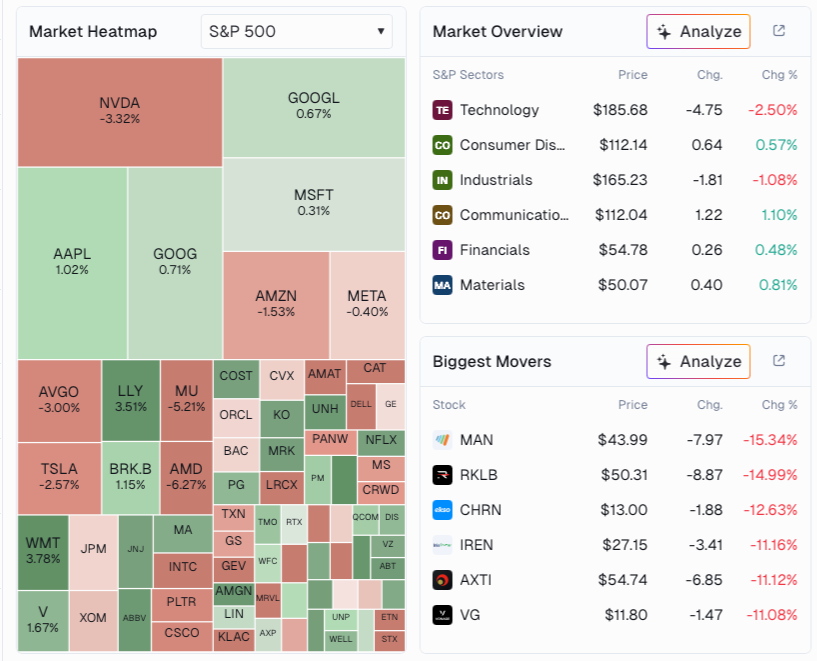
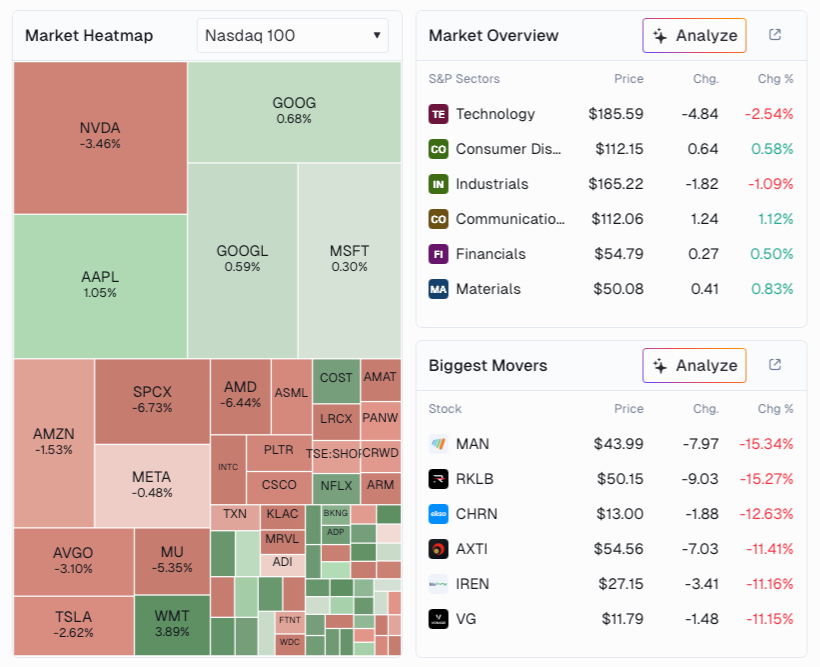
As the trading day gets underway, there’s a snapshot of what’s moving in the S&P 500 and the Nasdaq 100 courtesy of our sister site, TheFly:
Positions: None.